+91 99980 88430 | +91 95589 17778
 info@convello.in | sales@convello.in

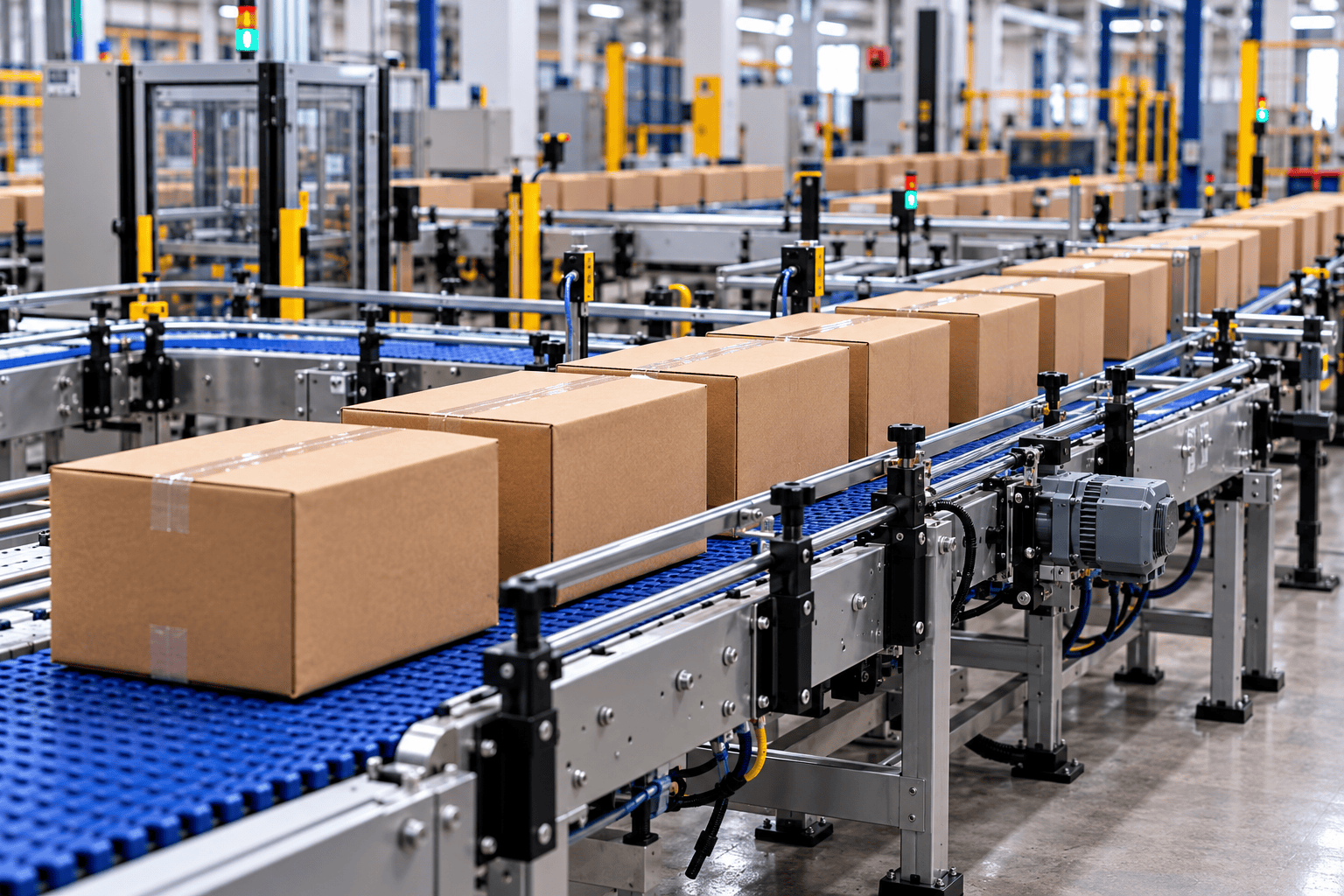
At 4:56 p.m., a labelling station stops for a roll change. The change itself takes about 90 seconds. Upstream cartons keep arriving, so one operator presses the line stop, another moves six cartons onto a trolley, and a third waits beside the photo-eye to feed them back in the right order.
The station is running again before 5:00 p.m. Yet the system does not return to normal flow until 5:08. Cartons are too close together, the scanner sees an unexpected gap, one destination lane becomes full, and the packing team spends the next few minutes rebuilding the sequence.
This is an illustrative shop-floor composite, but the pattern is common: the machine was down for 90 seconds; the operation spent twelve minutes recovering. The missing piece was not necessarily a faster machine. It was a controlled place for products to wait and a planned method for releasing them again.
| THE PRACTICAL TEST If people must lift products off the conveyor whenever the downstream process stops, the operators are functioning as the buffer. The project should measure that hidden work before deciding how much automated accumulation is required. |
What Is a Conveyor Accumulation System?
A conveyor accumulation system is a controlled section of conveyor that temporarily holds products when the next process, destination or route is unavailable. Depending on the product and application, items may remain separated, touch with limited back pressure, circulate in a loop or collect on a wider table. The aim is not simply to store more product. It is to decouple two parts of the operation long enough to absorb normal variation without immediately stopping the entire line.
Convello currently describes accumulation roller conveyors as solutions that allow products to collect at designated points without interrupting the overall material flow. The company positions these systems for production lines, assembly, packaging and automated material handling, where cartons, totes, trays or other stable unit loads need controlled movement and temporary buffering.
Accumulation Is Not the Same as Storage
A conveyor buffer normally covers seconds or minutes of variation. A storage system holds inventory for much longer. This distinction matters because a very long conveyor can become an expensive and difficult-to-maintain substitute for a process problem that should be solved elsewhere.
- Use accumulation to absorb brief machine stops, operator cycle variation, scanning delays, lane-full conditions and controlled merges.
- Use proper storage when material may wait for hours, requires inventory location control or must be protected from the production environment.
- Treat chronic downtime as a reliability problem. A larger buffer may hide the symptom without improving the cause.
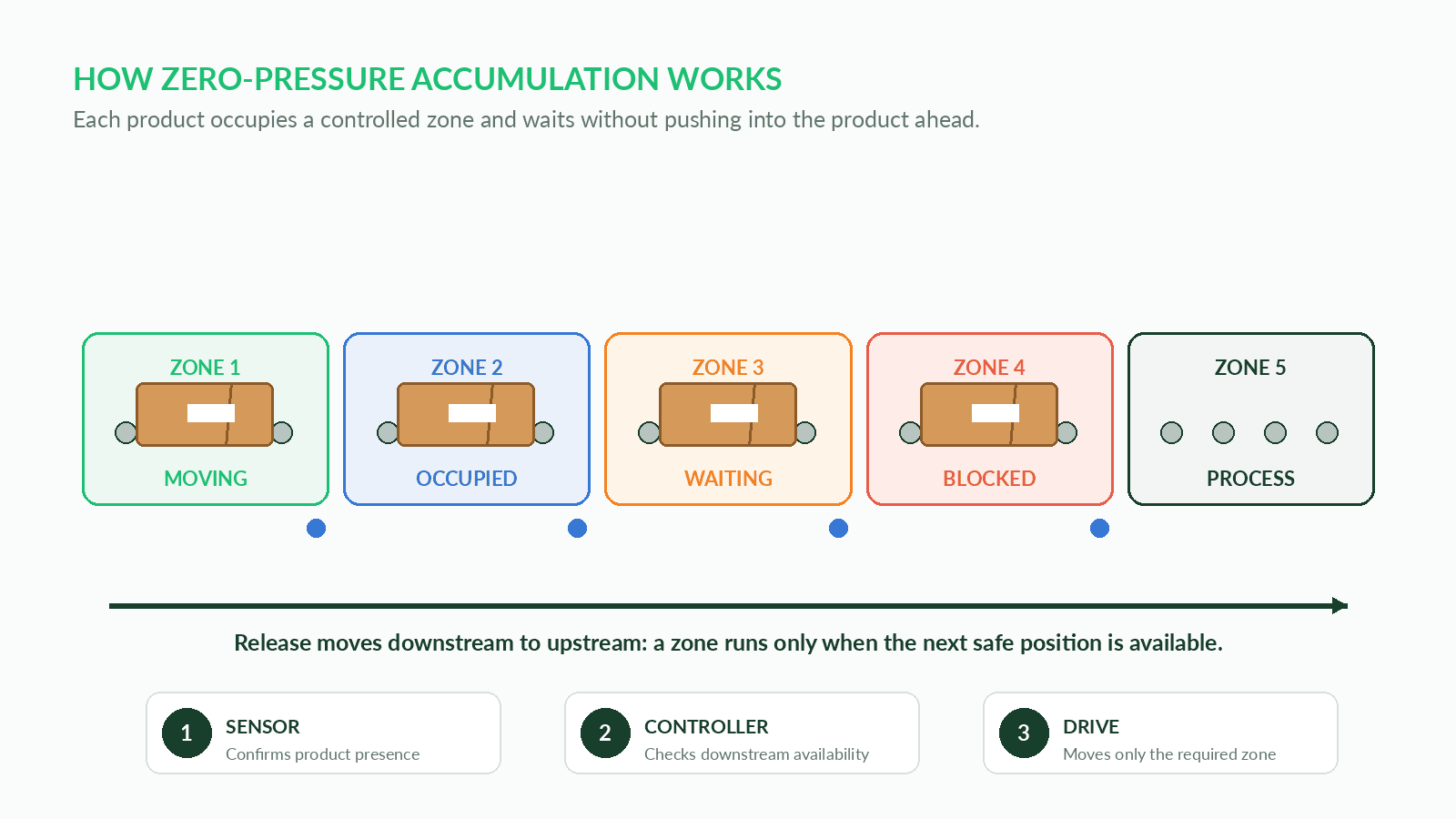
Zero-pressure accumulation uses independent zones so products wait without pushing into one another and release only when the next position is available.
Why Real Operations Need Accumulation
Production and warehouse processes rarely run at exactly the same rate every second. A checkweigher pauses for verification, a carton sealer needs tape, a picker takes longer on one order, a palletizer waits for stretch film, or a dispatch lane fills while the truck team clears the previous batch. Without a buffer, every small disturbance travels upstream like a wave.
- Short machine interruptions: A downstream machine can stop briefly without forcing immediate shutdown of every upstream process.
- Different cycle times: A fast upstream process and a slower downstream process can operate with controlled spacing rather than repeated start-stop behaviour.
- Product protection: Fragile cartons, glass bottles, electronics and mixed-size packages can wait without damaging contact pressure.
- Order and route control: Products can queue before scanners, diverts, sorters, packing stations and vehicle-loading lanes.
- Operator stability: People can complete a task at a repeatable pace instead of acting as emergency material handlers.
- Planned recovery: The control system can release a backlog in a defined sequence once the downstream process becomes available.
The Four Main Accumulation Approaches
| Approach | How it behaves | Typical fit |
| No accumulation | Products move continuously; upstream stops when downstream stops. | Stable continuous processes with little interruption. |
| Minimum pressure | Products may touch with controlled back pressure. | Strong, similar cartons or totes where high density matters. |
| Zero pressure | Products occupy zones and do not push into one another. | Mixed sizes, fragile loads, e-commerce, sensitive or valuable products. |
| Mass-flow or table accumulation | Products collect in multiple lanes or on a broad surface. | Bottles, cans and stable packages where controlled contact is acceptable. |
| Recirculating / spiral buffer | Products circulate or travel through a compact vertical path. | Cooling, curing, processing delay or long buffer time in limited floor space. |
| Pallet accumulation | Heavy-duty roller or chain zones hold pallets and unit loads. | Manufacturing, dispatch, AS/RS interfaces and robotic cells. |
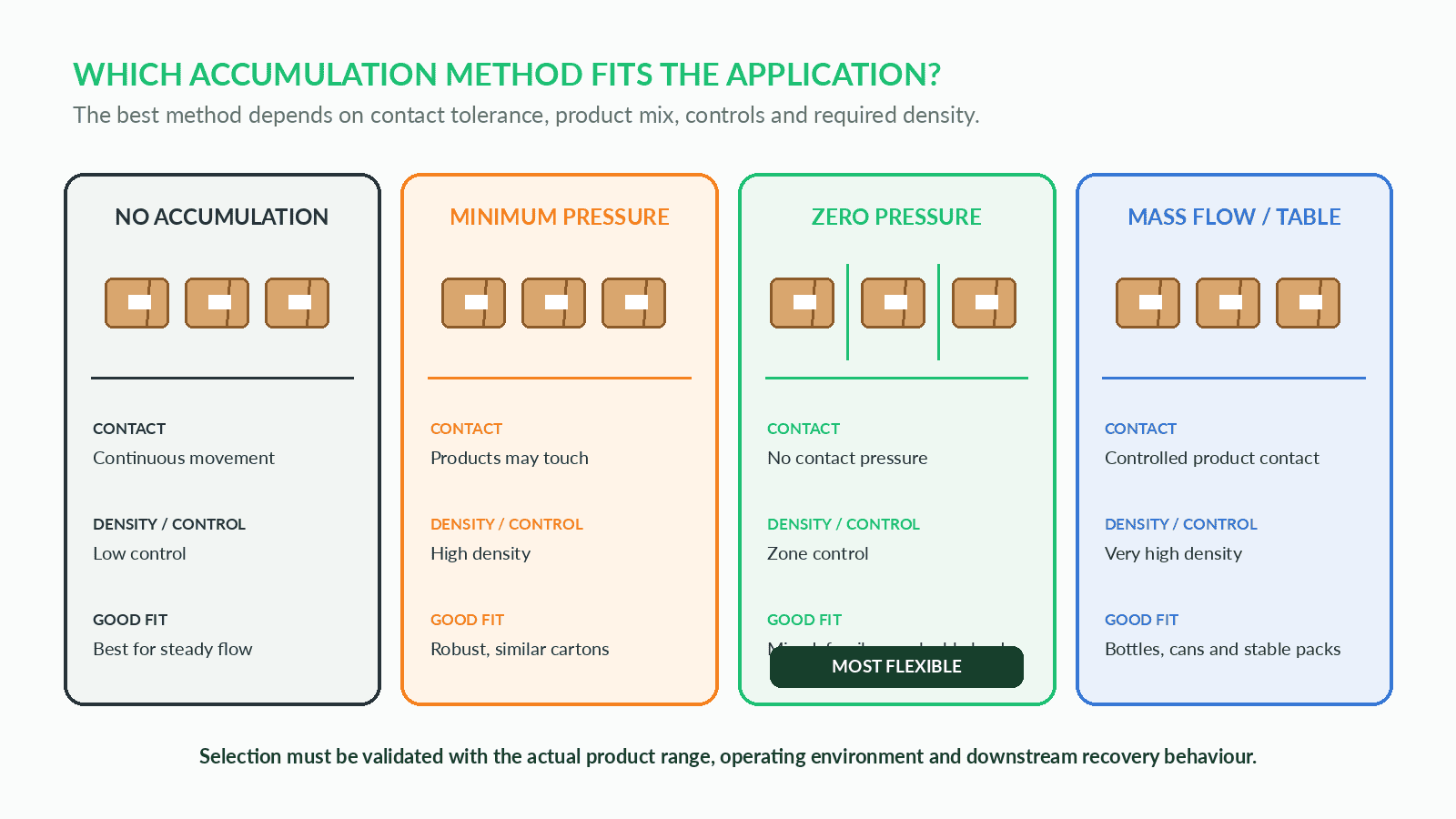
Accumulation method comparison: the most suitable approach depends on product contact tolerance, density, controls and process behaviour.
How Zero-Pressure Accumulation Works
A typical zero-pressure accumulation conveyor is divided into short zones. Each zone includes a product sensor and a controllable drive, often a motor-driven roller or a powered roller section. When a product reaches an occupied downstream zone, the upstream zone stops before the two products make contact. When space becomes available, the controls release the product according to the required sequence.
| Release mode | Behaviour | Typical use | |
| Singulation release | One zone releases at a time, preserving a gap. | Scanners, weighers, labellers and sorters that require spacing. | |
| Cascade or slug release | Several occupied zones start in sequence or together. | Rapid backlog recovery where downstream capacity is available. | |
| Indexed release | One product is presented on command. | Robots, assembly stations, palletizers and inspection machines. | |
| Priority / merge release | Multiple queues release according to route or priority logic. | Main-line merges, order consolidation and carrier routing. | |
| HUMAN CLUE When an operator knows exactly which carton to release first after a stop, that knowledge should become documented control logic – not remain a personal technique. | |||
Real-World Project: Buffering Sensitive Products Without Stopping Operations
A useful accumulation case study must show more than a conveyor photo. It should explain the operational problem, how buffering fits the wider system and what changed after implementation.
| SOURCE TRANSPARENCY The following examples are publicly documented projects from Interroll and Hytrol. They are included as industry evidence and are not presented as Convello customer installations. |
Alloga Pharmaceutical Logistics Modernisation
Alloga, a pharmaceutical logistics operation in Switzerland, needed to handle sensitive products, increase throughput within limited space, expand buffer capacity and modernise conveyor technology without stopping ongoing operations. According to Interroll, the project combined a modular conveyor platform with zero-pressure accumulation, custom loading towers, automated intermediate buffers and ergonomic packing stations.
The reported result was a doubling of transport capacity to the shipping department, together with improved flow, time and space savings, lower energy use and a platform that could support future expansion.
| Project element | What it shows |
| Operational challenge | Sensitive products, limited space, more throughput and modernisation without halting operations. |
| Accumulation role | Provide controlled buffer capacity between order picking, packing and shipping processes. |
| System elements | Modular conveyor, ZPA zones, loading towers, intermediate buffers and ergonomic packing stations. |
| Reported outcome | Transport capacity to shipping doubled; flow, space use and future scalability improved. |
| Project lesson | Accumulation delivered value because it was integrated with workstations, modularity, controls and the operating plan. |
What a Similar Project Team Should Learn
- Do not select buffer length before mapping the complete route from release point to destination.
- Modernisation can be phased, but temporary interfaces and cutover states must be designed as carefully as the final system.
- Sensitive products require both physical protection and reliable tracking through every occupied zone.
- Ergonomic loading and packing points influence throughput as much as conveyor speed.
- A buffer creates resilience only when downstream recovery capacity is greater than the continuing upstream arrival rate.
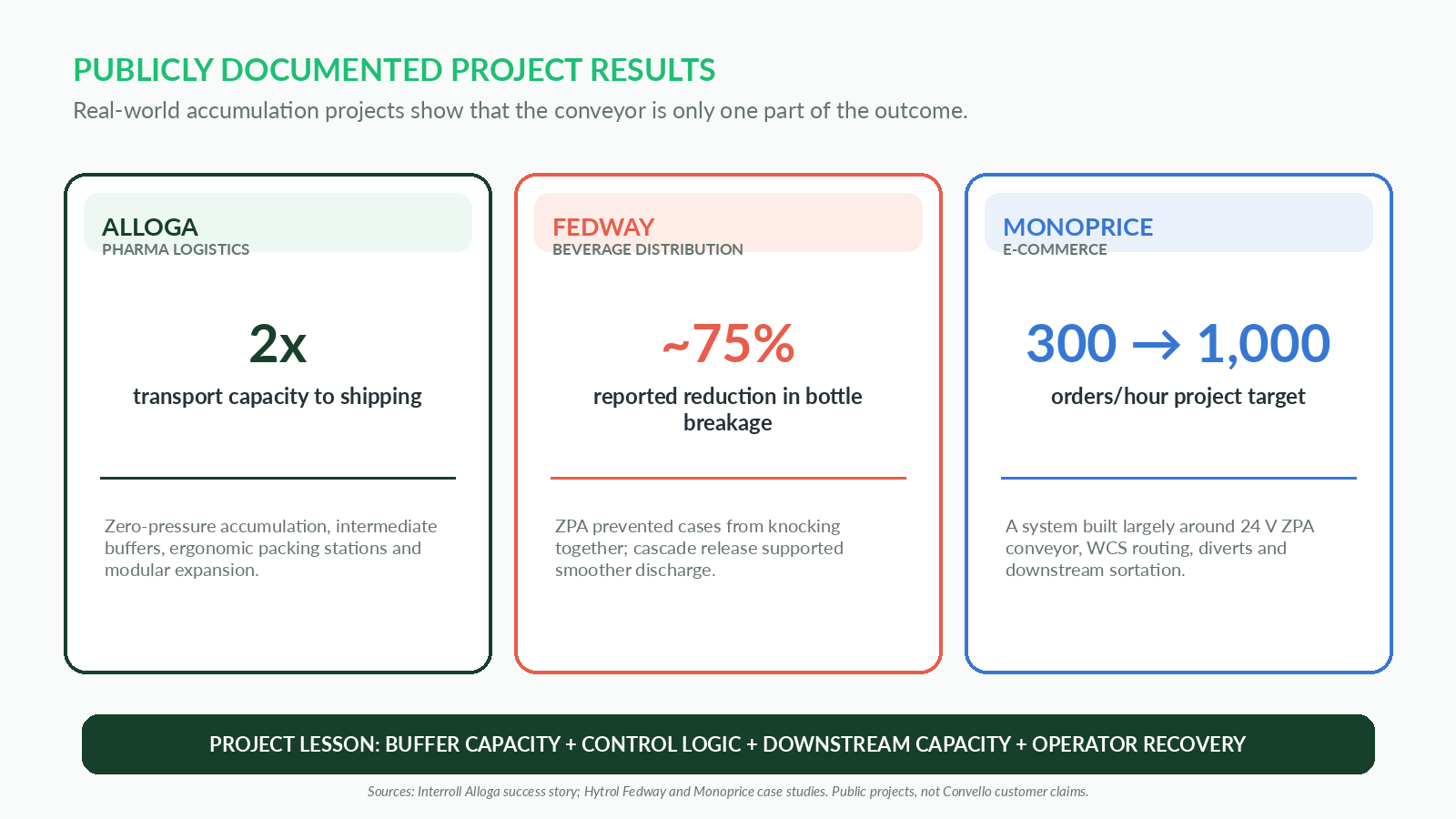
Published accumulation-conveyor projects show how buffer capacity, product protection and control integration support different operational goals.
Two Additional Public Project Signals
Fedway Associates reported that its new distribution system reduced bottle breakage by around 75 percent. The zero-pressure accumulation design prevented cases from knocking into one another, and the operation reported completing work in a 10-hour shift that had previously taken about 12 to 13 hours. This is a useful reminder that accumulation is not only about queue length; release behaviour can directly affect product quality and shift performance.
In an e-commerce project for Monoprice, the operating requirement was to support growth from roughly 300 orders per hour toward 1,000 orders per hour. The integrated solution used a system built largely around 24-volt zero-pressure accumulation conveyor, together with warehouse control software, diverts, picking zones, sorting and an extendible ZPA loading conveyor. The lesson is equally important: accumulation cannot create throughput by itself. The complete route, controls and downstream processes must be designed as one system.
Interroll – Alloga success story: View source – Public project description and reported doubling of transport capacity to shipping.
Hytrol – Fedway Associates: View source – Public project reporting approximately 75% lower bottle breakage and shorter shift completion time.
Hytrol – Monoprice e-commerce: View source – Public project describing a ZPA-based fulfilment architecture and throughput growth target.
How to Size the Accumulation Buffer
The right question is not, “How many metres of conveyor can we fit?” It is, “How many products can arrive while the downstream process is unavailable, and how quickly can the system clear that backlog after restart?”
Concept-Stage Buffer Formula
| FORMULA Required buffer positions = (upstream arrival rate – downstream rate during the event) x event duration + recovery allowance. Use consistent time units. If the downstream process stops completely, its rate during the event is zero. |
Illustrative Packaging-Line Example
| Input | Illustrative value |
| Upstream arrival rate | 30 cartons/minute |
| Downstream interruption | 80 seconds = 1.33 minutes |
| Theoretical backlog | 30 x 1.33 = approximately 40 cartons |
| Planning allowance | 20% for variation and sensor/release behaviour |
| Initial buffer target | 48 carton positions |
| Illustrative product pitch | 600 mm per position |
| Single-lane conveyor length | 48 x 0.6 m = 28.8 m |
The example shows why accumulation must be calculated early. A brief stop can require much more physical length than expected. The design team may decide to use two lanes, a recirculating buffer, a spiral arrangement, a faster recovery strategy or process changes that reduce the interruption itself.
Recovery Time Matters as Much as Buffer Size
Suppose the downstream process can run at 38 cartons per minute after restart while the upstream line continues at 30 cartons per minute. The net backlog-clearing rate is only 8 cartons per minute. A 40-carton backlog therefore needs about five minutes to clear. If the next interruption occurs before the queue is gone, the buffer will progressively fill even though every individual stop appears short.
| DESIGN PRINCIPLE A buffer buys time. It does not remove downtime. The line must have enough recovery capacity to return to normal before the next disturbance arrives. |
Fifteen Design Decisions That Determine Whether the Buffer Works
1. Define the complete product range
Record minimum and maximum length, width, height, weight, base condition and packaging quality. A small carton that bridges two sensors can behave differently from the average case.
2. Establish contact tolerance
Decide whether products may touch at all. Glass, fragile cartons, mixed sizes and easily scuffed products often justify zero-pressure control.
3. Measure sustained and burst arrival rates
Use real operating data at the point where the buffer begins, not only the nameplate speed of the upstream machine.
4. Record interruption duration and frequency
Ten 20-second stops may create a different design problem from one five-minute stop, even if total downtime is similar.
5. Calculate downstream recovery rate
The process must clear the queue faster than new products arrive. Otherwise the buffer only delays a full-line stop.
6. Select the right accumulation method
Choose between minimum pressure, ZPA, table accumulation, recirculating storage, spiral buffering or heavy-duty pallet accumulation.
7. Set zone length around the worst product
A zone must reliably detect and control the shortest and longest accepted products. One universal zone length may not suit a very wide mix.
8. Define the desired gap
Scanners, weighing, label application, sorting and human tasks may require a repeatable gap after release.
9. Match conveyor surface to the product
Soft bags, unstable pouches or products with irregular bases may need continuous belt support rather than rollers.
10. Design merge and divert behaviour
A buffer upstream of a merge requires priority, gap and destination-availability rules. Mechanical capacity alone is insufficient.
11. Plan destination-full logic
Define what happens when a packing station, sort lane, pallet position or truck-loading route becomes full.
12. Place sensors for real packaging conditions
Transparent wrap, dark surfaces, overhang, labels and reflective packaging can affect detection. Test the real product range.
13. Define all operating states
Running, occupied, blocked, starved, full, jammed, manual recovery and maintenance states should have clear meanings and responses.
14. Provide safe recovery and maintenance access
Operators should not reach into moving zones or bypass sensors to restore flow. Guarding, stops and energy isolation require project-specific risk assessment.
15. Reserve capacity for change
Future products, more destinations, higher peak rates and a second shift can change the required buffer. Modular zones and controls simplify expansion.
Control States the Project Should Define
| State | Meaning | Expected response |
| Available | The zone is empty and can accept a product. | Release upstream product if route is valid. |
| Occupied | A product is present and correctly detected. | Hold or move according to downstream state. |
| Blocked | The next zone or machine cannot accept product. | Stop release and propagate the blocked state upstream. |
| Full | Planned buffer capacity is occupied. | Stop or slow the source process before product pressure develops. |
| Jam suspected | Sensor remains occupied beyond the expected travel time. | Stop the affected area, identify location and require deliberate recovery. |
| Manual recovery | Authorised person controls movement after the hazard is assessed. | Use defined mode, visibility and restart rules. |
Where Accumulation Systems Add the Most Value
| Application | Typical accumulation role |
| E-commerce and warehouses | Before scanners, sorters, packing benches, destination lanes and truck-loading conveyors. |
| FMCG and packaging | Between fillers, labellers, checkweighers, cartoners, case packers and palletizers. |
| Manufacturing and assembly | Between machines with different cycle times, inspection stations and rework routes. |
| Food and beverage | For packaged products where hygiene, gentle contact and washdown-compatible equipment are required. |
| Pharmaceutical logistics | For sensitive products requiring controlled movement, traceability and reliable buffering. |
| Pallet handling | Before robots, stretch wrappers, lifts, AS/RS interfaces and dispatch staging. |
When Zero-Pressure Accumulation Is Not the Best First Choice
- The product has a soft or irregular base that cannot bridge roller gaps reliably.
- The operation needs long-term storage or inventory location management rather than short buffering.
- The downstream machine has no realistic recovery capacity, so every backlog will remain indefinitely.
- Products are allowed to touch and high-density mass-flow accumulation is more appropriate.
- The environment requires specialist hygienic, explosive-atmosphere, high-temperature or corrosion-resistant design beyond a standard unit-load conveyor.
- A recurring stop is caused by poor machine reliability that should be corrected before adding more buffer capacity.
Common Accumulation Design Mistakes
| Mistake | Why it creates trouble |
| Buying the available length | The longest straight section that fits may still provide too little buffer or far more than the process needs. |
| Sizing from average flow | Peak arrivals and stop duration determine the queue, not the monthly average. |
| Ignoring the smallest product | Short cartons can occupy sensors or transfer zones unpredictably. |
| No recovery calculation | A line may fill gradually because the downstream process never clears the backlog. |
| Treating all releases the same | A scanner may need singulation while a long discharge conveyor benefits from cascade release. |
| No exception route | Damaged, no-read or rejected products block the main buffer because there is nowhere else to go. |
| Using alarms without ownership | A full-zone alarm is not useful unless the team knows who responds and how flow resumes. |
| Bypassing sensors during pressure | Temporary overrides become permanent operating methods and undermine both control and safety. |
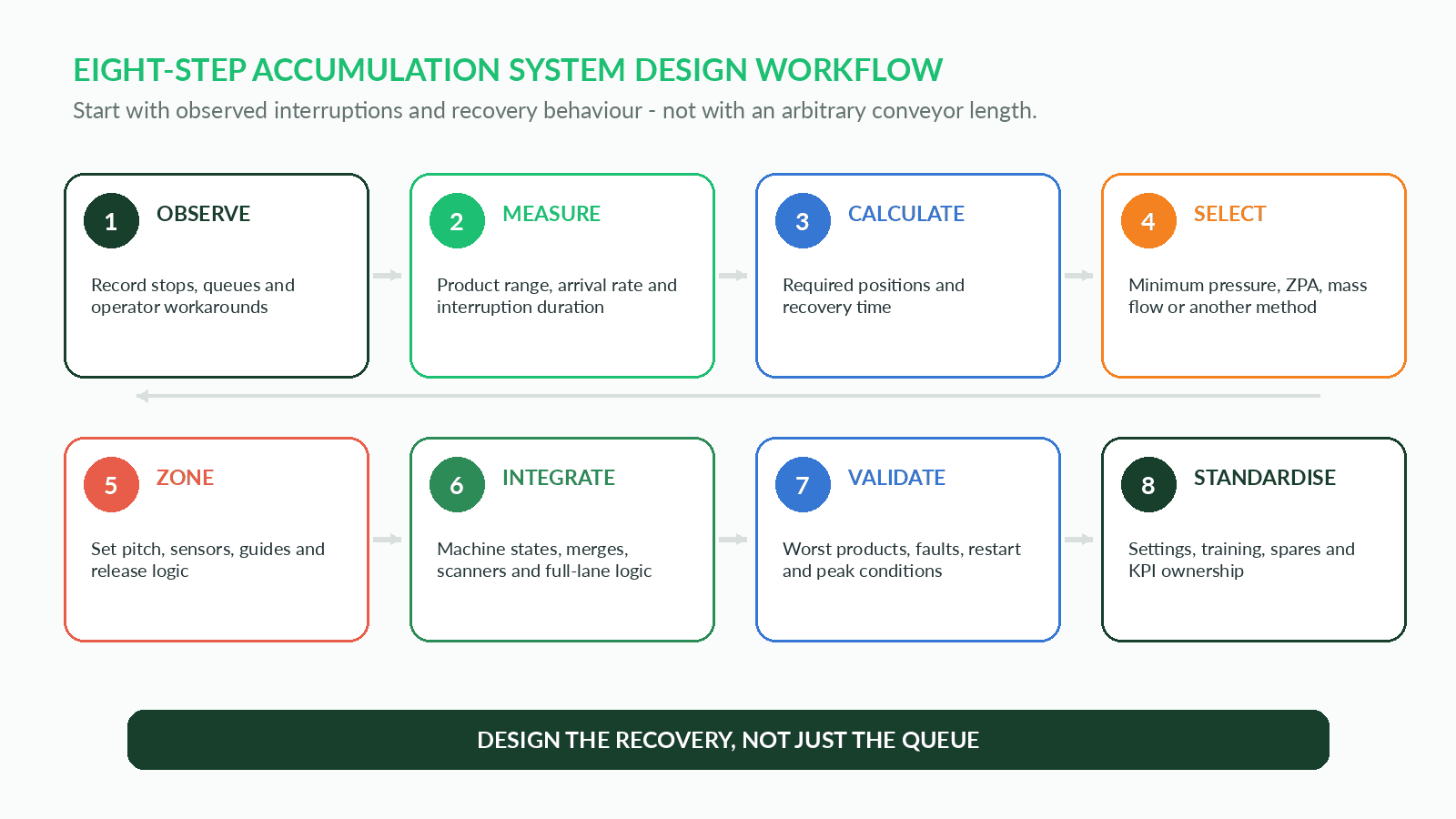
Eight-step accumulation system design workflow: begin with observed interruptions and end with validated settings, training and KPI ownership.
Eight-Step Project Workflow
- Observe the actual process: Watch a complete shift and record where people remove, hold, redirect or re-feed products.
- Measure product and flow data: Capture the product range, arrival rate, downstream rate, stop duration and frequency.
- Calculate buffer and recovery: Estimate positions, physical length and backlog-clearing time under realistic peak conditions.
- Select the accumulation method: Choose the surface, pressure philosophy, number of lanes and conveyor configuration.
- Engineer zones and transfers: Define zone length, sensors, guides, gaps, speed changes and transfer support.
- Integrate control states: Connect machine-ready, blocked, full, jam and route-availability signals.
- Validate failure and restart: Test the worst product, full buffer, power interruption, jam, sensor fault and controlled restart.
- Standardise operation: Document settings, train operators and maintenance, stock critical spares and track performance.
Information to Share for an Accurate Quote
| Requirement | Details to provide |
| Product data | Minimum and maximum dimensions, weight, base, fragility, packaging material and photographs. |
| Flow data | Normal, sustained peak and short-burst arrival rates. |
| Stop data | Which process stops, typical duration, longest credible event and events per shift. |
| Recovery data | Maximum downstream rate after restart and acceptable time to clear backlog. |
| Buffer objective | Required positions, minutes of protection or business condition to absorb. |
| Route and layout | Start/end points, available length, curves, levels, columns, doors and traffic routes. |
| Interfaces | Machines, scanners, scales, sorters, robots, WMS/WCS/PLC and upstream/downstream conveyors. |
| Operating environment | Temperature, dust, washdown, hygiene, corrosion, noise and working hours. |
| Control preference | Singulation, cascade, indexed release, priority merge and destination-full behaviour. |
| Safety and access | Guarding, emergency stops, crossings, jam access, isolation and maintenance envelope. |
| Acceptance criteria | Throughput, product damage, maximum queue, fault recovery, documentation and training. |
| CONVELLO PROJECT PROMPT Share the product range, arrival rate, downstream interruption pattern, required buffer time, recovery rate and layout. Convello can then assess whether a roller, belt, pallet, recirculating or hybrid accumulation solution is appropriate. |
Frequently Asked Questions
1. What is a conveyor accumulation system?
It is a controlled conveyor section that temporarily holds products when the downstream route or process is unavailable, allowing other parts of the operation to continue for a limited time.
2. What is zero-pressure accumulation?
Zero-pressure accumulation divides the conveyor into zones so each product can stop without pushing into the product ahead. Sensors and controls release products when downstream space becomes available.
3. What is the difference between minimum pressure and zero pressure?
Minimum-pressure systems permit light product contact and usually achieve higher packing density. Zero-pressure systems keep products separated and offer more control for fragile, mixed or valuable loads.
4. How much accumulation capacity do I need?
Capacity depends on the upstream arrival rate, downstream rate during the interruption, stop duration, event frequency, recovery rate and planning allowance. It should be calculated in product positions and minutes, not only metres.
5. How do I calculate conveyor buffer length?
Estimate the required product positions, multiply by the zone pitch or product pitch, and divide by the number of lanes. Transfers, sensor spacing, guides and maintenance access also affect the final footprint.
6. Can accumulation increase throughput?
It can protect throughput by preventing short downstream interruptions from immediately stopping upstream processes. It does not increase the inherent capacity of a slower machine and cannot replace adequate recovery capacity.
7. Is an accumulation roller conveyor suitable for all products?
No. Stable flat-bottom cartons, totes and trays are good candidates. Soft bags, small items and irregular bases may require a belt or another support method.
8. Can products of different sizes use the same ZPA conveyor?
Often yes, but zone length, sensor placement, roller pitch and control logic must be validated against the shortest, longest, lightest and most reflective products.
9. Does ZPA reduce product damage?
It can reduce contact pressure and impacts during queuing. Actual damage performance also depends on transfer points, side guides, release speed, packaging quality and downstream handling.
10. What happens when the buffer becomes full?
The controls should stop or slow the source process in a defined sequence before uncontrolled pressure or overflow develops. The response and restart ownership should be agreed during design.
11. Can accumulation conveyors integrate with WMS, WCS or PLC systems?
Yes. They can exchange route, product, zone, blocked, full and fault information, but the required signal list and recovery behaviour should be defined before commissioning.
12. What should be tested during commissioning?
Test normal flow, full accumulation, maximum and minimum products, destination-full conditions, sensor faults, power interruption, jam recovery, emergency stop, restart and backlog clearance at the required rate.
Turn Short Stops Into Controlled Flow – Not a Shift-Long Recovery
A well-designed accumulation system gives the operation time to absorb normal variation without damaging products or forcing operators to create temporary storage beside the line. The design should begin with real stop data and end with a tested recovery sequence.
| RECOMMENDED CTA Planning a production, packaging or warehouse buffer? Share your product dimensions, peak rate, common interruption duration, desired buffer time, downstream recovery rate and layout with Convello for an application-specific review. |