+91 99980 88430 | +91 95589 17778
 info@convello.in | sales@convello.in

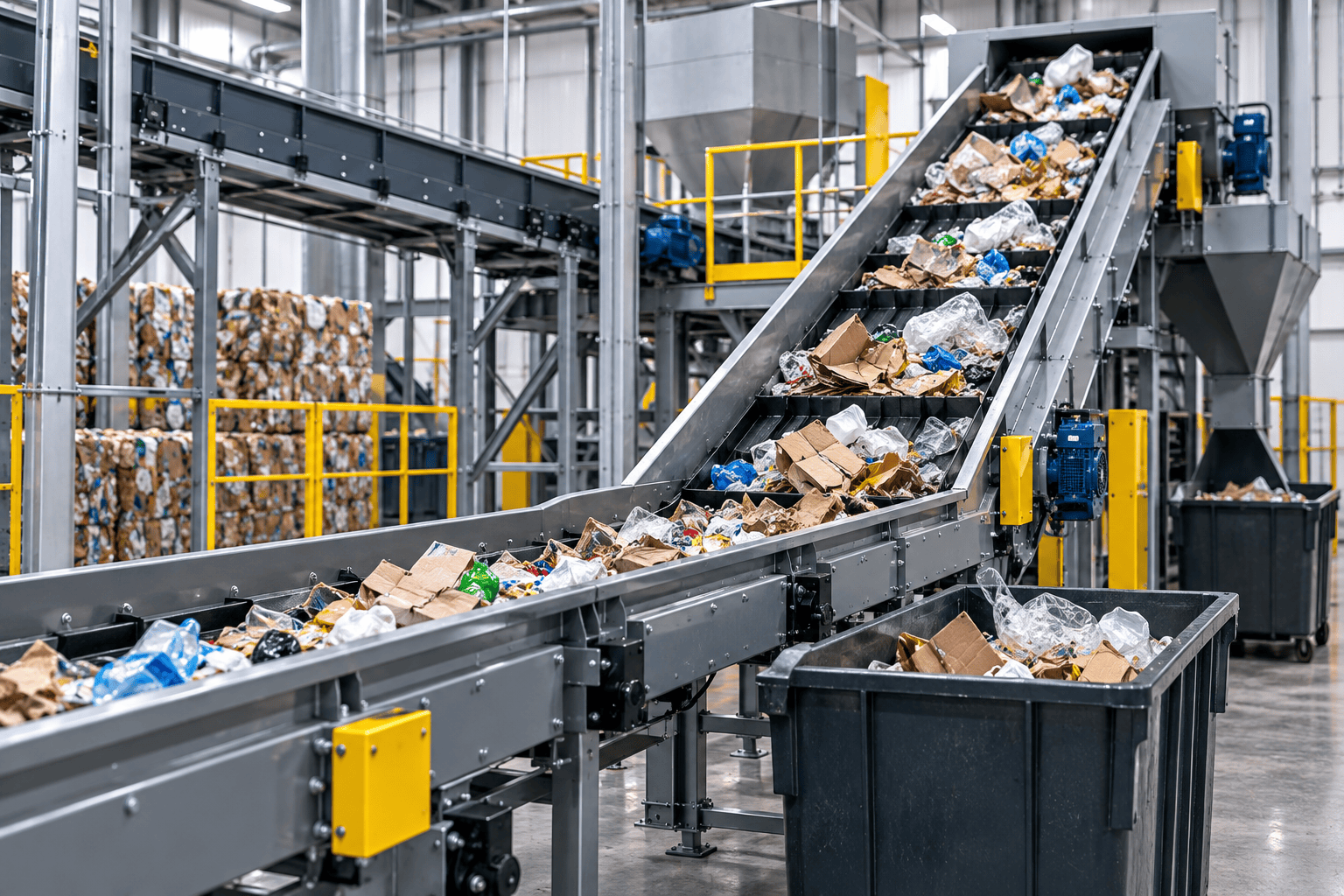
Waste is the part of production that nobody wants to look at – until it blocks an aisle, fills a bin before the tea break, forces a forklift into a busy work area or leaves operators wondering where the next reject should go. The machine making the product gets careful attention. The waste leaving that machine is often expected to “manage itself.” It rarely does.
A cardboard trim stream may be light but bulky. Stretch film may weigh almost nothing yet wrap around an exposed roller. Metal offcuts may be compact but sharp enough to damage an ordinary belt. Food or wet process waste may change the conversation completely because drainage, hygiene, odour and cleaning access become central design requirements. A waste handling conveyor has to deal with the material as it really arrives, not as it looks in a clean sample tray.
This is why the best waste-conveyor projects usually begin away from the drawing board. Someone watches the full shift. They note which bin fills first, when the surge occurs, what operators currently lift, which material gets mixed by accident and where maintenance loses time during clean-up. Those small observations often matter more than a monthly tonnage figure.
A well-designed system does not simply remove waste from sight. It creates a controlled route from the point of generation to sorting, recovery, compaction, storage or disposal. Along the way, it can reduce repeated handling, keep access routes clearer, present material more consistently to sorters and separators, and make the waste flow easier to measure.
This guide explains the applications, benefits and design decisions behind an industrial waste handling conveyor. It focuses mainly on production scrap, packaging waste, recyclables and selected non-hazardous process waste. Hazardous, biomedical, explosive, radioactive or chemically reactive waste requires specialist handling and regulatory review beyond a general conveyor-selection guide.
| Shop-floor reality Waste does not arrive politely. Design for the wet batch, the oversized reject, the film tail, the sudden twenty-minute surge and the clean-out job at the end of the shift – not only for the average material sample. |
What Is a Waste Handling Conveyor?
A waste handling conveyor is a mechanical system that transports waste, scrap or recoverable material between defined stages of an industrial or commercial process. Those stages may include collection beneath a machine, transfer from a production area, metered feeding, manual sorting, magnetic or other separation, screening, compaction, baling, storage and final discharge.
The conveying surface may be a rubber or PVC belt, a reinforced belt, a steel or apron-style surface, a cleated incline belt, a screw conveyor for selected fines, or another engineered arrangement. A complete system may also include hoppers, skirts, impact beds, covers, scrapers, drainage, sensors, pull cords, guards, access platforms, chutes and interfaces with equipment such as compactors, balers, screens, magnets or shredders.
In practical terms, the conveyor’s job is to turn an irregular, inconvenient waste stream into controlled movement. That sounds simple, but waste has a habit of changing shape, density and behaviour. The engineering challenge is not only “Can the motor move it?” The better questions are: Will the material stay on the belt? Will it damage the belt? Will it bridge in the hopper? Can it be cleaned safely? What happens when the largest unwanted item arrives?
The Shop-Floor Problem Nobody Plans for Early Enough
Waste handling is often designed after the production layout is nearly frozen. By then, the shortest route may be blocked by machines, electrical panels, columns, doors or operator walkways. The project team is left trying to fit bins, trolleys and forklift movements into whatever space remains.
That approach creates hidden labour. An operator lifts a scrap box onto a trolley. A helper moves it to a holding point. A forklift takes it to a compactor. Someone later separates cardboard from plastic because the streams were mixed at the source. None of those steps appears in the production cycle time, yet all of them consume people, space and attention.
A waste conveyor can remove several of those handoffs, but only if the route is treated as part of the process. The collection point, height, incline, discharge and destination should be planned with the same seriousness as raw-material input and finished-goods output.
| A useful diagnostic Walk the route of one full waste load from the machine to its final destination. Count every lift, push, trolley move, forklift touch, temporary pile and re-sorting step. That is the real process the conveyor has to improve. |
Where Are Waste Handling Conveyors Used?
Waste conveyors appear wherever material must be removed continuously, presented for sorting or moved to a defined recovery or disposal point. Common applications include the following.
| Application | Typical material | Typical conveyor role |
| Manufacturing plants | Plastic runners, rubber trim, rejected components, machining scrap, packaging waste and line-side bins | Source collection, under-machine conveyors, central scrap transfer and compactor feed |
| Recycling and MRF operations | Mixed recyclables, paper, plastics, cans, containers and residual material | Infeed, metering, sorting, separator feed, bunker discharge and residue transfer |
| Packaging and FMCG | Carton trim, labels, film, damaged packs, rejected containers and secondary packaging | Line-side capture, incline transfer, baler feed and segregated collection |
| Warehouses and distribution | Stretch film, damaged cartons, pallet wrap, dunnage and return packaging | Central collection from packing and returns areas, compactor or baler feed |
| Food processing | Selected organic rejects, packaging waste, peelings or process residuals, subject to hygiene review | Washdown-compatible collection, drainage, enclosed transfer and controlled discharge |
| Automotive and engineering | Metal stampings, offcuts, swarf, fixtures, packaging and rejected parts | Heavy-duty or steel-surface conveying, chip handling and magnetic-separation interfaces |
| Paper, printing and converting | Paper trim, board offcuts, cores and rejected sheets | Pneumatic or belt collection, trim transfer and baler feed |
| Municipal and commercial facilities | Selected mixed dry waste and recyclable streams | Receiving, sorting, recovery and residue movement within a controlled process |
The phrase “waste handling conveyor” therefore covers more than one machine type. The correct arrangement depends on what the waste is, how it arrives, what must happen next and what the site can realistically maintain.
Conveyor Types Used in Waste and Recycling Operations
| Configuration | Often considered for | Why it is used | Critical check |
| Heavy-duty belt conveyor | Mixed dry waste, recyclables, packaging scrap and many irregular unit or bulk streams | Continuous surface, versatile layout and sorting access | Belt cut resistance, impact zones, skirts, tracking and cleaning |
| Slider-bed sorting conveyor | Manual inspection and hand sorting of mixed material | Stable presentation at controlled speed | Ergonomic width, lighting, guards, emergency stops and reject chutes |
| Cleated incline conveyor | Raising loose waste to a sorter, bunker, baler or compactor | Compact elevation change and controlled carrying pockets | Incline angle, cleat height, sidewalls, rollback and discharge |
| Troughed or skirted belt | Loose bulk waste and higher-volume streams | Improved containment and carrying cross-section | Spillage control, loading profile, idler support and dust |
| Steel belt / apron-style conveyor | Sharp, hot, abrasive or impact-heavy scrap, subject to detailed review | High resistance to cuts and heavy impact | Noise, weight, drive load, pinch points and maintenance |
| Screw conveyor | Selected fines, powders, ash, chips or semi-solid material | Enclosed transfer and controlled discharge | Material flowability, wear, sealing, cleaning and feeder duty |
| Bunker or feeder conveyor | Buffering and metering uneven incoming waste | Controlled feed to sorting or processing equipment | Live load, bridging, extraction pattern and overloads |
| Mobile or temporary conveyor | Seasonal, overflow or changing collection points | Flexibility and fast deployment | Safe positioning, stability, cables, access and repeated setup |
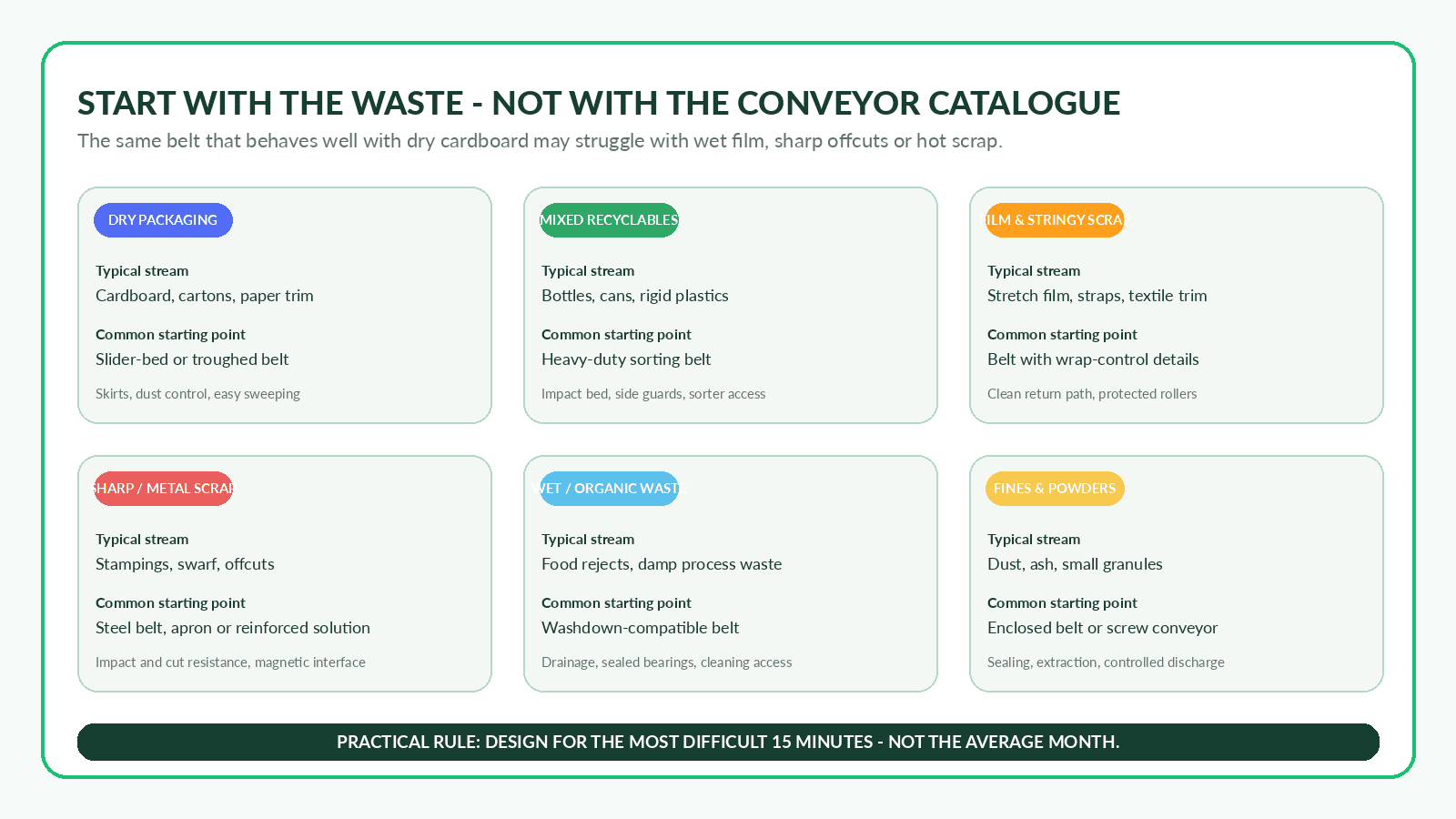
Waste-stream selection map: start with the most difficult material behaviour, then choose the conveying surface and protection around it.
There is no universal “waste belt.” A general-purpose conveyor may work perfectly for dry cartons and fail quickly when the stream changes to oily trim, hot scrap or stringy film. For mixed material, the design should be based on the most damaging credible item as well as the normal stream.
Benefits of a Well-Designed Waste Handling Conveyor
1. Cleaner production and dispatch areas
Continuous or scheduled removal prevents waste from collecting beside machines, under worktables or in access routes. The result is not cosmetic housekeeping alone; it makes the process easier to see and manage.
2. Fewer manual handling steps
A conveyor can replace repeated lifting, carrying, trolley movement and bin exchange. People may still sort or supervise the stream, but the equipment handles the travel between stages.
3. More predictable feed to downstream equipment
Balers, compactors, screens and separators work better when the incoming flow is controlled. A feeder or metering section can reduce the “empty, empty, sudden heap” pattern common with tipped bins.
4. Better material segregation and recovery
Separate collection routes make it easier to keep cardboard, plastic, metal or process scrap from becoming one low-value mixed stream. The conveyor supports recovery, but source discipline remains essential.
5. Reduced production interruption
When scrap leaves the work area continuously, operators are less likely to stop a productive task to replace a full bin, clear floor waste or wait for internal transport.
6. Safer and clearer movement
A defined conveyor route can reduce interaction between pedestrians, trolleys and forklifts. It does not remove all risk; it changes the risk and therefore needs guarding, stops, isolation and access planning.
7. Easier measurement
A controlled route allows teams to track volume, weight, contamination, downtime, jams and recovery by stream. The data can reveal where waste is created, not only where it is finally collected.
8. A foundation for later automation
Once waste arrives consistently, it becomes easier to add weighing, level detection, magnetic separation, optical sorting, compaction or other process equipment where the business case is justified.
Fifteen Design Considerations That Decide Reliability
1. Describe the waste stream honestly
List every expected material, including contaminants and accidental items. Record whether the stream contains cardboard, film, straps, glass, sharp metal, liquids, dust, hot pieces, food residue, oils or chemicals. “Mixed waste” is not a specification.
2. Record minimum, normal and maximum piece size
The smallest particles influence sealing and carryback. The largest pieces influence hopper openings, skirt height, belt width, transfer chutes and jam risk. Oversized rejects should have a defined route rather than becoming an emergency every time they appear.
3. Measure bulk density and volume
A light, bulky stream can fill a belt long before the drive reaches its mass limit. For packaging waste and loose recyclables, volume and surge behaviour may matter more than tonnes per hour.
4. Understand moisture, stickiness and free liquid
Wet material may adhere to the belt, build under scrapers, leak at transfers or attack bearings. The design may need drainage, sealed components, corrosion resistance, washdown details and a cleaning method that does not spread contamination.
5. Identify sharp, abrasive, hot or chemically aggressive material
Cuts, punctures, abrasion, heat and chemical exposure can shorten belt and component life. The conveying surface, fasteners, liners, seals and structure must be selected against the actual exposure.
6. Engineer the loading point
Most waste-conveyor damage begins where material enters. Drop height, impact energy, loading direction and the chance of heavy objects landing edge-first affect the need for impact beds, liners, spreaders, chutes and controlled feed.
7. Design for surges, not just averages
A plant may generate 500 kilograms over a shift but release half of it in a few short clean-out events. The conveyor, hopper and downstream machine must absorb that pattern or the line will repeatedly stop at exactly the busiest moment.
8. Select the belt or conveying surface from behaviour
Grip, cut resistance, abrasion resistance, oil resistance, heat resistance, drainage, hygiene and cleanability should drive selection. A stronger material is not automatically better if it is difficult to track, clean or repair on site.
9. Match incline geometry to the waste
Loose, rolling or slippery material may need cleats, sidewalls, pockets or a shallower angle. The return side must also be considered because film, fibres and sticky material can remain attached after discharge.
10. Contain the material without making cleaning impossible
Skirts, covers and side guards control spillage, but fully enclosing every point can create inaccessible build-up. Containment should be removable or safely accessible where inspection and clean-out are expected.
11. Plan the discharge and downstream interface
A reliable conveyor can still fail operationally if the discharge chute blocks, the baler fills faster than expected or the receiving bunker has no high-level interlock. Interface signals and physical geometry must be designed together.
12. Provide suitable sorting ergonomics
Where people sort material, consider conveyor height, reach distance, belt width, speed, lighting, standing space, reject openings and rotation. The goal is steady presentation without asking people to overreach or make rushed decisions.
13. Address dust, odour, fire and contamination risks
Dust extraction, covers, housekeeping, spark or heat sources, gas detection, fire protection and ventilation may be relevant depending on the stream. These matters require site-specific hazard review; a conveyor alone is not a dust- or fire-control system.
14. Build maintenance access into the layout
Allow safe access to head and tail pulleys, scrapers, bearings, take-up, drive, sensors and typical blockage points. A component that can be seen but not reached safely will often be ignored until failure.
15. Define controls, stops and isolation philosophy
Overload detection, belt misalignment, zero-speed detection, emergency pull cords, local stops, restart warnings, interlocks and lockout points should be designed from the risk assessment and operating method, not added as an afterthought.
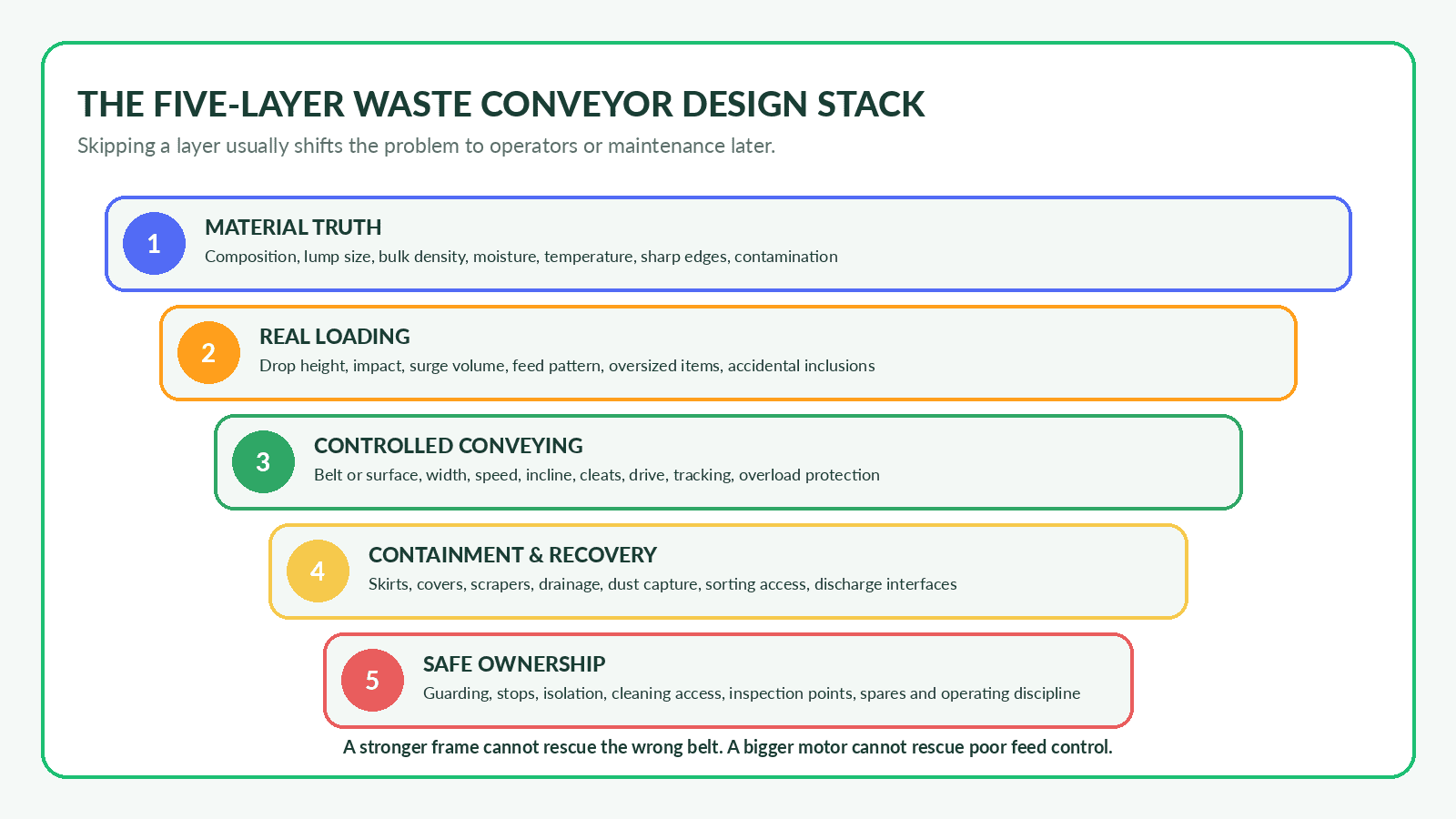
Five-layer design stack: material truth and loading conditions sit underneath every belt, drive, guard and maintenance decision.
Capacity, Surge and Feed Calculations
Waste conveyor capacity should be checked in both mass and volume terms. A dense metal stream may be drive-limited, while loose cardboard or plastic bottles may be space-limited. For irregular material, also consider how the material settles, bridges and forms peaks on the belt.
| Core planning formulas Peak mass flow (kg/h) = peak volume flow (m³/h) × bulk density (kg/m³)Required design capacity = credible peak flow × chosen contingency factorThe contingency factor should reflect variation, not compensate for missing data. |
An illustrative packaging area generates an average of 2.4 m³ of loose cardboard and plastic per hour, but shift-end clean-out raises the credible peak to 4.0 m³/h. If the blended bulk density is estimated at 120 kg/m³, the peak mass flow is about 480 kg/h. Applying a 25% planning margin gives a nominal design check of 600 kg/h – but the conveyor must still have enough belt width and side containment for the bulky 5.0 m³/h design volume.
| Input | Illustrative value | Engineering meaning |
| Average observed volume | 2.4 m³/h | Useful for baseline, not sufficient for sizing |
| Credible short-duration peak | 4.0 m³/h | Based on clean-out and batch-release observation |
| Estimated blended bulk density | 120 kg/m³ | Must be tested or validated with representative material |
| Peak mass flow | 480 kg/h | 4.0 × 120 |
| Illustrative planning margin | 25% | Selected from variability and consequence of overflow |
| Nominal design check | 5.0 m³/h and 600 kg/h | Both volume and mass must fit the selected conveyor |
The better input is usually a time-stamped observation sheet: what arrived, how much, over what period and what the team did when the bin or chute could not accept it. That record exposes the peaks a monthly waste report hides.
Belt, Surface and Construction Selection
| Waste stream | Possible starting point | Details that decide final selection |
| Dry cardboard and paper trim | General industrial belt or slider-bed arrangement | Dust, static, lightweight carryback and bulky surges |
| Mixed bottles, cans and rigid plastics | Heavy-duty belt with impact support and side containment | Irregular loading, bouncing, sharp edges and sorter access |
| Stretch film, straps and textile trim | Smooth, accessible design with protected rotating components | Wrapping around shafts, rollers and exposed edges |
| Sharp metal offcuts or stampings | Reinforced belt, steel belt or apron-style solution after detailed review | Cuts, puncture, impact, noise and heavy point loading |
| Wet food or organic reject | Washdown-compatible belt and corrosion-resistant structure as required | Drainage, hygiene, odour, sealed bearings and cleaning chemicals |
| Dust, ash or fine granules | Enclosed or skirted belt, screw conveyor or feeder depending on flow | Leakage, dust extraction, bridging, wear and controlled discharge |
| Hot process scrap | Heat-resistant or metallic conveying solution after temperature review | Thermal damage, ignition risk and cooling requirements |
These are starting points, not product specifications. Representative samples, temperature information, chemical exposure and the full operating method should be reviewed before the belt and construction materials are finalized.
Sorting, Segregation and Material Recovery Flow
A conveyor can make recovery easier because it presents material in a visible and repeatable flow. It cannot compensate for every upstream mistake. If cardboard, oily rags, metal pieces and food waste are mixed at the source, the sorting line inherits that contamination.
A practical waste flow often begins with segregation at the machine or work area. Separate conveyors, chutes or collection points then feed a central route. A hopper or feeder absorbs short surges. Material is presented to manual sorters or separation equipment. Recovered streams move to bins, bunkers, balers or compactors, while residue follows a controlled final route.
The U.S. EPA waste-management hierarchy places source reduction and reuse above recycling, energy recovery, treatment and disposal. For an industrial project, that is a useful reminder: the conveyor should support a broader material strategy. It should not become an excuse to move avoidable waste more efficiently.
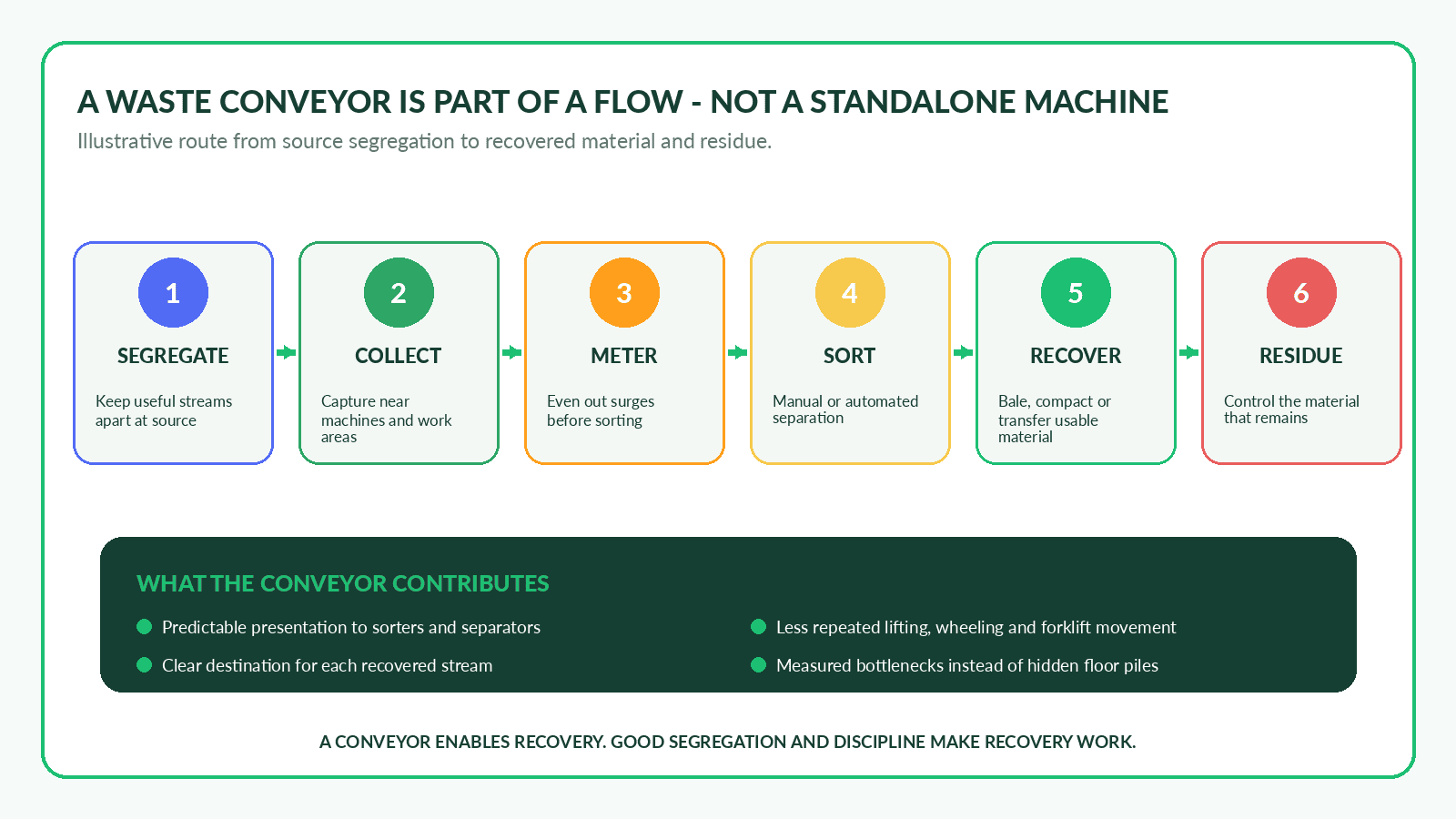
Illustrative recovery flow: the conveyor provides controlled movement, while source segregation and operating discipline protect the value of recovered material.
What Operators and Maintenance Teams Notice First
Drawings show dimensions. The people using the line notice behaviour. Their questions are often more direct and more useful:
- Does light film lift or blow off the belt near an open door?
- Which material wraps around the tail pulley or exposed shaft?
- Can a jam be seen before someone climbs onto the structure?
- Is there a safe place to stand while cleaning the scraper?
- Does the chute block when one oversized carton arrives?
- Can the conveyor restart while someone is still clearing material?
- Where does dirty wash water actually go?
- Which inspection point is skipped because access is awkward?
- What happens when the compactor or receiving bin is full?
These are not “small operational details.” They are design inputs. A human-centred waste conveyor is one that operators can feed consistently, sort without rushing and stop quickly, while maintenance can inspect, isolate, clean and repair without improvising unsafe access.
| Three questions worth asking on site Where do you wait? Where do you lift? Where do you improvise? The answers usually point to the best collection point, the real bottleneck and the access problem the drawing has missed. |
Illustrative Packaging-Plant Application
Consider a packaging plant where carton trim, rejected bottles and stretch film are collected in separate line-side bins. The bins are moved by trolley to a shared holding area, then emptied near a baler. During peak production, the cardboard bin fills early, film escapes around the holding area and a forklift crosses the dispatch aisle to remove the accumulated material.
A possible improvement would use short collection conveyors from selected work areas, feeding a central belt. A metering hopper would absorb batch releases. The line would include a dedicated film collection route, a manual inspection point and an inclined discharge to the baler. Level signals would prevent the central conveyor from feeding when the baler or receiving area is unavailable.
| Process element | Current condition | Illustrative conveyor-led improvement |
| Collection | Multiple small bins and repeated trolley trips | Defined line-side capture points feeding a central route |
| Peak control | Bins overflow during clean-out or changeover | Metering hopper or controlled release before main conveyor |
| Segregation | Cardboard and film become mixed after handling | Separated entry points and clearly marked recovery outlets |
| Internal traffic | Forklift enters dispatch aisle for waste movement | Waste routed to a destination outside the busiest crossing where practical |
| Baler interface | Material piles while baler is unavailable | High-level or ready signal interlocked with conveyor feed |
| Clean-up | Loose film and trim collected manually at shift end | Accessible skirts, scraper, floor clearance and defined clean-out method |
The business case would be built from measured trolley time, bin changes, forklift movements, clean-up time, production interruptions, recovered-material quality and maintenance effort. The example is illustrative, not a guaranteed saving or a substitute for site engineering.
Safety, Cleaning and Maintenance Planning
Waste conveyors combine normal conveyor hazards with material-specific hazards. Nip and shear points, moving belts, pulleys, drives and unexpected restart must be addressed. The waste itself may add sharp edges, broken glass, biological contamination, dust, heat, liquids or unstable objects.
The final system should be designed and risk-assessed for the intended site, material and operating method. Guards, emergency stops or pull cords, restart warnings, access control, safe isolation and written cleaning procedures should be part of the project scope. Lockout/tagout or the applicable site energy-isolation method is essential before work that exposes people to hazardous movement or stored energy.
Cleaning also needs an engineered method. Asking people to reach under skirts, stand on frames or pull wrapped material from a rotating area is not a maintenance plan. Provide access doors where suitable, removable covers, drainage, clean-out trays, lighting and enough clearance to use the correct tools.
| Frequency | Typical focus |
| Each shift / daily | Remove visible build-up using the approved safe method; inspect belt surface, tracking, skirts, discharge and emergency devices; report unusual sound or smell |
| Weekly | Inspect scrapers, rollers, bearings, fasteners, guards, pull cords, sensors, drains and typical wrap points; clean photoeyes and level devices |
| Monthly or planned interval | Check drive alignment, tension or take-up, gearbox and motor condition, structural bolts, wear liners, chute condition and spare-part consumption |
| After a jam or abnormal event | Identify cause before restart; inspect damage from oversized or foreign objects; verify guards and safety devices were restored |
| Shutdown maintenance | Isolate all energy, inspect hidden build-up and corrosion, replace wear parts, test interlocks and review recurring issues with operators |
Maintenance intervals should be set from the manufacturer’s instructions, site risk assessment, material severity and actual condition. A wet, abrasive or stringy stream may need much more frequent attention than a clean dry packaging stream.
When a Waste Conveyor Is Not the Right First Solution
A conveyor is not automatically justified because waste exists. Very low and occasional volumes may be handled more economically with well-designed bins, carts or scheduled collection. A route that changes every week may need a mobile or modular method rather than a fixed installation.
The first solution may also be source reduction. If a process generates avoidable trim, repeated packaging or preventable rejects, removing the cause can create more value than moving the waste faster. The conveyor should support the material strategy, not hide a quality problem.
Specialist review is required for hazardous chemicals, biomedical waste, explosives, hot reactive material, batteries, radioactive waste and other regulated streams. Mixed bulky demolition debris or very large irregular items may need loaders, grabs, feeders, shredders or other equipment before conventional conveying becomes practical.
Eight-Step Selection and Implementation Process
1. Observe the real process
Watch at least one representative shift and one peak or clean-out event. Record overflow, manual touches, jams and temporary storage.
2. Characterize the waste
Measure composition, size, weight, bulk density, moisture, temperature, sharpness, contamination and variability.
3. Map the route and interfaces
Define every loading point, elevation, support area, walkway crossing, sorter station, discharge and downstream equipment signal.
4. Select the conveying principle
Compare belt, cleated incline, steel or apron, screw, feeder and mobile options against the material and process – not only against purchase price.
5. Engineer feed, containment and controls
Design impact zones, skirts, covers, scrapers, drainage, level control, overloads, interlocks and fault response.
6. Complete safety and maintainability review
Confirm guarding, stops, isolation, restart method, cleaning access, jam-clearing strategy, platforms and maintenance clearances.
7. Test with representative material
Use real dirty, wet, light, sharp and oversized samples where safe and practical. A clean demonstration load may hide the exact behaviour that matters.
8. Measure after commissioning
Track throughput, jams, cleaning time, overflow, manual touches, recovery quality, downtime and operator feedback. Correct recurring causes instead of normalizing workarounds.
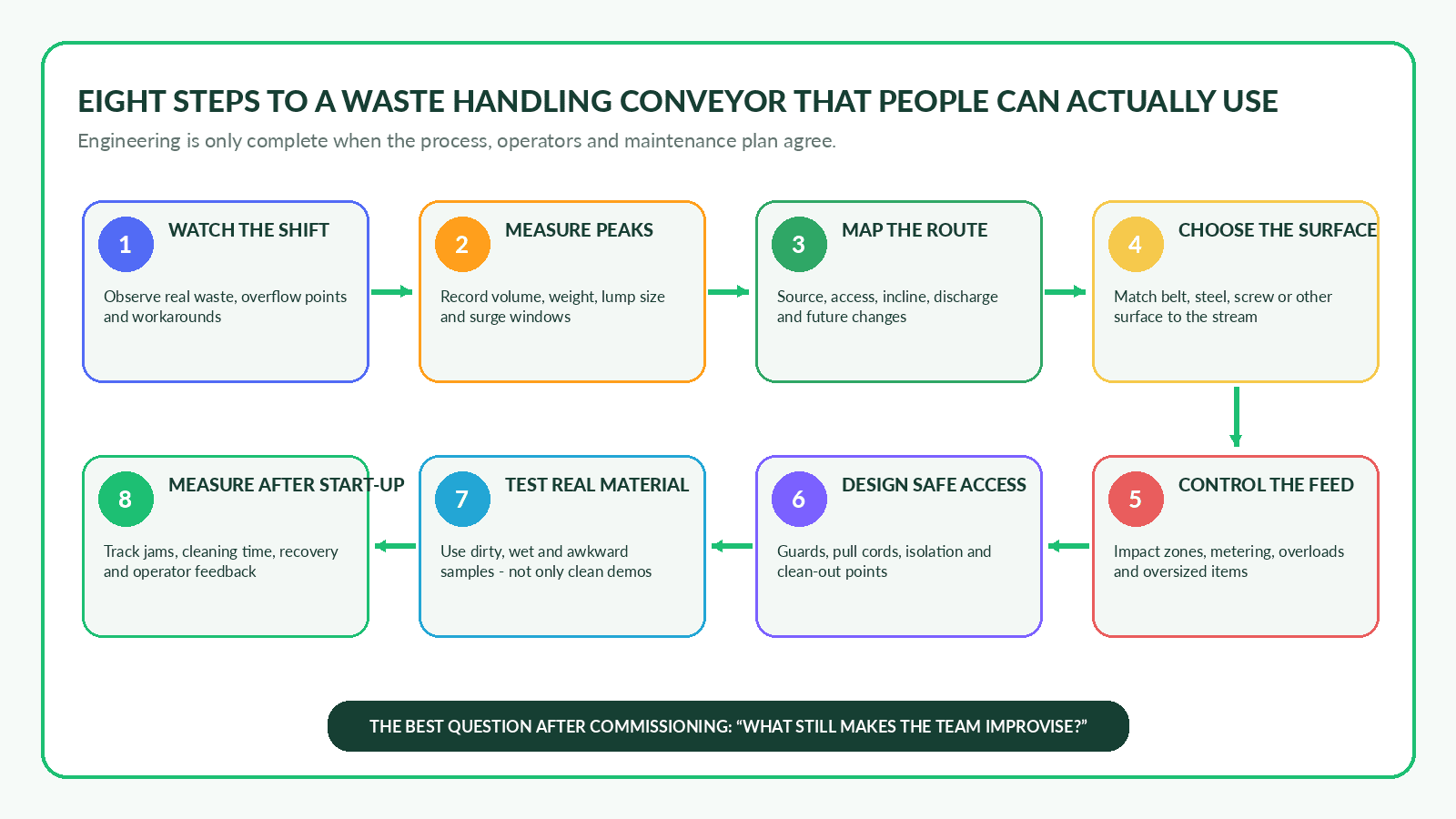
Eight-step roadmap: the project starts with watching real waste behaviour and ends with measuring whether people still have to improvise.
Information to Share for an Accurate Waste Conveyor Quotation
| RFQ item | Details to provide |
| Waste description | Materials present, approximate percentages, contaminants and whether streams are segregated |
| Sample evidence | Clear photos, videos and representative material samples where practical |
| Piece size | Minimum, normal and maximum dimensions; largest credible foreign object |
| Capacity | Average and peak kg/h, m³/h or pieces/h; duration and timing of surges |
| Material behaviour | Bulk density, moisture, stickiness, temperature, sharpness, abrasion, oil or chemical exposure |
| Loading method | Manual tipping, chute, machine discharge, forklift bin tipper, loader or upstream conveyor |
| Route | Length, width limits, incline, elevation, columns, doors, walkways and available floor area |
| Downstream destination | Sorter, screen, magnet, shredder, baler, compactor, bunker, skip or existing conveyor |
| Operating pattern | Hours per day, shifts, starts and stops, batch or continuous generation and duty cycle |
| Environment | Indoor/outdoor, washdown, dust, humidity, corrosion, hygiene, hazardous-area considerations |
| Controls | Available power, VFD, local panel, PLC signals, level sensors, interlocks and data requirements |
| Safety and access | Site standards, guarding expectations, pull cords, platforms, isolation, cleaning and maintenance access |
| Project scope | Design, manufacture, installation, electrical work, commissioning, training, documentation and spares |
| The fastest way to improve a quotation Send a short process video showing the waste as it is generated, one photograph of the complete route, a simple marked-up layout and the peak-volume observation. Those four items often remove more uncertainty than a long email. |
Common Waste Conveyor Selection Mistakes
- Calling the material “mixed waste” without describing what is actually mixed.
- Sizing from average daily tonnage while ignoring short clean-out surges.
- Choosing a general-purpose belt before checking sharpness, heat, oil, moisture or wrapping behaviour.
- Allowing high drop height and impact directly onto an unsupported belt.
- Designing containment that cannot be opened or cleaned safely.
- Routing the conveyor through the maintenance space of another machine.
- Ignoring what happens when the baler, compactor or receiving bin is full.
- Placing manual sorters at an uncomfortable height, reach or belt speed.
- Assuming more motor power will solve bridging, wrapping, poor loading or blocked discharge.
- Testing only clean sample material instead of representative dirty and difficult material.
- Leaving guarding, platforms, pull cords and isolation until after the mechanical layout is fixed.
- Failing to define who owns daily cleaning, inspection, jam response and spare parts.
Frequently Asked Questions
What is a waste handling conveyor?
It is a conveyor system designed to move production scrap, packaging waste, recyclables or selected process waste between collection, sorting, separation, recovery and discharge stages.
Which conveyor is best for mixed waste?
There is no single best type. Heavy-duty belt conveyors are commonly considered, but the final surface, frame, containment and feed arrangement depend on sharp objects, moisture, bulk density, lump size, contamination and required sorting access.
Can a normal belt conveyor be used for waste?
Sometimes, especially for clean dry packaging waste. Mixed, wet, sharp, hot, abrasive or stringy material may require a different belt, impact protection, scrapers, covers, sealed components or a different conveying technology.
How do I calculate waste-conveyor capacity?
Measure credible peak volume and mass flow, not only the daily total. Convert volume to mass using representative bulk density, then verify belt cross-section, speed, surges, loading pattern and downstream capacity.
What belt is suitable for sharp metal scrap?
The application may require a reinforced belt, steel belt, apron-style surface or another heavy-duty solution. Temperature, piece shape, drop height, point loading and expected wear must be reviewed before selection.
Can waste conveyors handle wet or organic material?
Yes, when designed for the stream. Drainage, corrosion resistance, washdown access, belt compatibility, sealed bearings, hygiene and odour control may become more important than basic carrying capacity.
How does a waste conveyor improve recycling?
It can keep streams separate, present material consistently to sorters and separators, and move recovered material to defined outlets. The recovery result still depends on source segregation, contamination control and the downstream process.
Can a waste conveyor connect to a baler or compactor?
Yes. The discharge geometry, feed rate, receiving capacity, high-level signal, ready status, stop logic and safe access should be engineered as one interface.
What safety features are used on waste conveyors?
Depending on the risk assessment, features may include guards, emergency stops or pull cords, local isolators, restart warnings, overload protection, misalignment and zero-speed detection, access controls and safe clean-out provisions.
How often should a waste conveyor be cleaned?
The interval depends on the material. A dry clean stream may need routine housekeeping, while wet, sticky, dusty or wrapping material may need inspection and cleaning each shift or more often. The procedure must include safe isolation where hazardous movement is exposed.
Can an existing waste process be retrofitted with a conveyor?
Often yes. Share the current layout, collection points, waste stream, existing machines, bottlenecks, access limits and available shutdown window so retrofit feasibility can be assessed.
What does Convello need to prepare a quotation?
Provide waste type, photos or video, piece size, bulk density if known, average and peak capacity, loading method, route, incline, destination, operating hours, environment, power and required controls. A marked-up layout helps reduce assumptions.
Conclusion: Treat Waste as a Material Flow
A waste handling conveyor is most valuable when it replaces an unclear process with a controlled one. It captures material close to where it is created, protects the production area from repeated build-up, presents waste consistently for sorting or processing, and gives each recovered or residual stream a defined destination.
The conveyor itself is only one part of the solution. Reliable performance comes from honest waste characterization, peak-capacity measurement, suitable belt or surface selection, controlled loading, accessible cleaning, safe isolation and clear ownership after commissioning.
Convello’s waste handling conveyor systems can be configured around production scrap, packaging waste, recyclable materials and selected industrial waste streams. To begin a project discussion, share the waste composition, photos or video, peak volume, largest pieces, moisture, route, loading method, discharge destination and operating hours. The better the input, the fewer assumptions have to be built into the proposal.
| Discuss a waste handling conveyor requirement Send Convello a marked-up layout, a short video of the waste during a busy period and the average/peak capacity. Request a project-specific recommendation at convello.in/contact/. |