+91 99980 88430 | +91 95589 17778
 info@convello.in | sales@convello.in

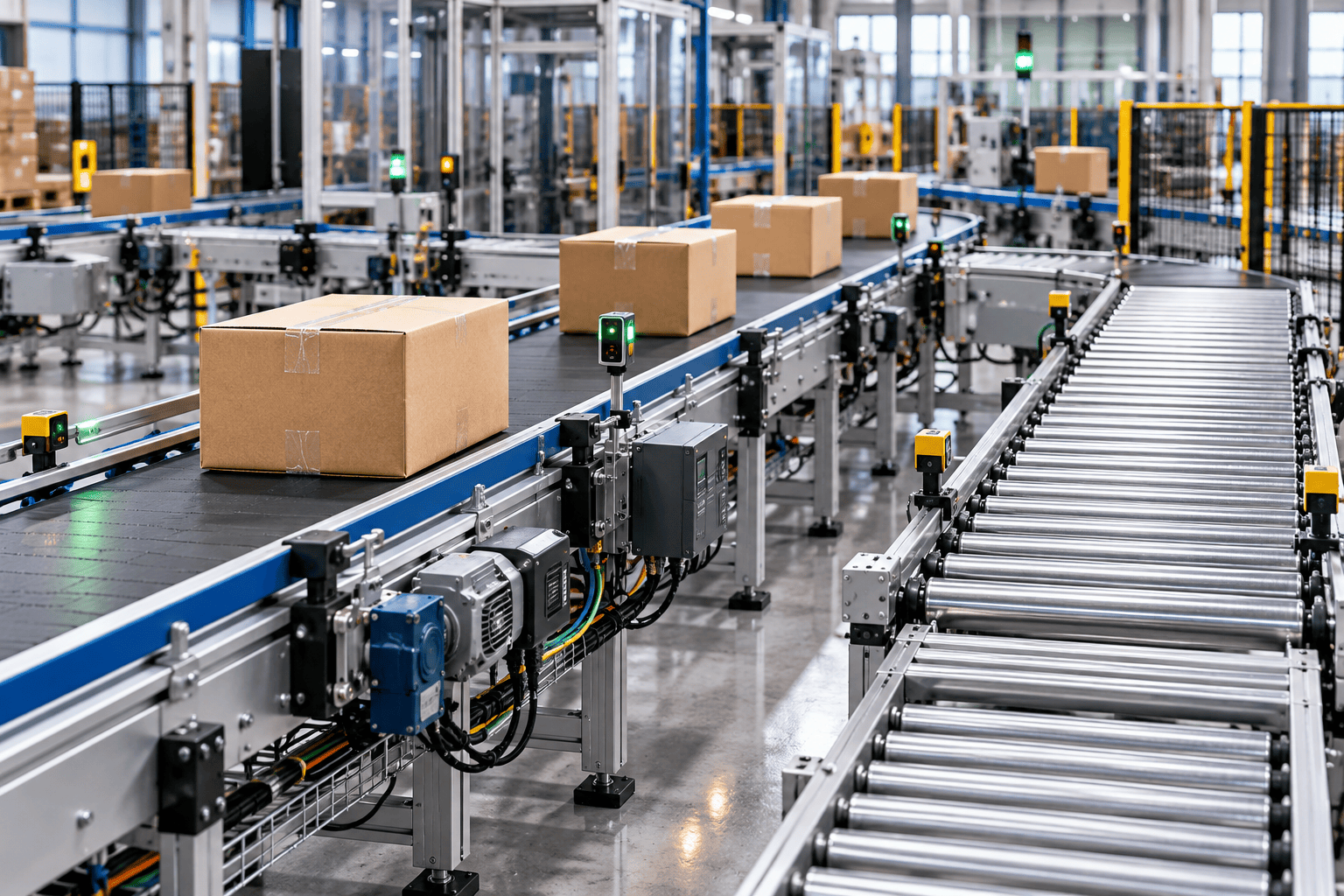
At 1:12 p.m., the packaging line is quiet for lunch. The case packer has stopped, no cartons are entering the dispatch lane and the operators have stepped away. Yet the belt conveyor is still running, two powered roller sections are still turning and the drive fan continues to hum inside the panel.
Nothing looks broken. That is exactly why nobody reacts.
At the end of the month, the electricity bill is higher than expected. Production blames the additional shift. Maintenance points to older motors. Management asks whether the complete conveyor line needs replacement. The simplest part of the answer is discovered during a ten-minute observation: for long periods, the conveyor is moving no product at all.
| SHOP-FLOOR OBSERVATION The conveyor was not moving product. It was still moving electricity. |
This is an illustrative plant-floor composite, not a claimed Convello customer incident. It reflects a common operating pattern: energy loss is often hidden inside normal-looking behaviour. A conveyor may start every morning, move products reliably and still consume more energy than the process requires.
Energy efficiency is therefore not a single motor specification. It is the combined result of mechanical design, product flow, control logic, maintenance condition, operating discipline and measurement. The objective is not to make the conveyor consume the least possible power at any cost. The objective is to use the least practical energy while maintaining safe, stable and required throughput.
What Makes a Conveyor System Energy-Efficient?
An energy-efficient conveyor system converts electrical input into useful product movement with as little avoidable loss as possible. That sounds simple, but the system boundary is wider than the motor. It may include the VFD or motor controller, gearbox, chain or belt transmission, bearings, rollers, conveyor belt, sensors, PLC, pneumatic devices, cooling fans, lighting and upstream or downstream equipment that causes the conveyor to wait.
A good design answers five practical questions:
- How much material must be moved, over what distance and elevation?
- What power and torque are genuinely required during starting, normal running and the worst accepted load?
- When should the conveyor run, slow down, sleep or stop?
- Where is energy being lost through friction, poor alignment, unnecessary pressure or repeated recovery?
- Which performance indicator will prove that the change saved energy without reducing production?
Convello’s current belt-conveyor information describes variable-speed support, anti-friction idlers and optimized motorized drives, while its roller-conveyor information describes gravity, powered and accumulation configurations with energy-efficient operation. These options become meaningful only when they are selected around the actual product, route, load, throughput and control philosophy—not added as isolated features.
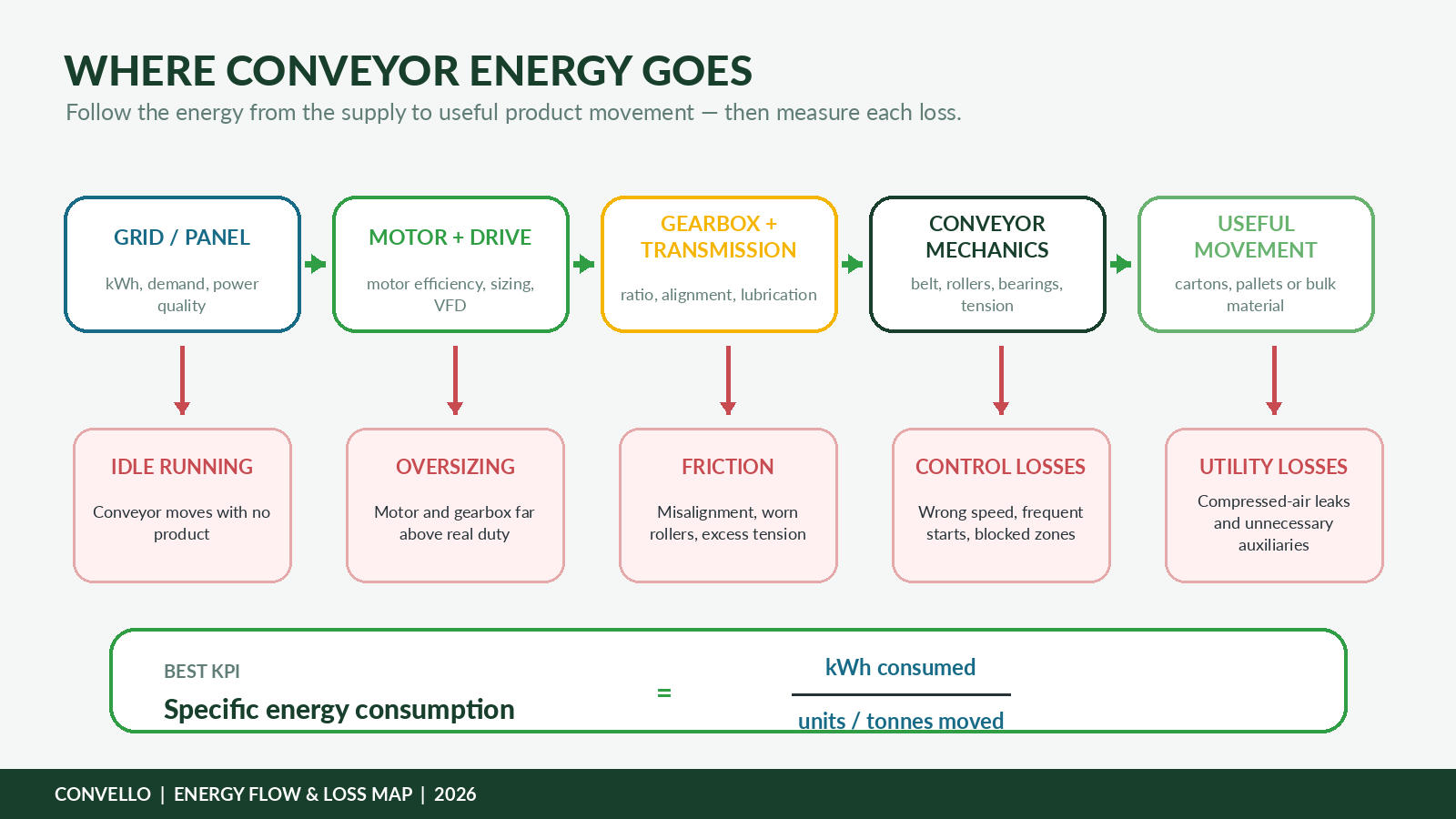
Figure 1. Conveyor energy should be traced from the incoming electrical supply to useful product movement, with losses measured rather than guessed.
Do Not Judge Energy Use from the Motor Nameplate Alone
A 7.5 kW motor does not automatically consume 7.5 kW at every moment. The nameplate states rated capability under defined conditions; actual electrical input changes with load, speed, efficiency, power factor and control method. Current alone also does not provide the full answer. A meaningful assessment should measure real power in kW and energy in kWh, then relate those readings to production output.
| CORE CALCULATION Annual conveyor energy cost = measured average kW × operating hours × actual electricity tariff |
For comparisons between shifts, conveyors or improvement trials, a specific-energy indicator is more useful than total kWh:
| PERFORMANCE INDICATOR Specific energy consumption = kWh consumed ÷ cartons, pallets, tonnes or tonne-kilometres moved |
The denominator must match the process. A parcel line may track kWh per 1,000 cartons. A pallet system may use kWh per 100 pallets. A bulk conveyor may use kWh per tonne or tonne-kilometre. Compare like-for-like periods with similar product mix, route, elevation and production conditions.
Real-World Project: ABB and Vigier Cement’s Downhill Limestone Conveyors
A useful real-world example comes from a public ABB case note for Vigier Cement in Switzerland. This is an external industry project—not a Convello installation—and its scale is much larger than a typical factory or warehouse conveyor. The value of the example is the engineering principle it demonstrates.
Vigier Cement used a two-conveyor system to transport limestone over a 2,642-metre downhill route from a crusher to the cement plant. The first 242 metres used a tubular belt conveyor; the second section ran for approximately 2,400 metres through a service and transport tunnel. The two conveyors used five 160 kW motors with ABB industrial drives connected to a common DC bus arrangement.
Because the route was downhill, the system could operate regeneratively. ABB reported that braking energy from the conveyors was returned to the mains through an energy-recovery unit. In less than two years, the project generated 521,200 kWh back into the plant electrical system. The drives also provided smooth speed and torque control during starts, stops and changing loads, helping avoid belt stretching, slipping or breaking.
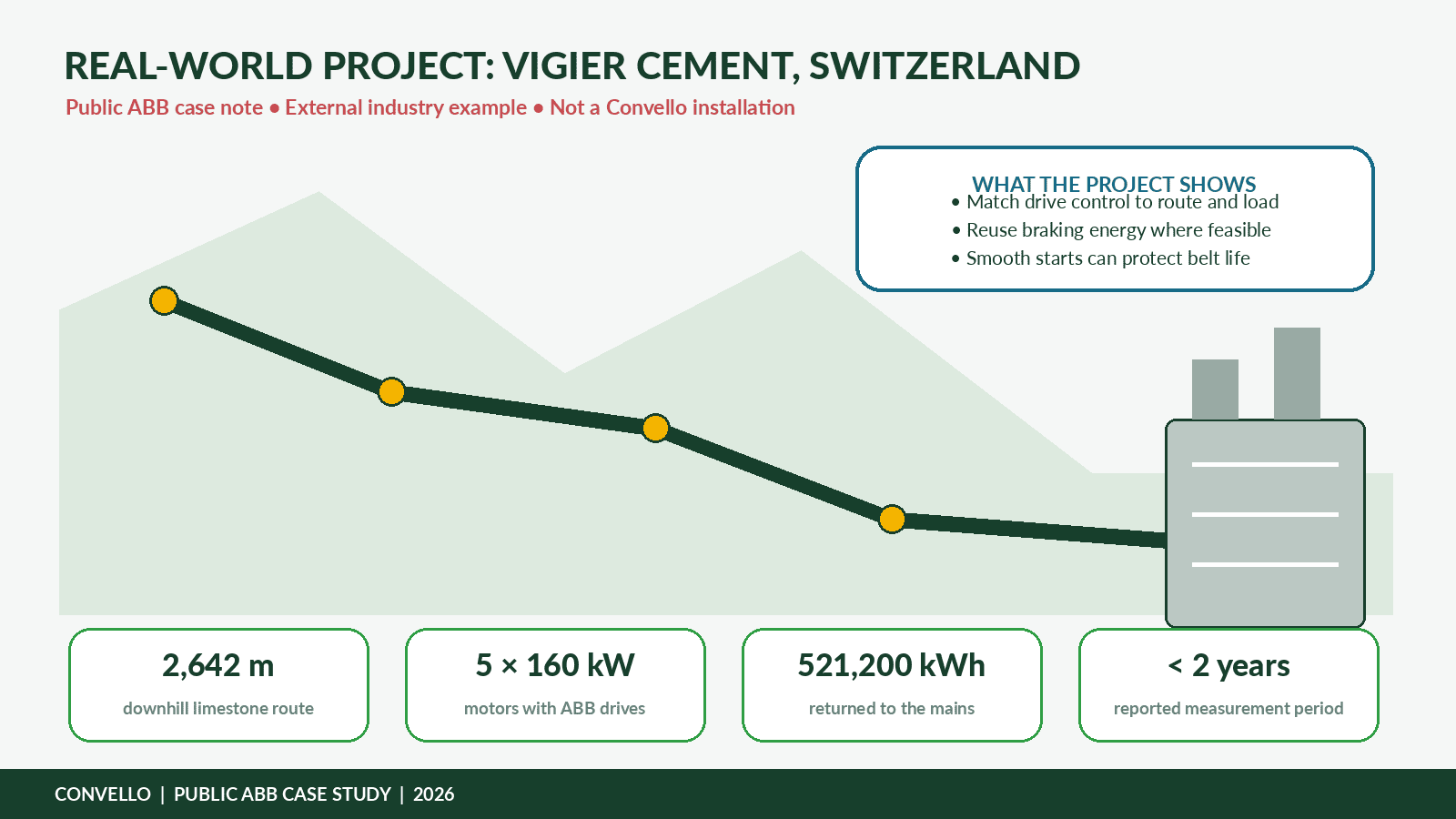
Figure 2. ABB’s public Vigier Cement case note reported more than 521,000 kWh returned to the mains in less than two years.
What a Factory or Warehouse Project Should Learn
- Optimize the complete system, not only the motor. Route, load direction, drives, mechanical resistance and controls interact.
- Energy can flow in both directions. Downhill or decelerating applications may justify regenerative engineering, but only after technical and commercial validation.
- Smooth control can protect assets as well as save energy. Reduced shock can lower belt stress, product instability and mechanical wear.
- Measure the result. The strongest part of the case is not the presence of drives; it is the reported kWh returned to the mains.
- Do not copy a large-project solution blindly. A short packaging conveyor may gain more from auto-stop logic and maintenance than from regenerative hardware.
Case-study source: ABB — “Substantial energy savings and prolonged lifetime of conveyor belts at Vigier Cement” — public two-page case note; figures above are attributed to ABB.
Twelve Practical Ways to Reduce Conveyor Power Consumption
1. Stop empty running
The easiest energy to save is often the energy used while nothing is being conveyed. Use blocked, starved and product-present logic to stop or sleep sections after a verified delay. Restart behaviour must be predictable and safe, especially where people can access the route.
2. Match conveyor speed to real process demand
Running at maximum speed and then accumulating product may create more starts, impacts and backpressure. A VFD or suitable motor controller can match speed to the real flow when the process allows it. Speed changes must be validated at transfers, scanners, inclines and manual stations.
3. Use zoned operation for unit-load conveyors
In a long roller conveyor, every section does not always need to run. Motorized rollers or controlled zones can operate only where products are present. This is particularly useful for accumulation, merge and dispatch lines with intermittent flow.
4. Right-size the motor and gearbox
Large safety factors can create a drive package that operates far from the intended duty. Correct sizing should consider starting torque, incline, load distribution, duty cycle, environmental conditions and future change—but “bigger” is not automatically safer or more efficient.
5. Reduce belt and roller resistance
Worn rollers, contaminated bearings, seized idlers, poor belt construction or excessive slider-bed contact convert electrical energy into heat. A recent literature review on belt-conveyor energy saving highlights low-friction belts, correct construction parameters, monitoring and maintenance as important measures.
6. Correct tracking, alignment and tension
A belt rubbing against the frame, a misaligned pulley or unnecessary tension increases drag and wear. Operators sometimes respond to slip by adding tension repeatedly, while the actual cause may be contamination, poor wrap, incorrect drive selection or mechanical resistance.
7. Improve loading and transfer points
Products that strike guides, skid, rotate or jam force the system to recover repeatedly. Bulk material loaded off-centre can increase belt mistracking and resistance. Good transfer design keeps the load supported, aligned and moving at a controlled relative speed.
8. Maintain bearings, chains, gearboxes and lubrication
Energy loss frequently appears before breakdown as heat, noise, vibration or rising motor current. Preventive maintenance protects both reliability and efficiency. The goal is not to lubricate everything more; it is to use the correct lubricant, quantity and interval for the actual component.
9. Reduce unnecessary accumulation pressure
Minimum-pressure or uncontrolled accumulation can make products push against one another and increase drive load. Where product value, surface or line behaviour justifies it, zero-pressure accumulation can separate zones and reduce continuous contact.
10. Recover energy where the duty makes it feasible
Long downhill bulk conveyors, lowering applications or frequently decelerating loads may have regenerative potential. The electrical network, drive topology, duty cycle and commercial payback must be engineered. This is not a default feature for every conveyor.
11. Measure each significant conveyor separately
A single plant electricity bill cannot reveal whether the packaging line, compressor or HVAC system caused the increase. Sub-meter significant conveyor groups or use temporary power analyzers during audits. Record production, operating state and kWh together.
12. Track kWh per unit moved
Total energy may increase when production increases and still represent an improvement. Specific energy consumption shows whether each carton, pallet or tonne required more or less energy. It also prevents “savings” created by simply reducing output.
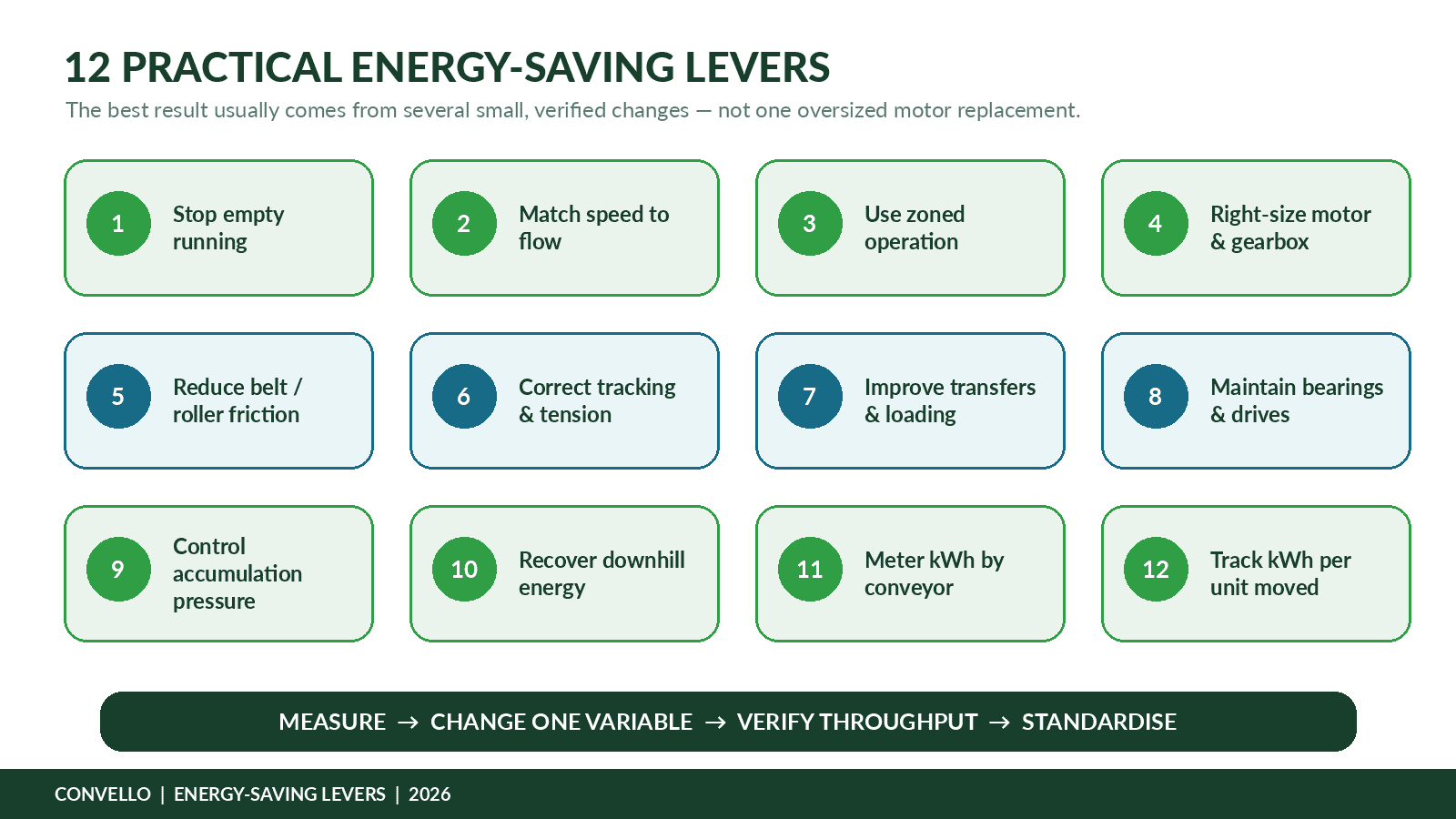
Figure 3. Energy reduction usually comes from a verified combination of controls, sizing, low resistance, maintenance and measurement.
Energy Strategy by Conveyor Type
| Conveyor type | Common energy losses | Practical improvement direction |
| Belt conveyor | Idle running, excessive tension, belt or slider friction, poor tracking, wrong speed | VFD where process-compatible; auto-stop; low-resistance components; tracking and tension control; correct belt and support design |
| Powered roller / MDR | All zones running continuously, accumulation pressure, seized rollers | Product-present zones; sleep logic; zero-pressure control; roller condition checks; efficient transfer design |
| Gravity roller | Excessive slope creates impacts; poor rollers increase manual force | Correct gradient; low-friction rollers; controlled braking; powered assist only where necessary |
| Slat or chain conveyor | Chain friction, poor lubrication, tight curves, high backpressure | Correct chain and wear-strip selection; lubrication discipline; route optimization; controlled accumulation |
| Screw conveyor | Overfilling, material buildup, wrong speed, worn flights, incline losses | Match speed and fill; control feed rate; maintain clearances; select geometry for real bulk material |
| Pallet conveyor | Heavy starts, unnecessary full-line running, transfer losses | Zoned controls; soft start or VFD; load detection; efficient roller/chain support; buffer logic |
| Incline / spiral | Elevation work, product slip, incorrect speed and transfer losses | Optimize route; surface grip; speed; product stability; evaluate regenerative potential on descending duties |
A Practical Conveyor Energy Audit
An energy audit should begin with observation, not a shopping list. Walk the conveyor during startup, full production, a downstream stoppage, a product change and a quiet period. Speak with the operator who resets it, the electrician who sees the current trend and the technician who knows which roller becomes hot after four hours.
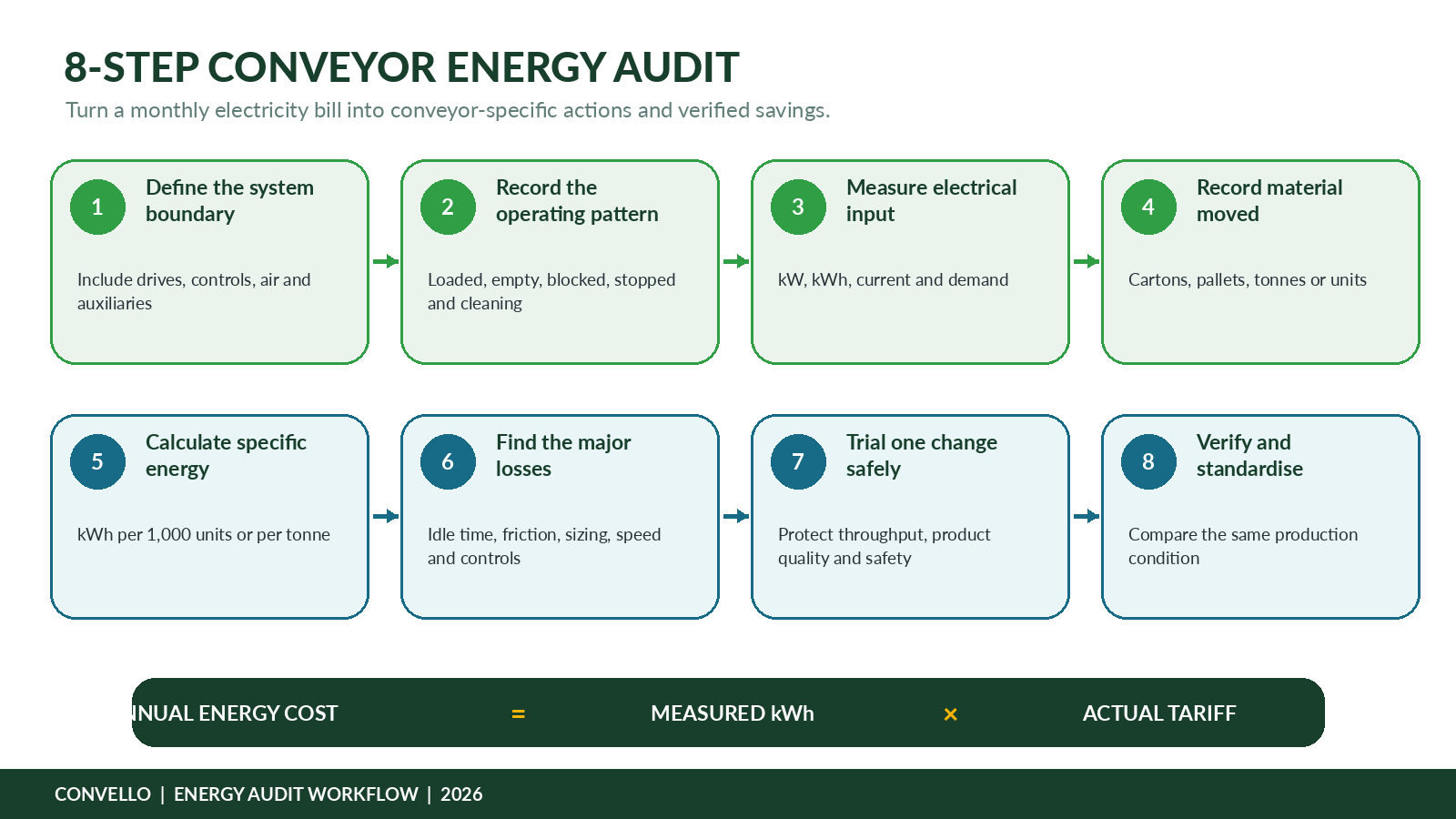
Figure 4. A conveyor energy audit connects electrical measurement with actual material movement and operating states.
Step 1: Define the System Boundary
List every energy user that belongs to the conveyor function: motors, drives, control panels, sensors, pneumatic devices, local exhaust, belt cleaners, heating or cooling, lifts and associated transfer modules. Decide whether upstream and downstream machines are inside or outside the comparison.
Step 2: Record the Operating Pattern
Divide the shift into loaded running, empty running, blocked, starved, standby, cleaning, changeover and maintenance. A line may have good motor efficiency but poor operating efficiency because it spends hours enabled without moving saleable product.
Step 3: Measure Electrical Input
Use a suitable power meter or analyzer and qualified personnel. Record kW, kWh, current, voltage, power factor and demand as appropriate. Do not open panels or attach instruments without the required electrical safety procedure and competence.
Step 4: Record Material Moved
Use cartons, pallets, kilograms, tonnes or another operational unit. Include the product mix and rejected or recirculated loads when they materially affect the duty.
Step 5: Calculate the Baseline
Calculate energy per operating hour and specific energy per unit moved. Note ambient conditions, route, elevation, speed and production schedule so the baseline can be repeated.
Step 6: Identify the Largest Verified Losses
Prioritize measured empty-running time, abnormal heat, high friction, load imbalance, oversizing, compressed-air losses and poor control logic. Avoid changing five variables at once, because the team will not know which change created the result.
Step 7: Trial the Change Safely
Run a controlled trial with the same product and comparable volume. Confirm that the change does not introduce jams, unstable accumulation, poor scans, unsafe restart, product damage or reduced quality.
Step 8: Verify and Standardize
Compare measured kWh and output against the baseline. Update PLC settings, operating instructions, maintenance tasks and training. Continue monitoring so savings do not disappear when sensors are bypassed or speed settings are changed later.
Illustrative Indian Packaging-Line Project Calculation
The following project-style scenario is illustrative, not a Convello customer claim or a market benchmark. It shows how a factory can convert measurements into a business case.
A packaging plant operates three connected conveyor sections around a checkweigher, labeller and case packer. Operators report that the conveyors remain running during short stops because restarting each section manually is inconvenient. Maintenance also finds two rough rollers and minor belt rubbing at one guard.
| Measure | Before improvement | After controlled improvement |
| Measured average power while enabled | 12.0 kW | 8.2 kW |
| Scheduled enabled time | 16 hours/day × 300 days | Same production schedule |
| Annual energy use | 57,600 kWh | 39,360 kWh |
| Annual production | 3.6 million cartons | 3.6 million cartons |
| Specific energy | 16.0 kWh per 1,000 cartons | 10.9 kWh per 1,000 cartons |
| Illustrative electricity tariff | ₹9.50 per kWh | ₹9.50 per kWh |
| Annual electricity cost | ₹5,47,200 | ₹3,73,920 |
The controlled improvement package includes:
- product-present and blocked/starved logic with a safe 90-second sleep delay;
- VFD speed reduction during the low-demand production window;
- replacement of the rough rollers and correction of the rubbing point;
- a defined restart sequence and operator indication before movement;
- sub-metering and a monthly kWh-per-1,000-cartons review.
| ILLUSTRATIVE BUSINESS CASE Illustrative annual saving: 18,240 kWh and ₹1,73,280. If the installed improvement cost is ₹3,00,000, simple payback is approximately 1.73 years. |
The apparent energy reduction is about 31.7%, but that percentage is not transferable to another plant. A different conveyor length, motor size, operating schedule, product mix, tariff or baseline condition will produce a different result. The important method is to compare the same production requirement before and after the change.
The Human Part of Energy Efficiency
A technically efficient conveyor can lose its savings within weeks when the operating reality is ignored. A sensor may be bypassed because it causes nuisance trips. An auto-stop delay may be increased because operators are not warned before restart. A VFD may be left at maximum speed because nobody owns the recipe. A worn roller may remain in service because it has not failed completely.
During the audit, ask the people who use the line:
- When do you leave the conveyor running even though product has stopped?
- Which automatic function do you override, and what problem are you trying to avoid?
- Where does the line hesitate, jam or require a manual nudge?
- Which part becomes noisy, hot or difficult to clean later in the shift?
- What must happen before the conveyor can stop or restart without disrupting your work?
| HUMAN-CENTRED PRINCIPLE The most efficient conveyor is not the one that stops most often. It is the one that stops safely when it is not needed and restarts predictably before it becomes the bottleneck. |
Motor, Drive and Control Decisions That Need Engineering
High-efficiency motors, VFDs and decentralized drives can support lower energy use, but they are not plug-and-play savings guarantees. The design team should verify:
- required starting and running torque across the complete load range;
- motor and gearbox efficiency at the expected operating point;
- duty cycle, starts per hour, braking and thermal conditions;
- minimum stable speed for product movement and cooling;
- harmonics, electrical protection, earthing and cable requirements;
- safe-stop, emergency-stop and restart behaviour;
- whether regenerative energy can be reused, returned or must be dissipated;
- how controls respond to blocked, starved, faulted and manual modes.
Interroll’s current RollerDrive EC5000 information is one example of an integrated drive concept intended for unit-handling conveyors, including straight sections, small belt conveyors and zero-pressure accumulation. The broader lesson is not that one drive type fits every project; it is that decentralized, zone-based drive architecture can align motor operation with product presence when the application is suitable.
When Should You Retrofit, and When Should You Replace?
| Decision path | Typical conditions |
| Retrofit is often sensible when | The structure is sound; product range is stable; major losses come from controls, drives, rollers, bearings, tracking or operating logic; spare parts remain available. |
| Replacement may be stronger when | The frame or route is unsuitable; capacity is inadequate; old controls are obsolete; guarding or access is fundamentally poor; several energy and reliability problems share the same root cause. |
| A hybrid approach can work when | Efficient sections are retained while bottleneck transfers, drives, accumulation zones or control panels are replaced. |
Evaluate lifecycle cost, planned shutdown, commissioning risk, spare support and future expansion—not only the purchase price. An energy retrofit that creates repeated production interruptions will not deliver a credible business result.
Ten-Step Implementation Roadmap
- Define the product, route, throughput and operating schedule.
- Create an energy boundary for the conveyor and its auxiliaries.
- Measure a repeatable baseline under representative production.
- Calculate specific energy consumption and identify empty-running time.
- Inspect mechanical resistance, loading, transfers, tracking and maintenance condition.
- Review motor, gearbox, drive and control sizing against actual duty.
- Prioritize low-risk measures such as repairs, logic changes and operating standards.
- Trial one controlled change and verify throughput, quality and safety.
- Build the commercial case using measured kWh, actual tariff, maintenance and downtime.
- Standardize the settings, train operators and monitor the energy-performance indicator.
Information to Share When Requesting an Energy-Efficient Conveyor Quote
| Requirement area | Information to provide |
| Product or material | Dimensions, weight, underside or bulk properties, temperature, contamination and accepted variation |
| Material flow | Average, sustained peak and short-burst throughput; batch or continuous duty |
| Route | Length, width, elevation, incline/decline, curves, transfer points and available space |
| Operating schedule | Hours per day, days per year, starts per hour, cleaning and changeover time |
| Existing electrical data | Motor ratings, drives, power supply, measured kW/kWh if available, tariff and demand charges |
| Current problems | Empty running, high heat, noise, tracking, jams, pressure, product damage or frequent resets |
| Control requirement | PLC, sensors, blocked/starved logic, zone control, recipes, remote monitoring and interfaces |
| Safety and environment | Access, guarding, emergency stops, hazardous area, washdown, dust and ambient temperature |
| Commercial goal | Energy target, production target, payback requirement, shutdown window and future expansion |
Photos, a layout drawing, a short process video, a recent electricity bill and temporary power-logging data can significantly improve the quality of the first technical discussion.
Common Mistakes That Make Energy Projects Disappointing
- Replacing a motor before measuring the real duty and mechanical resistance.
- Using current readings as a substitute for measured real power and energy.
- Claiming savings from lower production or shorter operating hours.
- Installing a VFD but leaving it permanently at maximum speed.
- Stopping conveyors automatically without designing a safe, predictable restart.
- Ignoring transfer jams, product pressure and rework that increase operating time.
- Tightening belts or chains repeatedly instead of diagnosing slip and drag.
- Comparing total kWh without normalizing for cartons, pallets, tonnes or distance.
- Copying a regenerative solution into an application that has no meaningful generating duty.
- Failing to involve operators and maintenance teams before settings are standardized.
Frequently Asked Questions
1. What is an energy-efficient conveyor system?
It is a conveyor designed and operated to deliver the required material flow with minimal avoidable electrical and mechanical loss. It combines suitable sizing, low resistance, controls, maintenance and measurement.
2. Do VFDs always reduce conveyor energy consumption?
No. A VFD can reduce energy when speed genuinely matches a variable process demand, improve starting or enable better control. If the conveyor must run at full speed continuously, savings may come from other areas.
3. How can I calculate conveyor electricity cost?
Measure average real power in kW, multiply by actual operating hours and then by the electricity tariff. Include demand charges or other billing components where relevant.
4. What is the best KPI for conveyor energy efficiency?
Use a specific energy indicator such as kWh per 1,000 cartons, kWh per pallet, kWh per tonne or kWh per tonne-kilometre, depending on the application.
5. Can an oversized motor waste energy?
It can operate away from its best efficiency point and may increase capital cost, but the complete motor, gearbox, drive and duty must be assessed. Do not downsize without verifying starting torque, load variation and safety margin.
6. How does preventive maintenance save energy?
Correct tracking, free-running rollers, healthy bearings, proper lubrication and clean drive components reduce motion resistance. Maintenance also prevents small losses from becoming failures.
7. Is a roller conveyor more energy-efficient than a belt conveyor?
Not universally. Gravity rollers use no drive energy, and zoned powered rollers can run on demand. Belt conveyors provide continuous support for products that rollers cannot handle. The correct comparison is application-specific.
8. What is regenerative conveyor braking?
A regenerative drive converts mechanical energy from a driven load—such as a downhill conveyor—into electrical energy that can be reused or returned to the supply, subject to the engineered drive and network arrangement.
9. How much energy can a conveyor retrofit save?
There is no universal percentage. Savings depend on baseline condition, idle time, load, route, friction, controls, tariff and operating schedule. Measure before and after under comparable production.
10. Should conveyors stop every time product flow stops?
Not automatically. The delay should consider process stability, restart frequency, downstream demand, safety and motor duty. A well-designed sleep strategy prevents empty running without creating a new bottleneck.
11. Can energy monitoring integrate with a PLC or dashboard?
Yes. Power meters, drives and motor controllers can provide data to PLC, SCADA, MES or energy-management systems. The project should define sampling, data ownership, alarms and the required performance indicator.
12. What should be tested during commissioning?
Test power under no-load and representative load, operating states, start/stop sequences, blocked and starved conditions, product transfers, emergency and fault recovery, throughput and specific energy consumption.
Reduce Energy Without Turning the Conveyor Into the New Bottleneck
The strongest energy project begins with a simple discipline: observe the real operation, measure the electrical input, relate it to useful material movement and change one verified cause at a time. A conveyor that runs less but causes queues is not efficient. A conveyor that uses a premium motor while rubbing against its frame is not efficient. A conveyor that saves kWh but creates an unsafe restart is not acceptable.
Convello can review the product, route, load, throughput, duty cycle, existing power data, controls and operating problems before recommending a belt, roller, pallet, screw, slat-chain or custom conveyor arrangement. Share a layout, representative product details, operating hours and any measured energy information to support a more accurate technical discussion.