+91 99980 88430 | +91 95589 17778
 info@convello.in | sales@convello.in

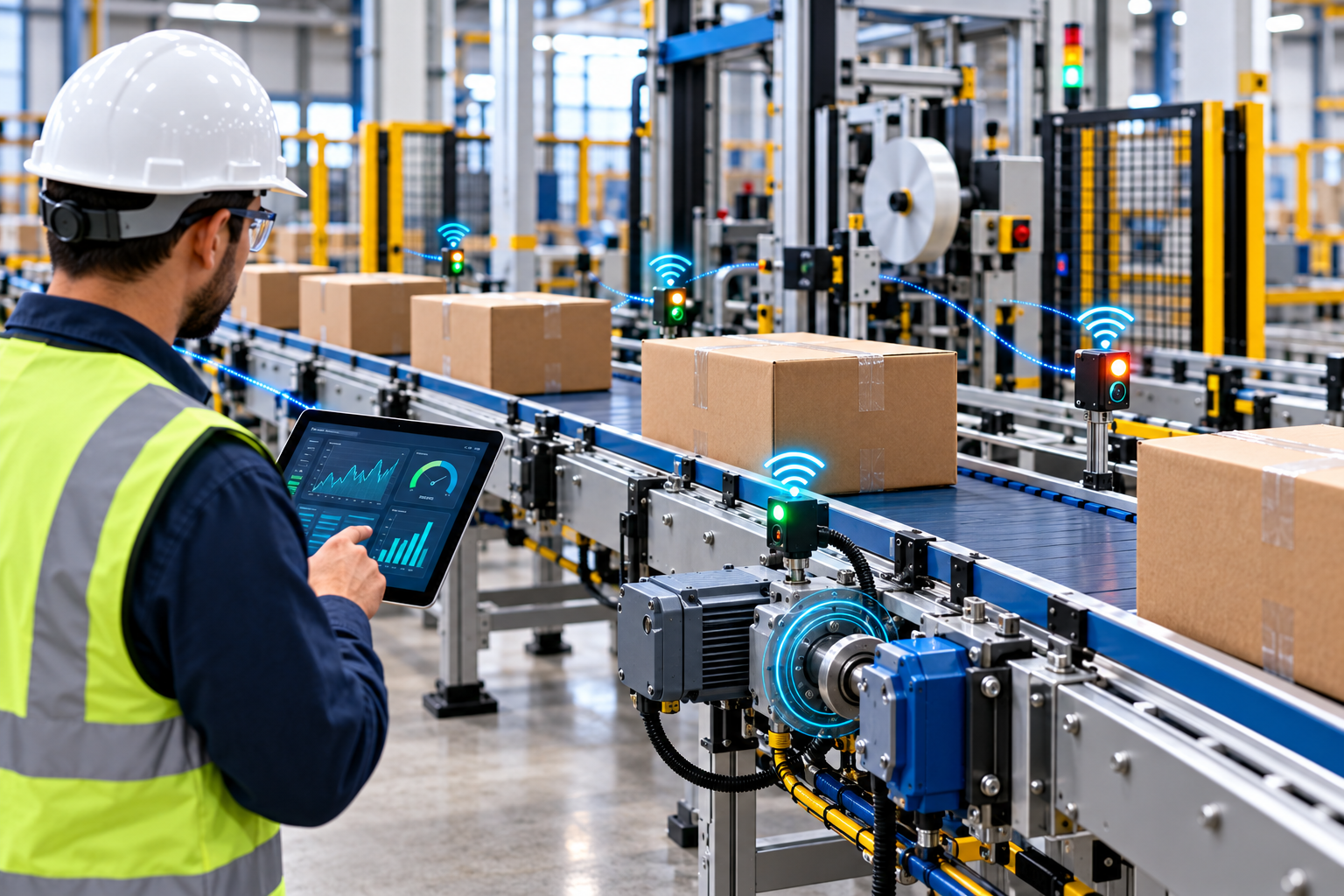
At 10:26 a.m., the packaging conveyor is still running. No alarm is active. The cartons are moving, the motor sounds normal to most people, and the production board shows that the line is on target.
One operator notices that cartons are beginning to arrive slightly skewed at the label applicator. A maintenance technician rests a hand near the drive-end guard and feels more heat than usual. The photo-eye at the next transfer has also been reset twice during the shift, but each event has been recorded as a sensor nuisance rather than a mechanical clue.
Two days later, a bearing tightens, motor current rises and the conveyor trips under load. Production loses forty minutes, cartons are moved into trolleys, and the team argues about whether the problem was electrical, mechanical or product-related.
| SHOP-FLOOR OBSERVATION The conveyor did not fail without warning. The warnings were isolated—in different people, different signals and different systems. |
This is an illustrative plant-floor composite, not a claimed Convello customer incident. It reflects a common reliability problem: useful evidence exists before failure, but nobody has connected the evidence to a shared maintenance decision.
A smart conveyor system is not simply a conveyor with more sensors. It is a conveyor in which mechanical condition, product flow, operating state and maintenance ownership are connected well enough for the team to act earlier and verify the result. That is the difference between collecting data and improving reliability.
What Is a Smart Conveyor System?
A smart conveyor system combines the physical conveyor with sensing, controls, data storage, analysis and a defined response process. Depending on the application, the system may include belt or roller equipment, motors and gearboxes, VFDs or motorized rollers, photo-eyes, vibration and temperature sensors, PLC logic, an HMI or SCADA screen, a historian, dashboards and a CMMS or EAM platform.
The useful definition is operational rather than technological. A conveyor becomes “smart” when it can help answer five questions reliably:
- What is the conveyor doing now—running, idle, blocked, starved, faulted or in manual recovery?
- Is the mechanical and electrical behaviour normal for the present load, speed, product and environment?
- Which change is significant enough to require inspection or planned intervention?
- Who owns the action, by when, and with what spare parts or shutdown window?
- Did the completed action return the conveyor to a verified healthy baseline?
NIST describes smart manufacturing as the real-time integration of operational technology and information technology. Applied to conveyors, that means the physical line, control system, maintenance records and production context should not operate as disconnected islands. Convello’s current conveyor information also positions systems for integration with PLCs, sensors, scanners, machines and workstations, with the interface and control philosophy defined during engineering.
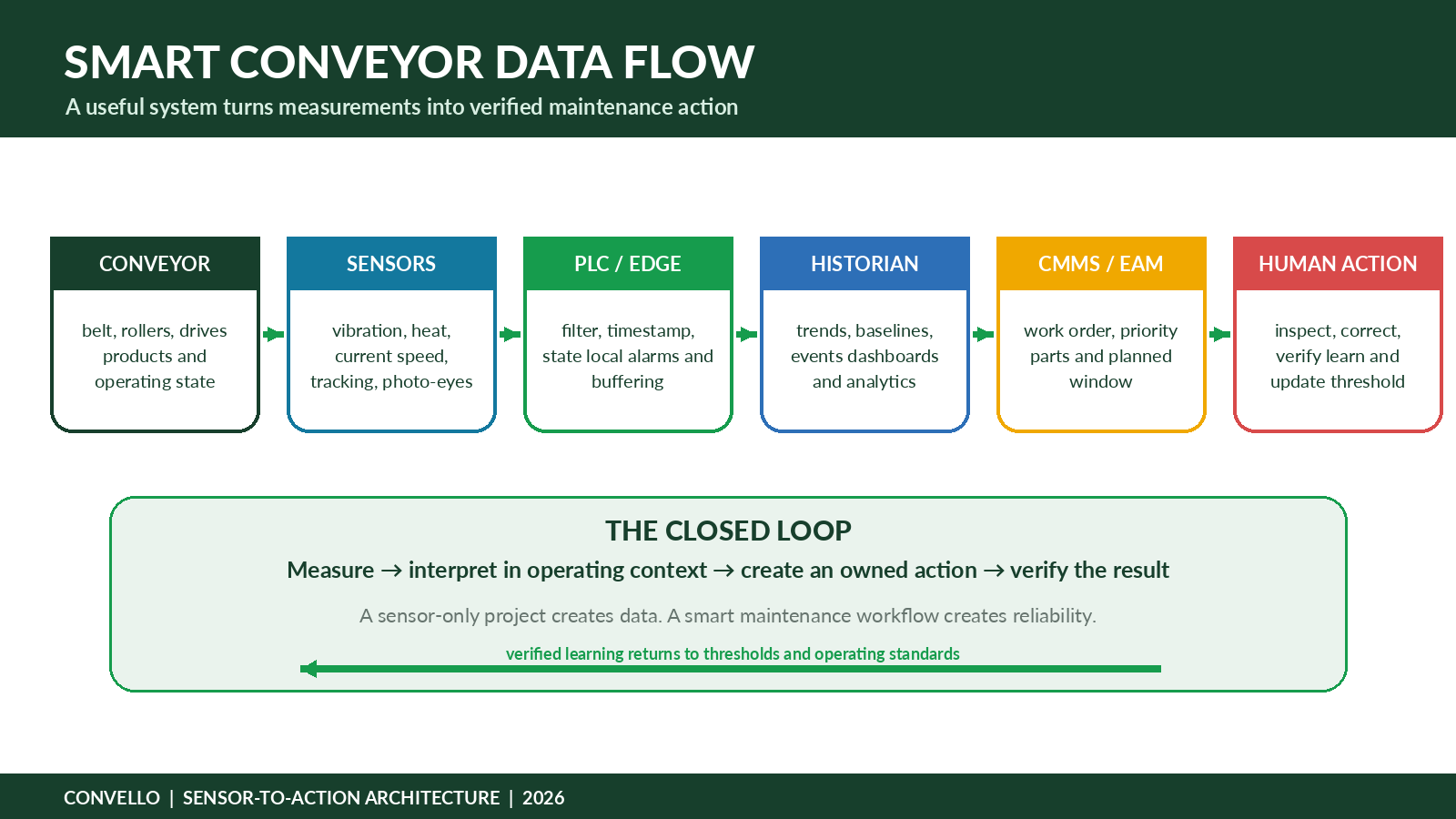
A smart conveyor requires a closed loop: measure, interpret in context, assign action, correct and verify.
Reactive, Preventive, Condition-Based and Predictive Maintenance
The words are often used interchangeably, but they describe different ways of deciding when work should be performed.
| Maintenance approach | Decision trigger | Practical implication |
| Reactive | Work begins after a failure or functional loss. | Simple, but the production consequence is usually uncontrolled. |
| Preventive | Work is scheduled by time, cycles or operating hours. | Useful for known wear tasks, but can be early or late for the actual condition. |
| Condition-based | Work is triggered when measured condition crosses a justified threshold or trend. | Requires reliable signals, baselines and action rules. |
| Predictive | Condition and operating data are used to estimate future deterioration or failure risk. | Can improve planning, but predictions still require engineering judgement and verification. |
A factory does not need to convert every maintenance task into predictive maintenance. Greasing a known bearing interval, replacing a low-cost wear strip during a shutdown and inspecting a mobile conveyor before each shift may remain sensible preventive tasks. Smart monitoring is most valuable where failure is costly, difficult to observe, safety-critical, recurrent or capable of damaging products and connected equipment.
Start with Failure Modes—not with a Sensor Catalogue
A common project mistake is to begin with a list of available devices: wireless vibration sensor, infrared temperature sensor, current transformer, cloud gateway and dashboard. The result may look modern while producing alerts that nobody trusts.
Begin instead with a short failure-mode question: “What can happen to this conveyor that matters to production, safety, product quality or cost—and what evidence normally changes before it happens?”
| Signal | Where it helps | Possible early clue | Context required |
| Vibration | Bearings, gearbox, structure, pulley or roller | Wear, looseness, imbalance, damage or resonance | Compare at similar speed and load; mounting quality matters. |
| Temperature | Motor, gearbox, bearings, brake or panel | Friction, lubrication loss, overload, cooling issue | Ambient temperature and recent operating state can change the reading. |
| Motor current / power | Drive motor or motorized zone | Drag, overload, jam, friction, mechanical resistance | A higher product load may be normal; record throughput and speed. |
| Speed / slip | Belt, shaft, roller or coupling | Belt slip, coupling problem, stalled section, drive mismatch | Compare commanded and actual speed during stable operation. |
| Tracking / position | Belt edge, pulley, idler and loading zone | Misalignment, uneven loading, structural shift, splice damage | Product entry and loading bias may be the root cause. |
| Photo-eye / flow events | Transfers, zones and destination lanes | Jam, skew, blocked lane, no-read, poor release sequence | Dirty lenses and packaging variation can create false events. |
| Zone status / run time | Powered roller and accumulation sections | Repeated cycling, stalled zone, blocked release, control issue | Look at downstream availability and release logic. |
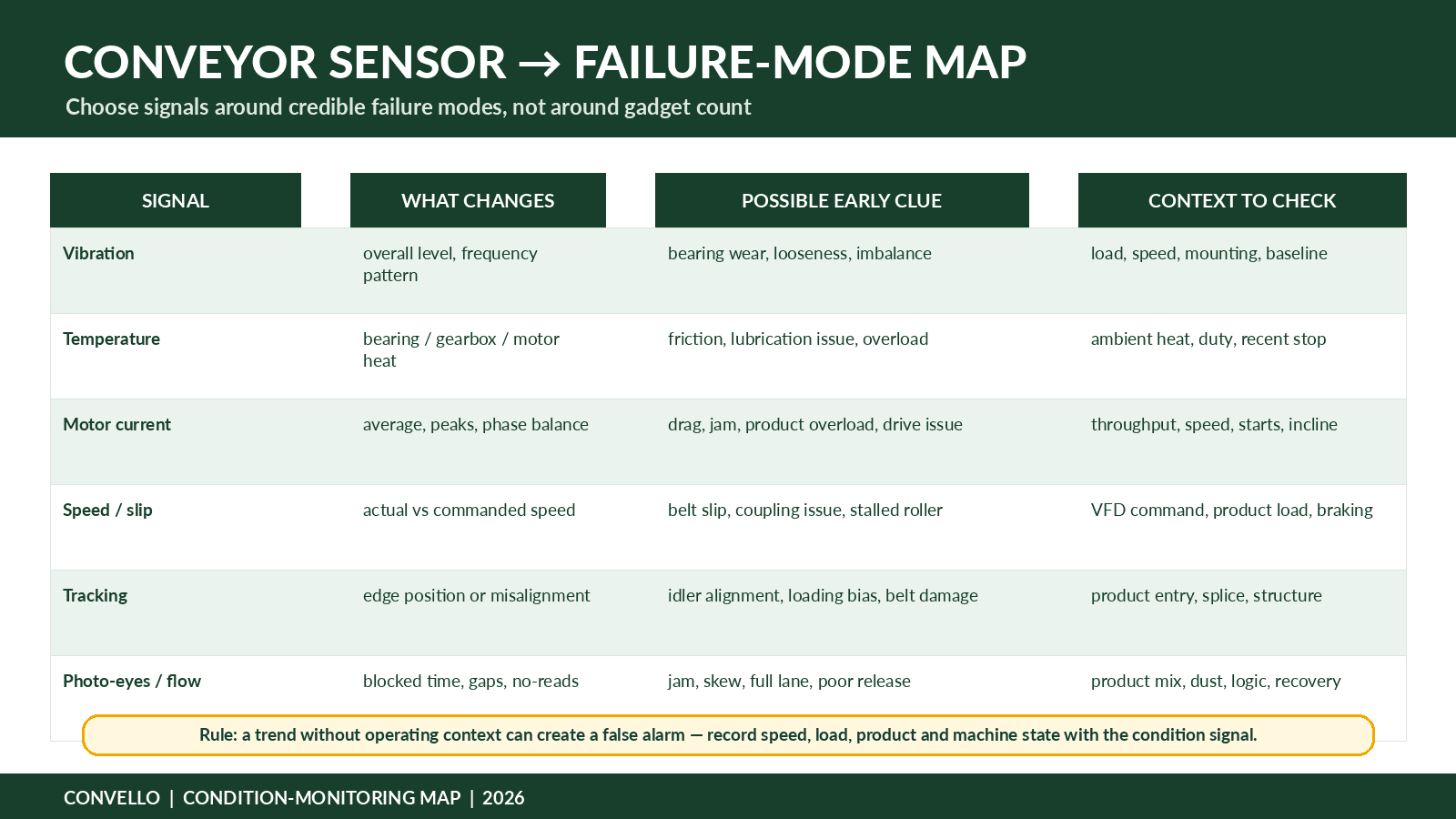
Select condition signals around credible failure modes and record the operating state that gives each reading meaning.
The Human Layer: An Alarm Is Not a Maintenance Strategy
The most sophisticated dashboard cannot decide who leaves the production meeting, inspects the drive, reserves a spare bearing and agrees on a maintenance window. Smart conveyor projects fail when the technology is installed but the human workflow remains undefined.
Every useful alarm should answer six questions:
- What changed, and how far did it move from the verified normal baseline?
- Was the conveyor in a comparable operating state—speed, load, product, direction and ambient condition?
- Is the alert advisory, urgent or safety-related?
- Who validates the signal and who owns the physical inspection?
- What action is expected if the condition is confirmed?
- How will the team verify that the corrective action fixed the condition?
Operators should also be part of the information flow. They often notice a new sound, a warmer guard, a recurring product skew or a change in how frequently they clear a transfer before a dashboard reaches a formal threshold. Their observations become more useful when they can be recorded against the correct conveyor zone, time and operating state.
| PRACTICAL RULE Do not train people to ignore an alarm. Improve the alarm until it reliably points to a decision that someone owns. |
Real-World Public Case Study: Bełchatów Mine Uses In-Situ Belt Diagnostics
A peer-reviewed 2025 case study describes how the Bełchatów lignite mine in Poland moved from belt-age and visual-inspection decisions toward in-situ sensor-based diagnostics. The DiagBelt+ system uses objective measurements of steel-cord belt condition and thickness so that refurbishment, continued operation and replacement decisions are based on the internal condition of the belt rather than external appearance alone.
The mine adopted the system for full-scale use in 2023. In the initial reported period, approximately 106.5 km of belt across more than 20 excavator-conveyor-stacker systems was scanned. The study reports that 62% of the scanned belts were considered suitable for continued operation, 22% were directed for refurbishment and 16% were scrapped. Diagnostic decisions extended the planned service life of 25.5 km of belt while identifying 6.1 km for earlier replacement because the measured condition was worse than visual assessment suggested.
The project also illustrates why “predictive” does not mean replacing maintenance expertise with an algorithm. In one described case, a belt that still looked acceptable externally showed a deterioration trend that was expected to cross the intervention threshold within weeks. The belt was removed for refurbishment before a sudden failure. In another case, diagnostics confirmed that the original planned refurbishment timing was appropriate. Good condition data can therefore change a decision—or validate it.
The study reports that moving from subjective visual assessment toward magnetic diagnostic evidence improved the refurbishment success rate from roughly 70% to above 90%. The broader lesson for factories and warehouses is not that every conveyor needs mine-scale scanning. It is that hidden condition should be measured where external observation cannot reliably show the failure risk.
Supporting Public Project: Boliden Connects Process and Bearing Data
A separate AVEVA success story describes a mission-critical Boliden conveyor that transports ore from the crusher to the concentrator. The operation had experienced shorter-than-expected bearing life. Traditional condition monitoring relied mainly on vibration data, which limited the team’s ability to understand why the bearings were behaving differently.
The project connected selected process data from the AVEVA PI System with SKF Observer condition-monitoring data and shared it securely with SKF specialists. Combining process and condition information exposed operating issues that were not visible in the narrower dataset. AVEVA reports that the approach improved understanding of conveyor performance, enabled earlier resolution of hidden issues and supported lower unplanned downtime and maintenance burden.
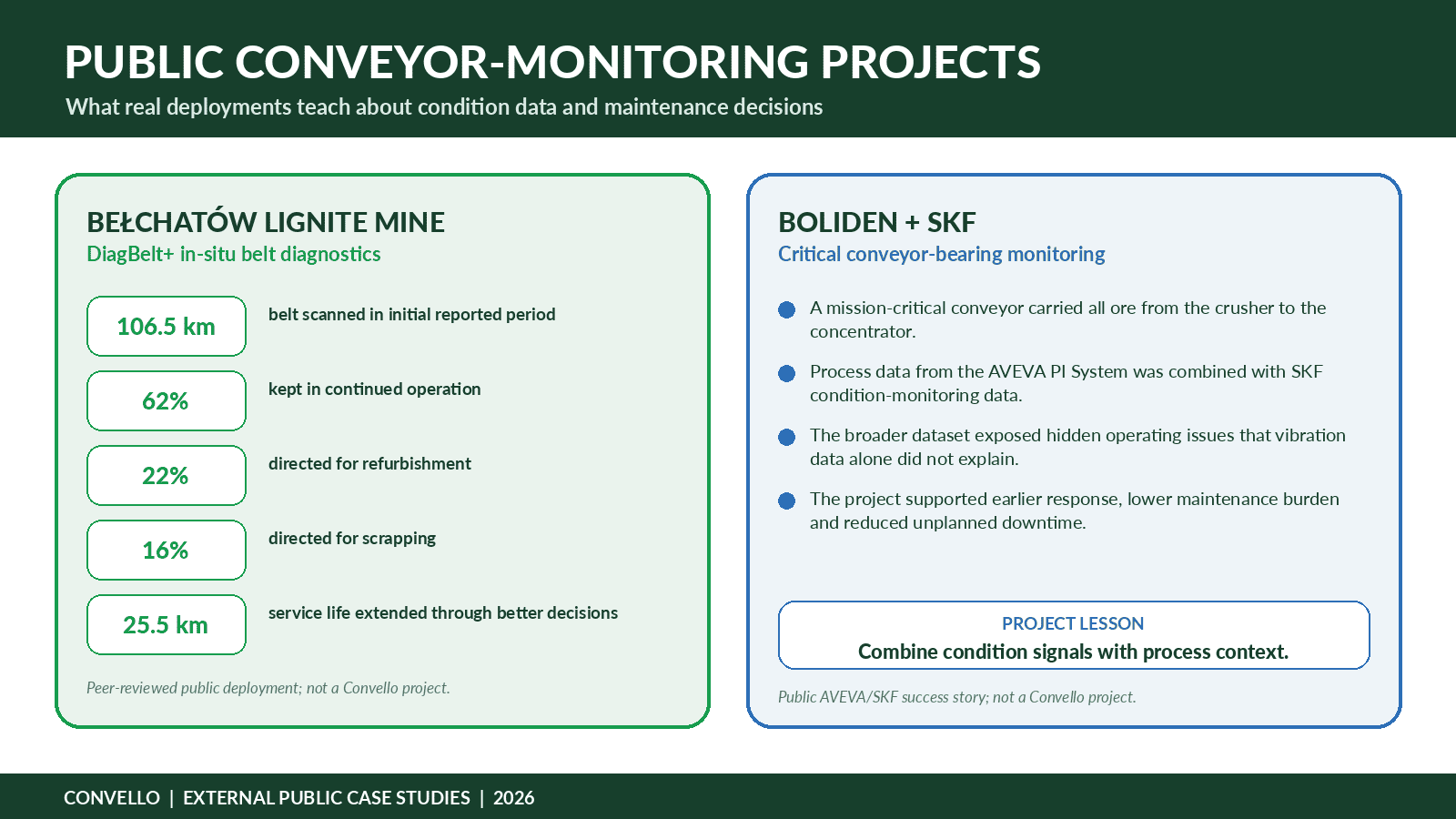
Public external projects show two complementary lessons: inspect hidden belt condition objectively and combine condition signals with process context.
Case-study transparency: Bełchatów and Boliden are external public projects based on the cited Sensors and AVEVA/SKF sources. They are not represented as Convello installations.
Illustrative Indian Project: A Packaging-to-Dispatch Conveyor Pilot
Consider an illustrative Indian factory with a 60-metre mixed belt-and-powered-roller line connecting final inspection, labelling, carton accumulation and dispatch. The line operates two shifts, six days per week. Three recurring symptoms are creating disruption: a drive-end bearing runs hotter than neighbouring bearings, cartons periodically skew at one transfer, and a photo-eye fault returns after cleaning and reset.
The maintenance team does not begin by installing dozens of devices. It selects one critical drive, one problematic transfer and one accumulation zone for a twelve-week pilot.
| Pilot phase | What the team does | Why it matters |
| Weeks 1-2: baseline | Record stop reasons, load, speed, product mix, motor current, bearing temperature and operator observations. | Define what normal looks like during real production. |
| Weeks 3-4: validate signals | Compare temperature and current trends with physical inspection; check transfer alignment and product entry. | Remove misleading signals and correct obvious mechanical faults. |
| Weeks 5-8: controlled alerts | Set persistence, rate-of-change and severity rules; create a named owner and response time. | Convert a measurement into a repeatable action. |
| Weeks 9-12: integrate and review | Open CMMS work orders, record inspection findings and verify the post-repair baseline. | Decide whether the pilot deserves wider rollout. |
The line has historically suffered six unplanned conveyor stops per month, averaging 38 minutes each. That is 228 minutes, or 3.8 hours, of monthly unplanned downtime. If the estimated lost contribution is ₹30,000 per hour, the illustrative exposure is ₹1,14,000 per month before overtime, damaged packaging and recovery disruption.
Assume the pilot and improved maintenance workflow prevent 40% of that downtime. The protected value would be approximately ₹45,600 per month, or ₹5,47,200 per year. If hardware, engineering, commissioning and training cost ₹4,80,000, simple payback would be roughly 10.5 months.
| IMPORTANT This is an illustrative calculation method—not a Convello quotation, market benchmark or guaranteed result. Actual value depends on verified downtime, production economics, fault detectability, false-alert rate and the team’s ability to act on the signal. |
Which Sensors Fit Different Conveyor Types?
| Conveyor type | Useful signals | Typical questions |
| Belt conveyor | Belt speed, slip, edge tracking, pulley or bearing vibration, temperature, motor current, zero-speed status | Tracking drift, belt slip, pulley/bearing deterioration, abnormal drag |
| Powered roller / MDR | Zone current, run time, roller status, photo-eye blockage, release timing, network faults | Stalled zones, failed rollers, repeated cycling, accumulation-control problems |
| Slat-chain / chain conveyor | Motor current, chain speed, tension indication, lubrication condition, sprocket/bearing vibration | Chain wear, tight spots, lubrication loss, misalignment |
| Screw conveyor | Motor current, speed, bearing temperature, inlet level, blockage or torque condition | Plugging, material overload, hanger-bearing problems, unexpected drag |
| Pallet conveyor | Drive current, pallet-present sensors, transfer timing, lift position, zone occupancy | Overload, skewed pallet, failed transfer, blocked accumulation |
| Telescopic / mobile conveyor | Extension position, tilt, speed, motor current, wheel or lock status, emergency circuit | Overextension, unstable setup, jam, cable or control issue |
The final selection must still consider the product, environment, washdown, dust, temperature, hazardous-area classification, data architecture and maintenance skill available at the site. A low-cost sensor that cannot survive the environment or cannot be mounted repeatably may produce more confusion than value.
Design Alerts That People Can Trust
Fixed high/low limits are only one type of alert. Smart conveyor monitoring may use several layers:
- Absolute threshold: temperature, current or vibration exceeds a maximum justified value.
- Deviation from baseline: the signal differs from the normal value for the same speed, load and product.
- Rate-of-change: the condition is deteriorating faster than expected even though the absolute limit has not been reached.
- Persistence: the condition must remain abnormal for a defined time to avoid reacting to brief transients.
- Sequence or state rule: a zone remains occupied after a release command, or actual speed does not follow the commanded state.
- Cross-signal rule: temperature and current rise together, or repeated photo-eye faults coincide with increasing drive load.
Debounce, deadband and delay logic should be engineered carefully. Too little filtering creates nuisance alarms. Too much filtering can hide a real condition. Alarm thresholds should also be reviewed after a product change, speed change, conveyor modification, bearing replacement or major maintenance event because the healthy baseline may have changed.
From Alert to Verified Work Order
| Step | Required outcome |
| 1. Detect | A signal or state changes beyond an agreed rule. |
| 2. Validate | Check sensor health, operating state and whether the event is repeatable. |
| 3. Classify | Decide advisory, planned maintenance, urgent maintenance or safe stop. |
| 4. Assign | Create a named owner, due time and work order with evidence. |
| 5. Plan | Reserve access, isolation, parts, tools and production window. |
| 6. Inspect | Confirm the physical condition and root cause. |
| 7. Correct | Repair, align, lubricate, replace, clean or update logic as appropriate. |
| 8. Verify | Compare the post-action trend with the healthy baseline. |
| 9. Learn | Update thresholds, failure modes, spare strategy and maintenance standard. |
A closed work order should record what was found—not merely that maintenance attended. Useful closeout includes the measured condition, physical finding, corrective action, replaced component, post-repair reading and whether the alert rule remained appropriate.
KPIs for a Smart Conveyor Pilot
| KPI | Question it should answer |
| Unplanned conveyor downtime | Did disruption reduce after the pilot? |
| Mean time between failures | Are meaningful failures becoming less frequent? |
| Mean time to repair | Did earlier evidence make repair faster and more prepared? |
| Planned vs emergency work | Is more work moving into controlled maintenance windows? |
| Recurring fault rate | Are the same alarms and work orders returning? |
| Alert precision | How many alerts produced a confirmed actionable finding? |
| Warning lead time | How much time existed between a reliable warning and functional loss? |
| Specific energy / motor current | Did corrected friction or drag reduce load without reducing throughput? |
| Maintenance closeout quality | Are findings and post-repair verification being documented? |
Avoid celebrating the number of sensors installed, the number of dashboards created or the volume of data stored. Those are project outputs, not reliability outcomes.
Cybersecurity, Data Ownership and Resilience
Connecting conveyors to plant networks and cloud services creates operational value, but it also expands the system boundary. The project team should define who can change thresholds, who can acknowledge alarms, how user access is managed, whether remote access is allowed, where data is stored and how local operation continues if the network or cloud connection is unavailable.
Safety functions should remain engineered in the appropriate safety-related control architecture. A predictive dashboard should not be treated as a substitute for guarding, emergency stops, interlocks, safe isolation or validated safe-stop behaviour.
When Smart Monitoring Is Not the Right First Investment
Condition monitoring may not be the first priority when:
- The process is unstable and the real bottleneck is unclear.
- Basic guarding, alignment, lubrication or housekeeping deficiencies remain unresolved.
- The conveyor is low criticality, easy to replace and has little operational consequence.
- Nobody owns alarm validation or maintenance action.
- Spare parts and shutdown planning are missing, so early warning cannot change the response.
- The product, speed or loading pattern changes too frequently for an uncontextualized signal to be meaningful.
- The team has not yet implemented a reliable defect log, reason code or preventive inspection routine.
In these situations, a disciplined preventive-maintenance programme and accurate downtime data may create more value than an immediate IoT project. Smart monitoring should build on good maintenance fundamentals, not distract from them.
A 10-Step Roadmap for Smart Conveyor Systems
- Select one critical conveyor or recurring failure—not the entire plant.
- Define the failure modes and business consequence in practical terms.
- Collect a healthy baseline under real speed, load, product and environmental conditions.
- Choose the minimum signals capable of detecting the defined failure modes.
- Design the data path, local resilience, storage and time synchronization.
- Set alert rules, severity, persistence, owner and required action.
- Connect confirmed alerts to CMMS or a controlled work-order process.
- Pilot through normal production, changeovers, stops, cleaning and recovery.
- Measure avoided downtime, false alerts, lead time and maintenance closeout quality.
- Scale only the sensor, control and workflow patterns that proved useful.
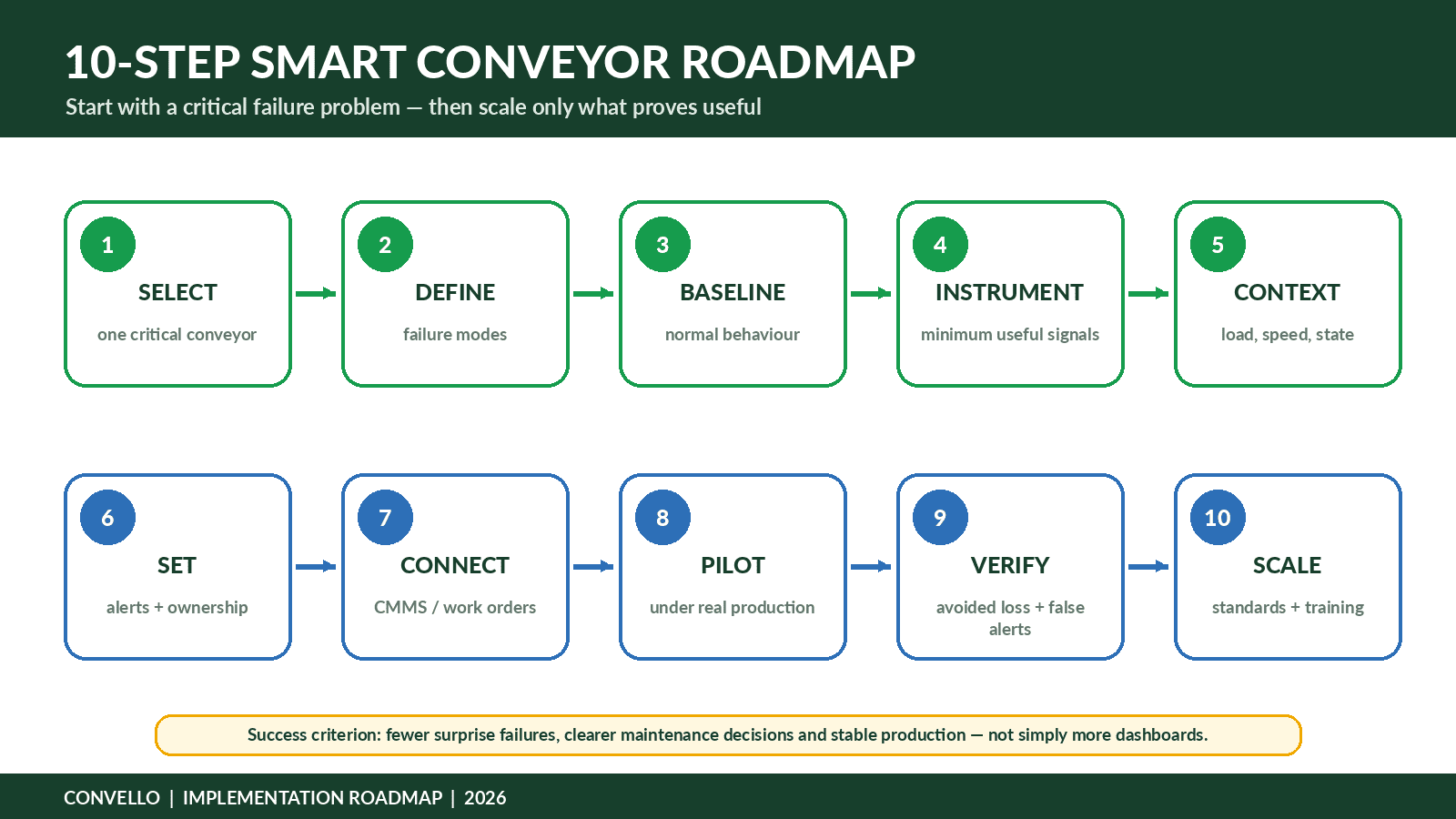
Start with a critical failure problem, prove the workflow under real production and scale only what produces reliable action.
Information to Share When Requesting a Smart Conveyor Proposal
| Requirement group | Details to provide |
| Process and product | Product dimensions, weight, underside, orientation, accepted packaging variation and throughput. |
| Conveyor details | Type, length, width, speed, drive arrangement, zones, transfers, incline and existing drawings. |
| Critical failures | Recurring stops, damaged components, alarm history, photos, videos and maintenance findings. |
| Operating context | Shifts, duty cycle, product mix, load variation, ambient conditions, dust, washdown and temperature. |
| Existing controls | PLC, VFD, HMI, network, IO availability, scanner or machine interfaces and current alarm logic. |
| Maintenance systems | CMMS/EAM platform, work-order process, spare-parts strategy and maintenance response capacity. |
| Data requirements | Required trends, retention, reports, local or cloud preference, cybersecurity and remote access policy. |
| Success measures | Target downtime reduction, lead time, maintenance planning, product quality or energy KPI. |
Common Smart Conveyor Project Mistakes
- Installing sensors before defining the failure mode and decision owner.
- Comparing readings taken at different speed, load or product conditions.
- Using a single fixed threshold for every operating state.
- Sending every alert to every person, which quickly creates alarm fatigue.
- Ignoring sensor mounting, calibration, battery condition or communication health.
- Building a dashboard without a work-order and verification process.
- Treating a prediction as certainty instead of a probability requiring inspection.
- Scaling the pilot before measuring false alerts and maintenance outcomes.
- Keeping data only in a cloud system without a practical local fallback.
- Allowing monitoring equipment to bypass or weaken conveyor safety controls.
Frequently Asked Questions
What is a smart conveyor system?
It is a conveyor integrated with sensing, controls, data and a defined response workflow so abnormal condition or flow can be detected, interpreted and acted on earlier.
Does a smart conveyor require artificial intelligence?
No. Many useful systems rely on well-engineered thresholds, trends, state logic and human validation. AI may help in complex applications, but it is not a requirement.
Which conveyor sensors are most useful?
The answer depends on the failure mode. Common signals include vibration, temperature, motor current, speed, slip, belt tracking, zone status, product presence and blocked-time data.
What is the difference between preventive and predictive maintenance?
Preventive work is scheduled by time or usage. Predictive maintenance uses condition and operating data to estimate deterioration or increasing failure risk.
Can an existing conveyor be upgraded with monitoring?
Often yes. Feasibility depends on mechanical condition, available mounting points, controls, network, IO, power, environment and the value of the failure being monitored.
How much historical data is needed?
A useful baseline should cover normal production states, load ranges, product variants, starts, stops and environmental changes. The required period depends on the process cycle and failure mode.
Why do predictive-maintenance alerts create false alarms?
Common causes include poor mounting, sensor drift, dirty photo-eyes, network interruptions, thresholds without operating context and normal product or load variation.
Should conveyor data go to the cloud?
Cloud analytics can be useful, but local controls and safe operation should not depend on continuous internet availability. Data architecture should follow the site’s operational and cybersecurity requirements.
How do we calculate the value of a smart conveyor project?
Use verified avoided downtime, reduced emergency work, lower product damage, longer component life, energy reduction and maintenance-planning benefits—then compare them with the complete lifecycle cost.
Can condition monitoring replace inspections?
Usually not. It can target and prioritize inspections, but physical checks, lubrication, guarding, cleaning and verification remain important.
What should be included in commissioning?
Baseline capture, sensor validation, alert simulation, fault and communication testing, user permissions, work-order routing, safe recovery, training and post-action verification.
How should a company start?
Choose one critical recurring problem, define success measures and run a controlled pilot before expanding across multiple conveyors.
Build a Smart Conveyor Around the Decision—not the Dashboard
A conveyor can generate thousands of readings and still surprise the plant with a preventable failure. The practical objective is smaller and more useful: identify the few condition and flow signals that matter, understand them in operating context, assign a clear response and verify that the action improved the line.
For a new system or an existing-line upgrade, Convello can review the product, route, drive arrangement, recurring failures, control interfaces and maintenance objectives before defining an appropriate conveyor and monitoring scope.