+91 99980 88430 | +91 95589 17778
 info@convello.in | sales@convello.in

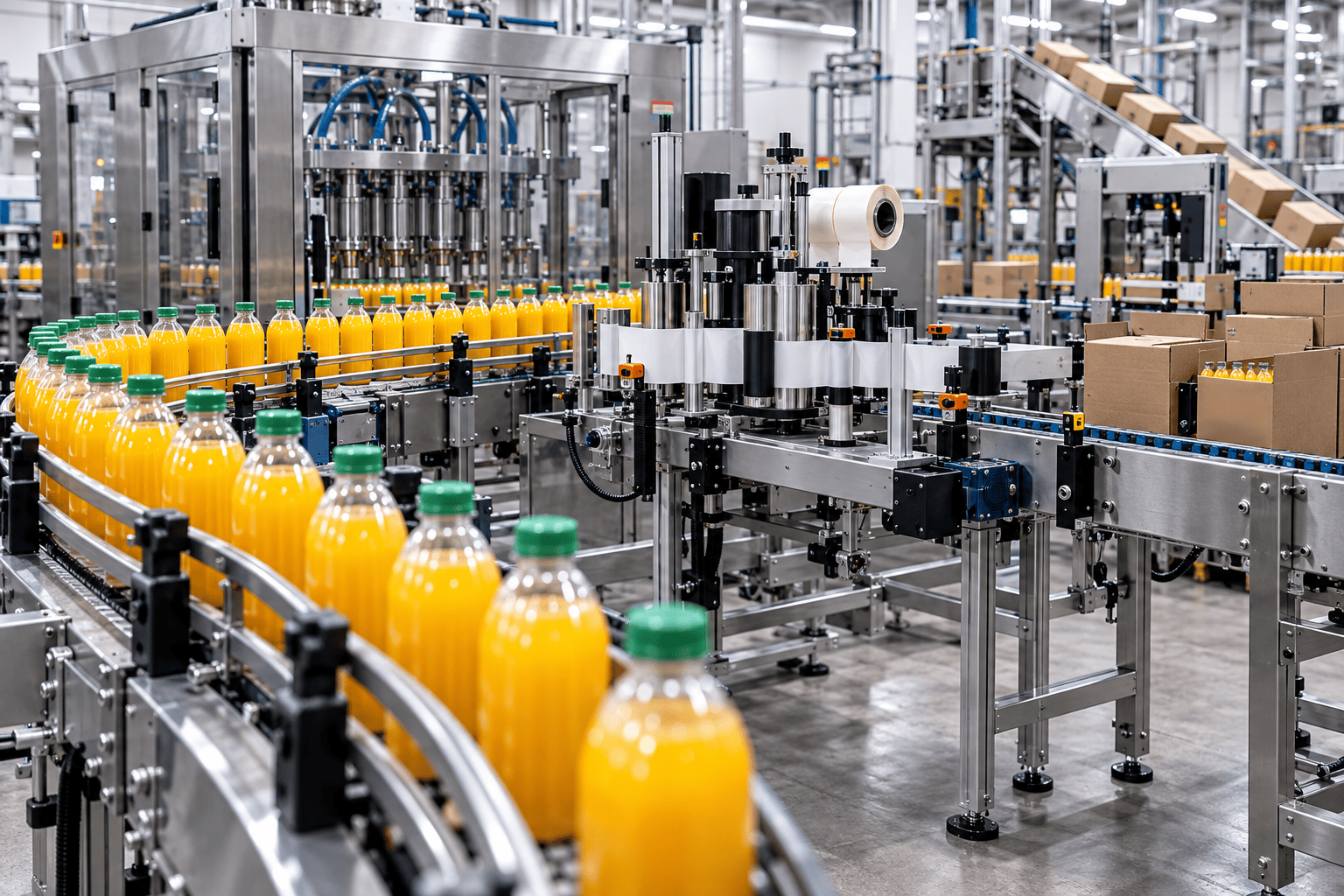
At 3:17 p.m., the filler is ready for the 500 ml bottle, but the rest of the line is not. One guide rail still carries the marks for the 1 litre SKU. The labeller operator is waiting for the correct setting sheet. A few uncapped bottles have been moved by hand into a plastic crate. Downstream, empty cartons are beginning to stack before the case packer.
Someone points out that the conveyor is still running. Technically, that is true. Operationally, almost nothing useful is reaching the end of the line.
This is where many FMCG conveyor projects go wrong. The discussion begins with metres per minute, motor power and conveyor length, while the daily losses are happening somewhere else: at a transfer gap, during a format change, when a reject lane fills, when bottles push too hard into a stopped labeller or when the line restarts in the wrong order.
A good FMCG conveyor system does more than move products. It protects pack stability, creates controlled space between machines, gives operators a practical way to clear faults and helps the complete line recover after normal interruptions. The straight sections matter, but the handoffs decide whether the line feels calm or constantly needs rescuing.
What Are FMCG Conveyor Systems?
FMCG conveyor systems are connected material-handling sections used to move fast-moving consumer goods through production, filling, labelling, inspection, secondary packaging, case handling, palletising and dispatch. Depending on the product, the system may use belts, modular belts, slat chains, powered rollers, gravity rollers, indexing conveyors, transfers, elevators and pallet conveyors.
The word system is important. A line is not simply a collection of separate conveyor purchases. The filler, capper, labeller, checkweigher, metal detector, cartoner, bundler, case packer and palletiser all influence conveyor speed, product spacing, accumulation and controls. A conveyor that is correct in isolation can still be wrong for the line around it.
FMCG plants also live with product variety. The same production hall may handle tall shampoo bottles, short jars, flexible refill pouches, cartons, shrink bundles and corrugated cases. Each format behaves differently. The smallest SKU may fall at a transfer that easily carries the largest one. The lightest empty bottle may become unstable at a guide curve. A soft pouch may bridge across rollers that handle cartons perfectly.
| Practical rule Do not ask only, “How fast can this conveyor run?” Ask, “What happens when the next machine stops for 20 seconds, when the SKU changes, and when one pack arrives crooked?” |
Map the Product Journey Before Choosing the Conveyor
Start at the first stable handling point and follow the product all the way to the pallet or dispatch area. The object changes during that journey. A filled bottle is not handled like a shrink bundle, and a shrink bundle is not handled like a corrugated case.
At the primary-pack stage, the line may need close side guiding, low back pressure, precise pitch and gentle transfers. At inspection, it may need controlled spacing for cameras, coders, checkweighers or metal detectors. At secondary packaging, the conveyor may need to merge, turn, index or feed products in counted groups. After case packing, a powered roller line may be more practical than the slat chain used near the filler. After palletising, the design changes again to heavy-duty pallet rollers or chains.
A useful line walk does not stop at equipment boundaries. Watch what operators do between the machines. Do they straighten packs by hand? Hold a guide rail during startup? Move rejected products into an unlabelled crate? Walk empty cartons across the conveyor? These improvised actions are often the clearest evidence that the material flow, recovery route or workstation layout needs attention.
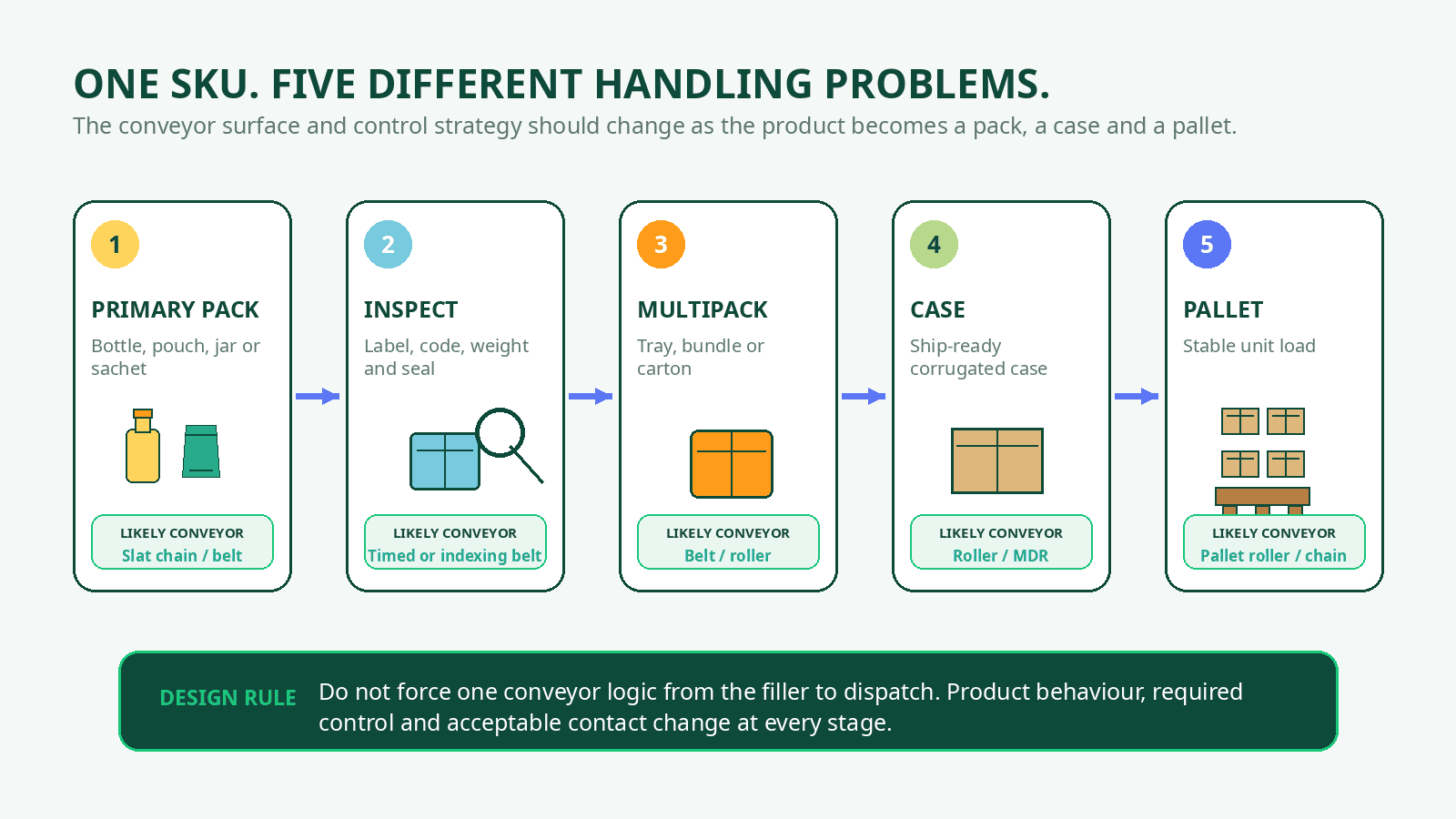
The same SKU may require different conveyor technologies as it moves from primary pack to pallet.
Match the Conveyor to the Pack Format
The best starting point is the physical product, not the preferred conveyor in a supplier catalogue. Record the smallest and largest dimensions, weight, base shape, centre of gravity, surface condition, temperature, rigidity and packaging quality. Then include the awkward cases: a partly filled pouch, a dented carton, a tall bottle with a small base or a shrink bundle with loose film.
Bottles, cans and jars. Rigid containers often work well on slat chain or tabletop chain because the surface gives continuous support and can follow curves. Side-guide design is critical. Too much pressure can scuff labels, deform lightweight bottles or create unstable surges; too little control can allow containers to rotate or fall.
Pouches and sachets. Flexible packs normally need a continuous belt, good support through transfers and careful control of air, static, wrinkles and sealing edges. Small sachets may require very short transfer gaps, vacuum support or a purpose-designed indexing section. They are rarely happy on widely spaced rollers.
Cartons, trays and cases. Stable flat-bottom loads can use belt or roller conveyors. Powered roller or motor-driven roller systems become useful where controlled accumulation, zone release, merging or dispatch routing is required. The carton underside and minimum length still matter because a case must remain supported across multiple rollers.
Shrink bundles and multipacks. These may look rigid but can distort under pressure, especially while the film is still warm. Conveyor surface, side guides, transfer geometry and accumulation pressure should be checked with real samples rather than assumed from the nominal dimensions.
Pallets. Once the product becomes a unit load, the conveyor must be designed around pallet construction, runner direction, maximum weight, load distribution, forklift interface and accumulated section load. This is a different engineering problem from conveying individual consumer packs.
Conveyor Types Commonly Used on FMCG Packaging Lines
| Conveyor type | Typical FMCG use | Watch carefully |
| Slat chain / tabletop chain | Bottles, cans, jars and rigid containers through filling, capping and labelling | Guide pressure, curves, lubrication, container stability and transfer plates |
| Flat belt conveyor | Pouches, cartons, trays, components, packaged goods and inspection sections | Belt grip, transfer gaps, tracking, cleaning and product orientation |
| Modular plastic belt | Wet or dry packaged products, curves, drainage and selected food/FMCG areas | Hinge cleanliness, sprocket engagement, product marking and transfer detail |
| Powered roller / MDR | Cases, totes, cartons, accumulation, merging and dispatch | Minimum product length, roller pitch, zone logic and soft-package suitability |
| Timing / indexing conveyor | Vision inspection, coding, labelling, robotic pick-and-place and precise positioning | Pitch accuracy, fixture design, speed transitions and jam recovery |
| Inclined / cleated conveyor | Elevation changes for cartons, pouches and packaged goods | Product rollback, cleat pitch, side containment and available footprint |
| Cross transfer / diverter | Rejects, rework, lane changes, routing and perpendicular movement | Product support during lift, cycle time, sensors and safe recovery |
| Pallet roller / chain conveyor | Palletising, finished-goods transfer and warehouse interface | Pallet quality, weight distribution, fork access and guarding |
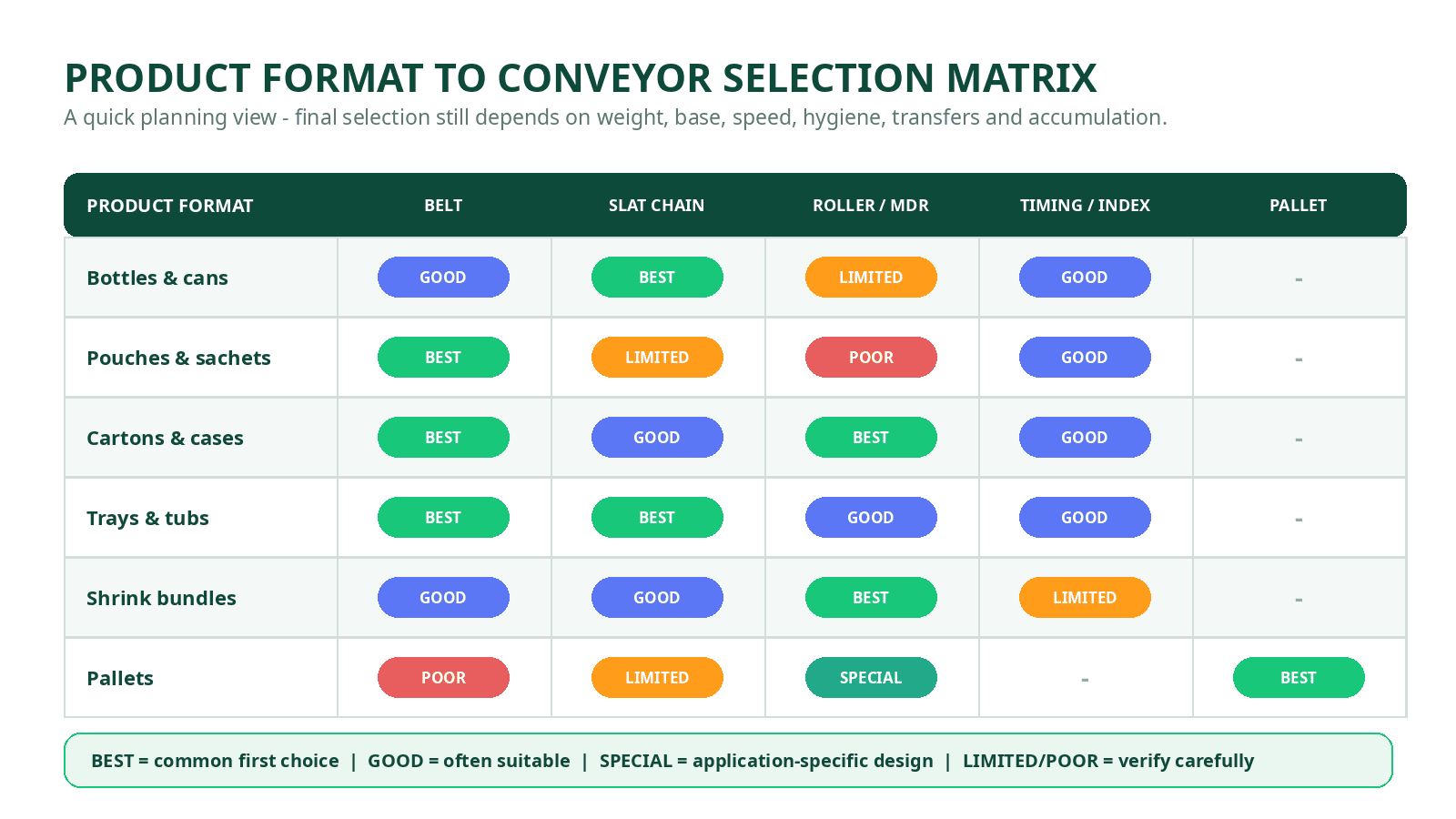
A planning matrix helps narrow the first conveyor choice, but real products must still be tested.
Fifteen Design Decisions That Determine Line Performance
1. Define the complete SKU envelope
Do not design around the most common pack only. Include the smallest, tallest, lightest, heaviest and least stable SKU, plus expected future formats. The limiting product is often the one produced only once a month.
2. Use sustainable peak rate, not only catalogue speed
A machine may be rated at a high number under ideal conditions, while the line runs slower because of changeovers, replenishment, inspection, minor stops and product variation. Design around the required sustainable output and the rate needed during recovery.
3. Protect product stability
Base size, centre of gravity, fill level, cap condition, film temperature and side-guide contact influence whether a product remains upright and correctly oriented. Stability should be checked through starts, stops, curves and merges.
4. Engineer the transfer points
Many jams begin in the final 100 mm between two good machines. Match heights, speeds, surfaces and support. Minimise unsupported gaps and test the smallest pack at both normal speed and recovery speed.
5. Coordinate machine and conveyor speeds
Running every section at the same nominal speed does not guarantee smooth flow. Small controlled speed differences can create spacing or close gaps, but poor coordination can cause surging, product pressure or unstable transfers.
6. Plan accumulation as a recovery tool
Accumulation should absorb normal microstops and help decouple machines. It should not be used to hide a permanently unreliable process. Define where products may queue, how much pressure they tolerate and how the line restarts.
7. Make changeovers repeatable
Guide widths, sensor positions, belt heights, lane dividers and recipe values should have repeatable settings. Indexed scales, digital position indicators, keyed change parts and tool-less adjustments reduce dependence on memory.
8. Design reject and rework routes
A reject is not finished when it leaves the main conveyor. Provide a secure, identified and capacity-checked route for no-reads, underweight packs, label faults, damaged cartons and quality samples.
9. Support line clearance and SKU segregation
FMCG lines often require complete clearance before the next SKU, flavour, fragrance, batch or label enters. Avoid ledges, hidden pockets and long uncontrolled returns where old product can remain.
10. Choose materials for the environment
Consider cleaning chemicals, oils, powders, moisture, temperature, static, dust and product contact. The correct belt or chain is not just a colour choice; it must suit the process and approved cleaning method.
11. Define upstream and downstream handshakes
Each machine should know when the next section is ready, blocked, starved, stopped or in fault. Conveyor controls need a clear response to every state so products do not pile up or restart unexpectedly.
12. Use sensors where they answer a real question
Photoeyes, encoders, barcode readers, vision systems and pressure sensors are valuable when their purpose is clear. A sensor without a defined fault response simply creates another light for operators to ignore.
13. Design for operator access and ergonomics
Operators need to replenish packaging, remove samples, clear jams and inspect quality without climbing over frames or reaching into unsafe areas. Walkways, working heights and access doors belong in the early layout.
14. Plan safe stop, isolation and restart
Guarding, emergency stops, interlocks, stored energy and controlled restart should be addressed through a project-specific risk assessment. Recovery should be simple enough that the safe method is also the practical method.
15. Make maintenance and future changes possible
Leave access for belts, chains, bearings, sensors, drives and cleaning. Standardise critical spares where practical and reserve space, I/O and structural capacity for likely line extensions.
Changeovers: Repeat Settings, Not Operator Memory
A changeover is where the designed line meets the real shift. Production plans say “switch to the 500 ml SKU”; the floor experiences guide rails, sensor brackets, printer data, labels, caps, cartons, film, recipes, tools and clearance checks.
The conveyor should make this work easier. Use clear position references, labelled change parts and adjustment points that can be reached without removing unrelated guarding. Store validated settings by SKU. Mark the direction and location of each guide. Keep fasteners captive where possible. Pre-stage the next set of parts so the line is not used as a workbench.
An illustrative example shows the difference. A three-person team takes 31 minutes to change a bottle format when guide settings are found by trial, sensors are moved with a spanner and the first ten minutes of production are spent fine-tuning. After adding indexed scales, recorded recipe values, tool-less guide clamps and a line-clearance checklist, the same change may take 17 minutes. Those figures are not a benchmark; they show why repeatability matters more than telling the team to work faster.
A useful post-changeover review asks where time was actually lost. Was the line waiting for packaging material, waiting for quality approval, searching for a change part, making mechanical adjustments or stabilising the first saleable product? The conveyor can only solve the losses connected to movement, access, settings and line control, but those losses are often significant.
Accumulation and Microstop Recovery
FMCG equipment rarely runs without interruption. A label roll ends, a carton blank misfeeds, a code is unreadable, a packer waits for film or a quality check takes longer than expected. These short stops become expensive when every machine is tightly coupled.
Accumulation creates time between processes. The basic planning calculation is simple: upstream rate multiplied by expected stop duration gives the theoretical queue. Real design then adds product pitch, lane arrangement, allowable pressure, recovery speed, control logic and a sensible margin.
For example, an upstream line producing 180 bottles per minute sends three bottles per second toward a labeller. A frequent 40-second labeller stop can create 120 bottles of theoretical queue. Adding an illustrative 25 percent recovery allowance gives 150 positions. At a 100 mm pitch, that would be 15 metres in a single lane, which may lead the designer toward a multi-lane table, different accumulation technology or a review of the actual stop cause.
The buffer also needs a discharge strategy. If the downstream machine restarts at exactly the upstream production rate, the queue never clears. A controlled recovery speed or temporary upstream slowdown may be required. The line should avoid releasing a compressed group of unstable bottles into a labeller that has only just restarted.
Measure both blocked time and starved time. A machine that is stopped because the next machine cannot accept product needs a different improvement from a machine that is waiting because the previous process cannot supply it.
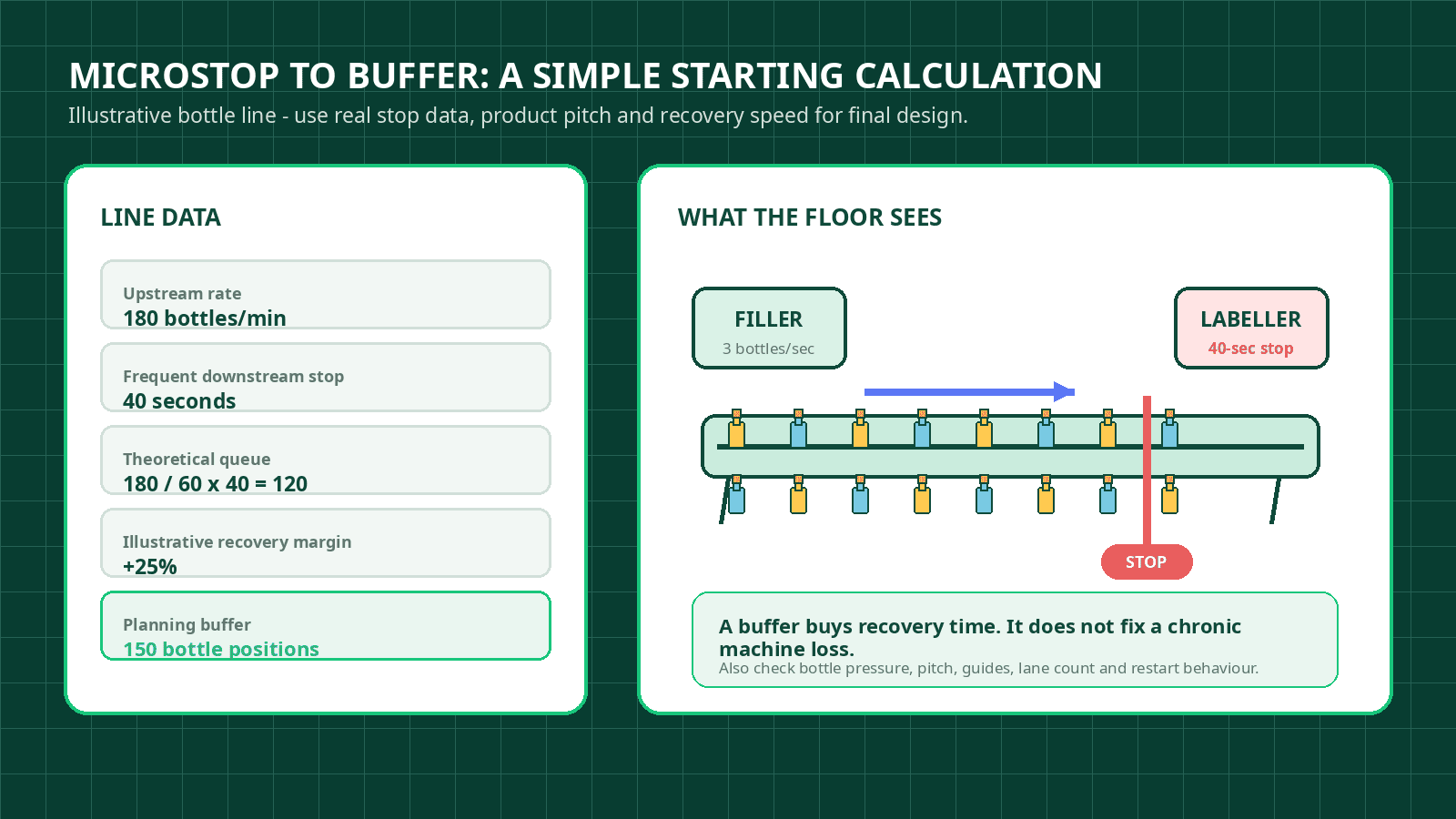
A simple accumulation calculation is only the first step; product pressure, lane count and recovery behaviour determine the real design.
Controls, Data and Packaging-Machine Integration
A line works better when machines describe their condition consistently. At a minimum, the conveyor control philosophy should define running, stopped, blocked, starved, held, faulted, manual and maintenance conditions. It should also define who is allowed to start each section and what must be clear before automatic restart.
Variable-frequency drives or motor-driven roller zones can adjust speed and release product according to demand. Sensors can confirm presence, spacing, queue length, full lanes, reject arrival and transfer completion. Barcode, vision, checkweigher and metal-detection results can be linked to reject tracking so the right pack is removed at the right location.
For multi-machine packaging lines, a common machine-state and data approach can make integration and troubleshooting more consistent. OMAC positions PackML as a standardised approach to machine behaviour and data, while ISO 22400 provides an industry-neutral framework for manufacturing KPIs. The project does not need to become a standards exercise, but it should avoid creating a different meaning for “blocked” or “production” on every HMI.
Useful line data includes good units, total units, reject reason, blocked time, starved time, minor-stop frequency, changeover duration, mean time to repair and time to stable production after restart. A single OEE number may be useful at management level, but maintenance and operations still need the underlying loss detail to decide what to fix.
Two Practical FMCG Line Scenarios
Scenario 1: Shampoo bottles through labelling and case packing
The product family includes 200 ml, 500 ml and 1 litre bottles with different heights and base widths. The line uses slat chain near the filler and capper, where continuous support and curves are useful. Adjustable side guides keep bottles stable, and a low-pressure accumulation section sits before the labeller.
After labelling and vision inspection, a controlled reject device sends faulty bottles to a secure lane with confirmation that the reject arrived. Accepted bottles are grouped for secondary packaging. Once they become corrugated cases, powered rollers provide zoned accumulation toward palletising.
The human detail is the changeover. Guide positions are indexed by SKU, sensors have marked mounting locations and the operator can check the first bottle without reaching across moving containers. The reject lane has enough capacity for a realistic fault, not just one demonstration sample.
Scenario 2: Refill pouches through checkweighing and cartoning
Flexible refill pouches leave the packaging machine with variable shape and trapped air. A continuous belt supports them through a short settling section. Product spacing is controlled before checkweighing, and the transfer into the inspection conveyor is designed around the smallest pouch rather than the largest one.
Underweight or seal-fault pouches are diverted into an identified reject bin with capacity monitoring. Good pouches move to an indexing section for counting and cartoning. Finished cartons then transfer to roller conveyors for case handling and dispatch.
Here the wrong decision would be using roller conveyors too early because cartons later in the process are roller-friendly. The primary pouch requires a different surface. The line becomes simpler when each stage is allowed to use the conveyor that matches the product at that stage.
Safety, Access, Maintenance and Cleaning
An FMCG line must be recoverable without encouraging unsafe improvisation. Common hazards include nip points at pulleys and sprockets, moving chains, transfer devices, unexpected starts, falling products, unstable stacks and access conflicts with forklifts or pallet trucks.
A project-specific machinery risk assessment should cover normal production, changeover, cleaning, fault finding, jam clearing, maintenance and foreseeable misuse. Guards and interlocks must be designed together with access. If a guard takes too long to remove, blocks the only cleaning route or cannot be handled by one person, the floor will eventually find a workaround.
Maintenance access should include belt tensioning and tracking, chain lubrication where applicable, drive removal, bearing replacement, sensor adjustment and inspection of transfer components. Critical parts should be reachable without dismantling half the line. Housekeeping should prevent labels, shrink film, cartons and broken product from accumulating around drives and supports.
Cleaning requirements vary across FMCG categories. Food, beverage, cosmetics, household chemicals and personal-care products may need different materials and procedures. Define the approved cleaning method, drainage, chemical compatibility and contamination risks before finalising the structure and belt or chain.
When a Conveyor Is Not the First Answer
Not every flow problem needs more automation. A conveyor may be the wrong first investment when the product is still unstable because primary packaging is inconsistent, when one unreliable machine creates most of the stops, when the route changes every week or when volume is too low and intermittent to justify fixed equipment.
Sometimes the better first step is to standardise pack dimensions, repair the chronic machine fault, organise packaging-material replenishment, create a clear reject process or remove an unnecessary manual inspection. Portable conveyors, carts, gravity sections or a small workstation redesign may solve the immediate problem with less capital and less operational rigidity.
The decision should follow the bottleneck. Automating a confused process usually makes the confusion move faster.
Eight-Step FMCG Conveyor Selection Process
1. Map the real product flow
Walk from the first handling point to pallet or dispatch. Include manual handling, returns, rejects, quality checks, cleaning and changeovers.
2. Capture every relevant SKU
Record dimensions, weight, base, stability, packaging material, orientation and the planned future range. Collect real samples.
3. Measure demand and losses
Use normal, sustainable peak and short-burst rates. Record frequent stop durations, blocked/starved time and changeover duration.
4. Select the conveyor surface
Choose belt, slat, roller, indexing or pallet handling according to the product at each stage, not one technology for the whole line.
5. Engineer transfers and accumulation
Define heights, gaps, guides, merges, curves, lane count, buffer capacity and recovery speed.
6. Design changeover, reject and clearance
Make adjustments repeatable, provide identified reject routes and support complete SKU or batch clearance.
7. Integrate controls and safety
Define machine states, handshakes, sensors, recipes, HMI messages, guarding, isolation and controlled restart.
8. Test with real products and real faults
FAT and SAT should include the smallest SKU, unstable packs, stops, full downstream lanes, empty upstream supply, reject confirmation and restart recovery.
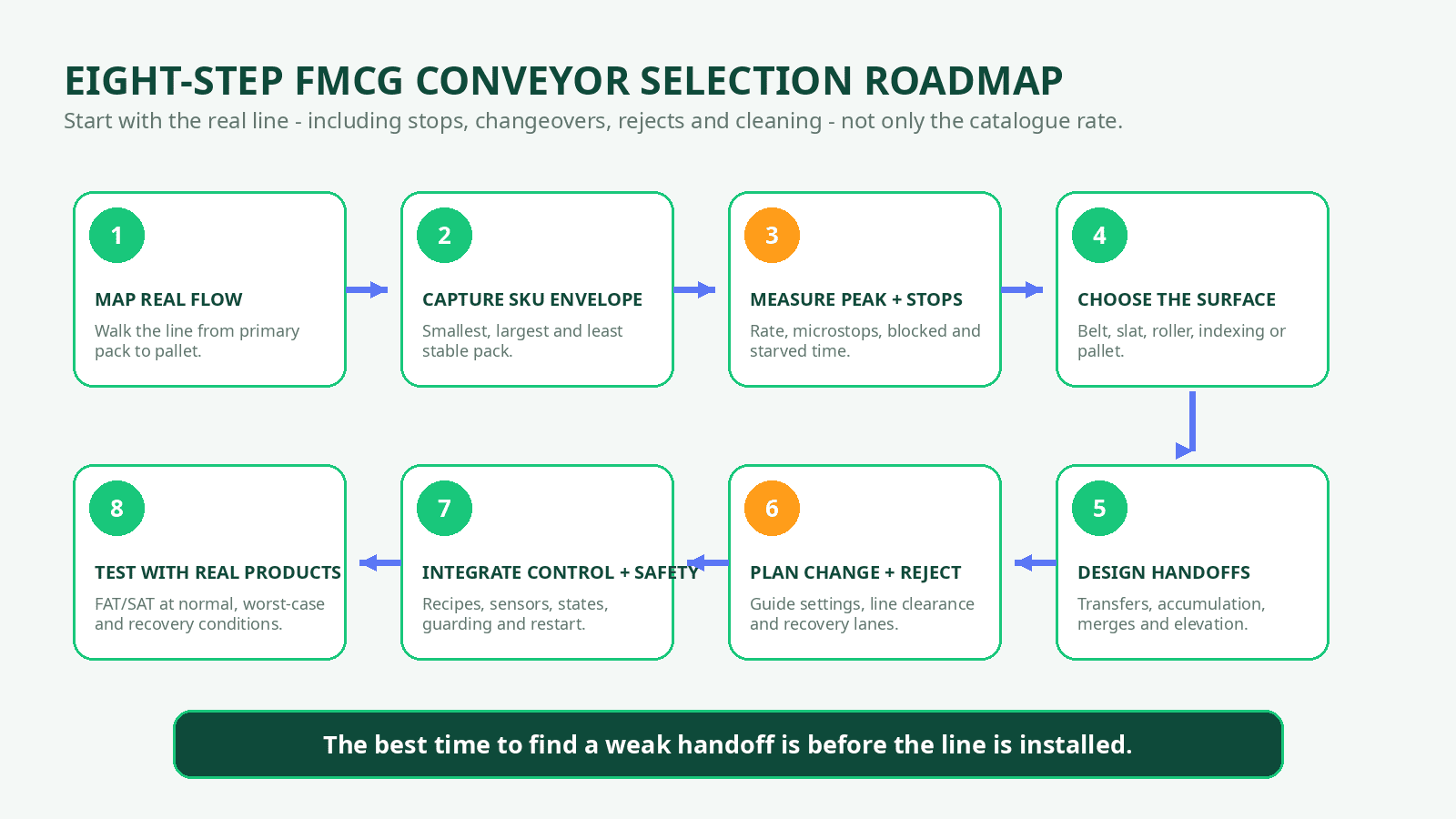
A practical selection process begins with the existing line and ends with testing under real products, faults and recovery conditions.
Information to Share for an Accurate Conveyor Quotation
– Product and packaging type at every conveyor stage, including real photos and samples where possible.
– Minimum and maximum length, width, height, weight, base geometry and centre of gravity.
– Required orientation, spacing, pitch, grouping and any no-contact or gentle-handling requirement.
– Normal rate, sustainable peak rate, short-burst rate and expected operating hours per shift.
– SKU list, changeover frequency, future formats and acceptable changeover time.
– Existing and proposed layout, conveyor lengths, widths, elevations, curves, merges and available floor space.
– Upstream and downstream equipment, interface heights, rated speeds and control signals.
– Frequent stop durations, desired accumulation time and product pressure limits.
– Reject types, reject confirmation, rework route, sampling points and line-clearance requirements.
– Cleaning method, chemicals, moisture, temperature, dust, static and material compatibility needs.
– Electrical supply, PLC/HMI preferences, recipes, barcode/vision integration and production-data requirements.
– Guarding, operator access, forklift routes, maintenance access and isolation expectations.
– Installation window, shutdown constraints, site services, FAT/SAT requirements, training and documentation.
Common FMCG Conveyor Mistakes
– Designing around the largest pack and discovering that the smallest pack falls into transfer gaps.
– Using the maximum machine speed as the required conveyor rate without studying sustainable output.
– Treating accumulation length as a substitute for fixing frequent machine faults.
– Selecting roller conveyors for soft pouches because cartons later in the line use rollers.
– Ignoring side-guide pressure and bottle behaviour during stops and restarts.
– Making every changeover adjustment tool-dependent and unmarked.
– Providing a reject lane that holds only a few products and then blocks the main line.
– Forgetting line clearance, old labels, mixed cartons and hidden product pockets.
– Allowing different machines to use inconsistent blocked, starved and fault logic.
– Placing sensors where they are difficult to clean, adjust or protect from damage.
– Designing guards without involving the people who clear jams and maintain the equipment.
– Testing only at normal steady-state speed instead of testing stops, full lanes and recovery.
Frequently Asked Questions
What is the best conveyor for FMCG bottles?
Slat chain or tabletop chain is a common starting choice for bottles, cans and jars because it gives continuous support and can follow curves. The final design depends on bottle stability, line speed, guide pressure, cleaning and accumulation.
Which conveyor is suitable for pouches and sachets?
A continuous belt is often more suitable than rollers because flexible packs need full support. Small sachets may require short transfer gaps, vacuum support or an indexing conveyor for inspection and packing.
Can one FMCG conveyor handle several bottle or carton sizes?
Yes, when the guide range, transfer geometry, sensor positions, belt or chain width and control recipes cover the full SKU envelope. Repeatable changeover settings are essential.
How much accumulation should an FMCG line have?
Base the first estimate on upstream rate and frequent downstream stop duration, then add product pitch, acceptable pressure, lane count, recovery speed and a practical margin. Use real stop data rather than a generic number of minutes.
Should every conveyor run at the same speed?
Not necessarily. Controlled speed differences can create spacing or close gaps. The speeds must be coordinated so products remain stable and do not surge into stopped equipment.
When should I choose slat chain instead of a belt?
Slat chain is often useful for rigid bottles, cans, jars, curves and stable container flow. A belt is often better for flexible packs, cartons, small components or applications requiring full continuous support.
How can conveyor design reduce changeover time?
Use indexed guide positions, tool-less clamps, labelled change parts, stored recipes, accessible sensors and a line-clearance checklist. Test the setting method with the actual operators.
Can conveyors integrate with fillers, labellers and case packers?
Yes. Define interface heights, speed ranges, ready/block/starve signals, fault responses, accumulation and restart sequence during engineering.
What conveyor is best for cartons and cases?
Flat belts and powered rollers are common. Roller pitch must support the minimum case length, while zoned MDR conveyors can provide controlled accumulation and routing.
How do I calculate FMCG conveyor capacity?
For unit loads, capacity is linked to conveyor speed and product pitch. Required spacing, stops, merges, inspection dwell time and downstream cycle time can reduce sustainable throughput below the theoretical value.
Can an existing FMCG production line be retrofitted?
Often yes. A retrofit may add new transfer sections, sensors, accumulation, drives, guides, reject routes or controls. Structural condition, obsolete components and shutdown constraints should be reviewed first.
What information is needed for a conveyor quote?
Share product data, SKU range, rate, layout, upstream and downstream machines, accumulation needs, cleaning environment, controls, safety expectations and installation constraints. Videos of the current problem are especially useful.
Conclusion: Design the Line Around the Difficult Minutes
The easiest part of a conveyor line to photograph is the long, clean, straight section. The difficult part is 3:17 p.m., when a format change is late, the labeller has stopped, bottles are building pressure and the case packer is waiting. That is the moment the design should be able to handle.
The right FMCG conveyor system matches the product at each stage, protects handoffs, gives the line enough controlled accumulation, makes changeovers repeatable and provides a safe recovery path. It also leaves room for the people who operate, clean and maintain it.
When requesting a proposal, share the uncomfortable details as well as the target speed: unstable packs, frequent stops, awkward SKUs, rejected products, cleaning restrictions and tight access. Those details are not problems to hide. They are the information needed to engineer a line that works beyond the demonstration run.
| Discuss your packaging line with Convello Share the product formats, line rate, changeover frequency, current bottlenecks, layout and upstream/downstream machines. Photos, a floor plan and a short operating video can make the conveyor recommendation more accurate. |