+91 99980 88430 | +91 95589 17778
 info@convello.in | sales@convello.in

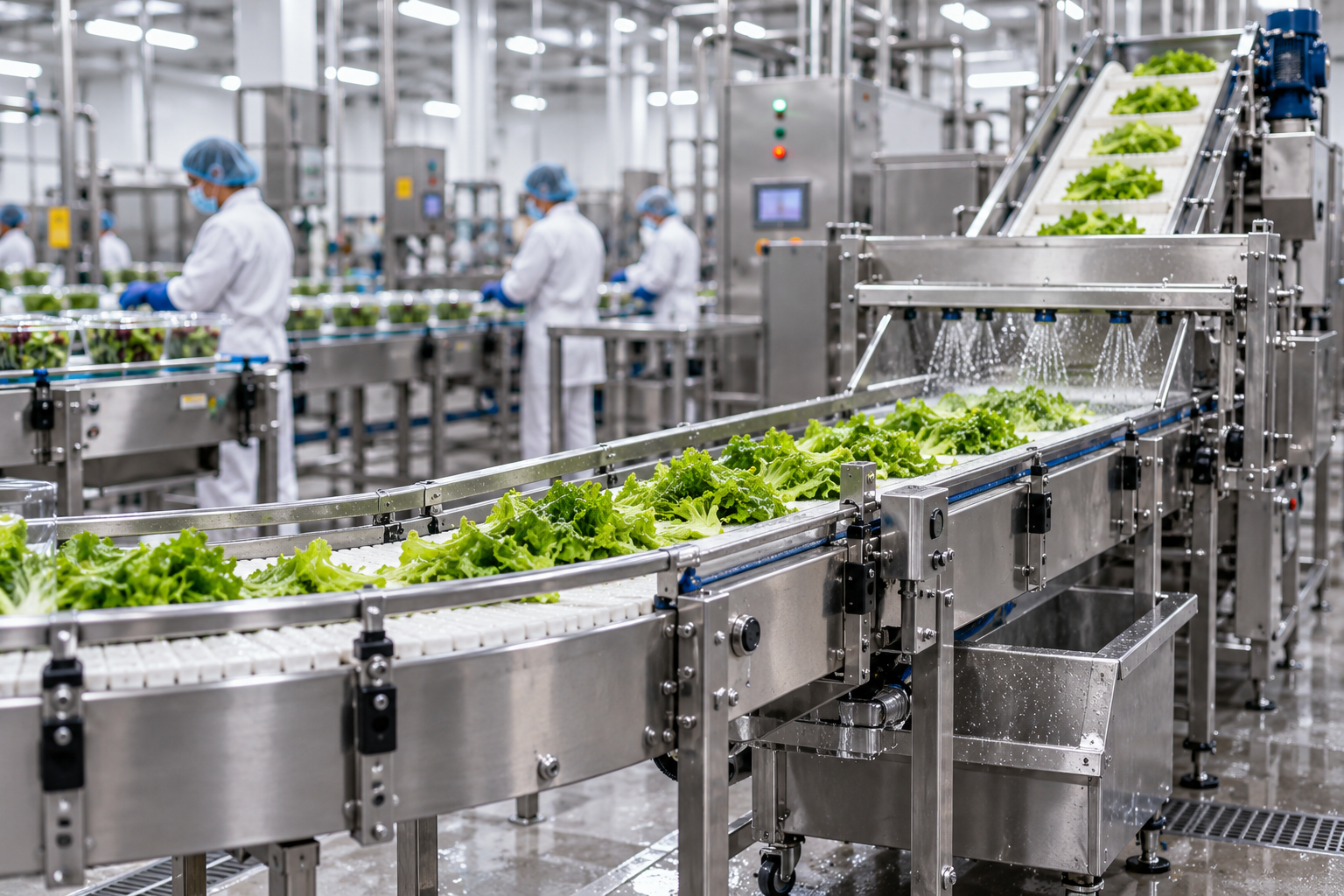
At 1:20 a.m., after the last tray leaves the line, the sanitation team sees a different conveyor from the one production sees at noon. Production sees speed, spacing and output. The cleaning crew sees the strip of paste under a side guide, the crumbs resting on the return belt, the puddle beneath a flat support and the guard that needs three tools before anyone can reach the pulley.
That difference matters. A conveyor can be made from stainless steel and still be frustrating to clean. It can look polished from the aisle while food residue remains behind brackets, inside damaged hollow sections or under a transfer plate. It can run perfectly for two shifts and then lose an hour every night because the team cannot release the belt, inspect the underside or drain rinse water without improvising.
A hygienic food processing conveyor system is therefore not simply a conveyor fitted with a white belt. It is a machine designed around the food, the contamination risk, the cleaning method and the people who must operate, clean, maintain and verify it. The design should help them do the right work consistently, not rely on heroic effort at the end of every shift.
This guide takes a practical approach. It does not assume that every food plant needs the same belt, the same stainless grade or the same washdown routine. A paneer line, a spice plant, a biscuit conveyor and a sealed-carton packaging line face very different risks. The right solution begins by understanding those differences.
What Is a Food Processing Conveyor System?
A food processing conveyor system moves ingredients, unpackaged food, containers, trays, packaged products or waste between operations while supporting the required hygiene, product handling and process-control conditions. Depending on the application, it may transport raw material to preparation, carry exposed product through inspection or cooling, feed a packaging machine, move sealed packs to coding and case packing, or transfer powders and granules inside an enclosed system.
The word system is important. The belt or chain is only one part. Hygienic performance also depends on the frame, supports, carryway, return path, transfer plates, guides, scrapers, tensioning arrangement, bearings, drives, cable routing, covers, controls, drainage, maintenance access and the way the conveyor connects with neighbouring machines.
For packaged cartons in a dry dispatch area, a conventional belt or roller solution may be adequate. For exposed ready-to-eat food in a wet-cleaned area, the design usually needs a very different level of access, drainage, material compatibility and separation. Treating both applications as the same purchasing category is one of the fastest ways to create cleaning problems.
The Sanitation Shift Should Influence the Design
Equipment is often selected in a meeting dominated by throughput, footprint and capital cost. Those questions are necessary, but the people who clean the line should be present before the design is frozen. They know which covers are difficult to lift, where foam does not reach, where rinse water collects and how long a safe strip-down actually takes.
A useful design review asks the sanitation team to walk through the intended sequence: stop the line, isolate energy, remove product, open access, release or lift the belt, clean the carry surface, reach the return path, inspect transfers, rinse or vacuum, allow drainage or drying, reassemble, verify and release the line. Every step that depends on a loose bolt, a hidden latch, a heavy guard or an improvised brush is a design decision – not merely an operating issue.
The same applies to maintenance. A bearing replaced above exposed food, an unprotected lubrication point or a cable that traps debris can undo good sanitation work. Hygienic design works best when production, food safety, sanitation, engineering and maintenance describe the same machine from their own perspective.
| Plant-floor rule A conveyor is not easy to clean because the drawing says it is. It is easy to clean when a trained person can safely reach, see, clean, drain, inspect and reassemble the real equipment within the available sanitation window. |
Classify the Product, Hygiene Zone and Cleaning Method First
Before selecting belt material or frame style, define the actual application. Four questions change almost every design decision:
– Is the food exposed and in direct contact with the conveying surface, or is it already sealed inside primary or secondary packaging?
– Is the product raw, cooked, ready-to-eat, allergenic, low-moisture, chilled, frozen, sticky, oily, fragile or dusty?
– Will the area use routine wet cleaning, controlled wet cleaning, dry cleaning or a combination of methods?
– What must be prevented: microbial growth, allergen carryover, foreign material, chemical residue, pest attraction, moisture migration or product mix-up?
| Application zone | Examples | Design emphasis |
| Direct-contact, exposed product | Cut vegetables, dough, confectionery, meat, dairy, cooked food | Highest attention to cleanability, material suitability, drainage, transfer design and contamination control. |
| Indirect or nearby exposure | Open containers, trays, uncovered product near the conveyor | Control splash, aerosols, drips, overhead components and indirect contamination routes. |
| Primary packaged product | Sealed pouches, bottles, tubs or trays | Product-contact risk is lower, but package damage, leaks, washdown and line hygiene still matter. |
| Secondary packaging | Cartons, cases, shrink bundles | Industrial conveyor design may be suitable if the surrounding zone and cleaning requirements allow it. |
| Bulk ingredient transfer | Flour, sugar, spices, pellets, granules | Dust containment, enclosed cleanability, product retention, allergen changeover and safe access become central. |
Five Hygienic Design Principles
A practical hygienic design review can be organised around five connected principles: material compatibility, cleanability, draining ability, accessibility and segregation. These principles are useful because they force the team to look beyond a material label and examine how the complete conveyor behaves during production and sanitation.
- Material compatibility: Food-contact surfaces, belts, seals, gaskets, lubricants and cleaning chemicals must be suitable for their intended use. The product may be hot, cold, acidic, salty, oily or abrasive. The cleaning programme may involve alkaline detergent, acid descaling, sanitiser, steam or repeated temperature cycling. A material that works mechanically can still swell, crack, corrode, absorb odour or shed particles in the real environment.
- Cleanability: Surfaces should be smooth enough, open enough and simple enough for the defined cleaning method. Cleanability is not the same as a shiny finish. Overlapping plates, exposed threads, dead-end slots, poorly finished welds and narrow gaps can remain difficult to clean even when the visible surface looks excellent.
- Draining ability: Water, product and cleaning solution should leave the equipment. Horizontal ledges, flat box sections, upward-facing channels and poorly oriented cable trays can hold liquid. Standing water lengthens drying time and creates a recurring inspection concern.
- Accessibility: The team needs safe access to both sides of the belt, the return path, rollers, scrapers, guides, transfers and drives. Tool-less or reduced-tool access can shorten sanitation, but quick-release features still need positive retention, parts control and safe isolation.
- Segregation: Raw and cooked zones, allergen and non-allergen products, food and chemicals, product and lubricant, and clean and dirty components may need physical or procedural separation. The conveyor layout, airflow, drainage direction, personnel movement and maintenance access can all influence cross-contamination risk.
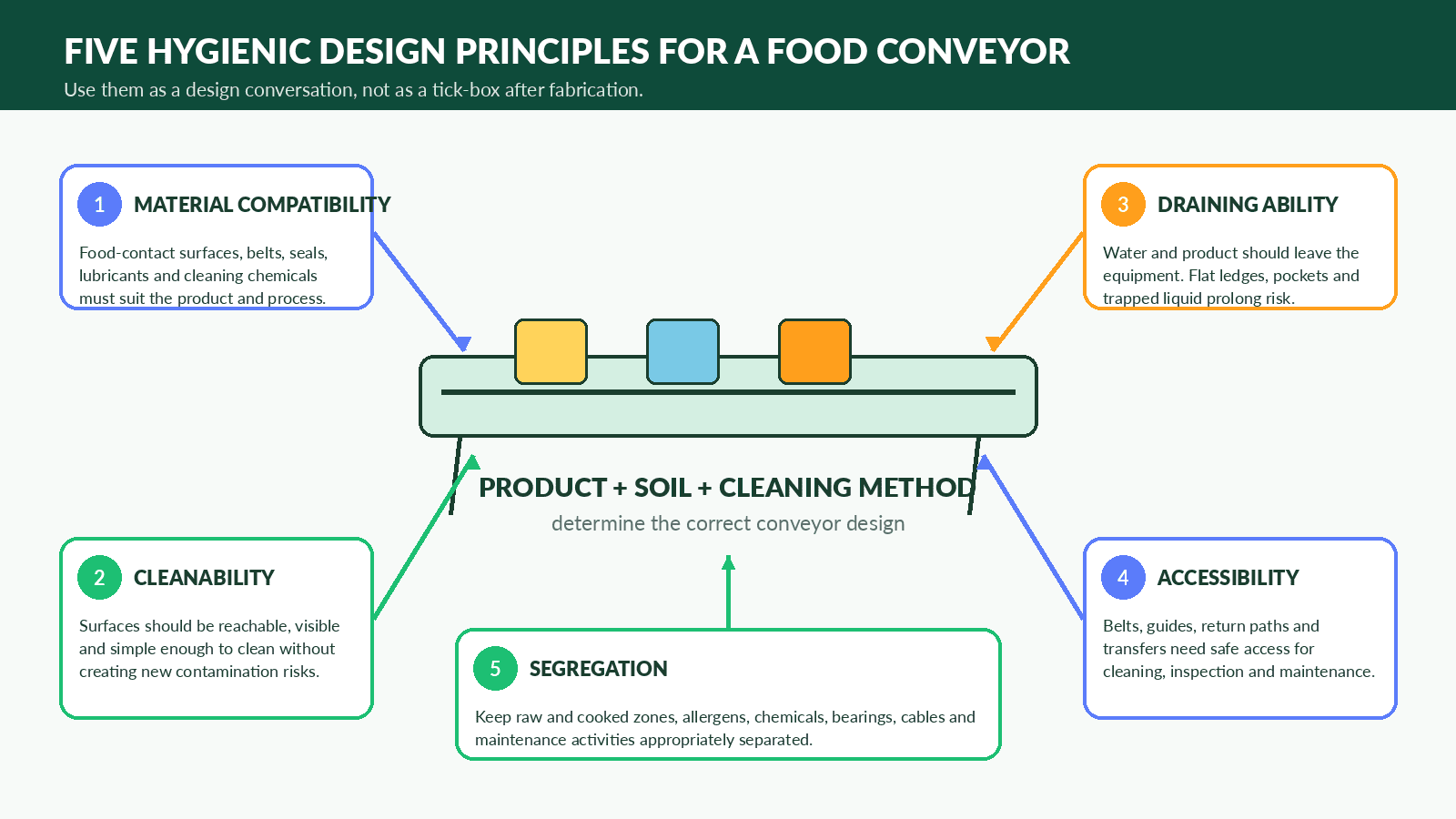
Five principles: the correct conveyor design follows the product, soil and cleaning method.
Wet-Clean Versus Dry-Clean Conveyor Design
Wet cleaning is not automatically more hygienic, and dry cleaning is not simply a cheaper substitute. The correct method depends on the product, hazards, soil and plant food-safety programme. In a wet-cleaned ready-to-eat area, drainage and washdown compatibility may dominate the design. In a low-moisture powder or bakery process, introducing water can create a new hazard and extend the time required to dry the line.
The cleaning method should be defined before the conveyor is engineered. If the plant intends to use foam, rinse water or a controlled-pressure wash, the frame, bearings, motors, cables, enclosures and belt-release arrangement must support that method. If dry pickup, vacuuming and brushing are required, the machine should minimise dust shelves and allow tools to reach every collection point without blowing contamination deeper into the equipment.
Hybrid situations need special care. A dry line may still require occasional wet cleaning after an allergen campaign or major spill. The design must then allow complete drying before restart. Conversely, a wet-cleaned line may include sensitive sensors, printers or electrical devices that require protected placement and a defined cleaning boundary.
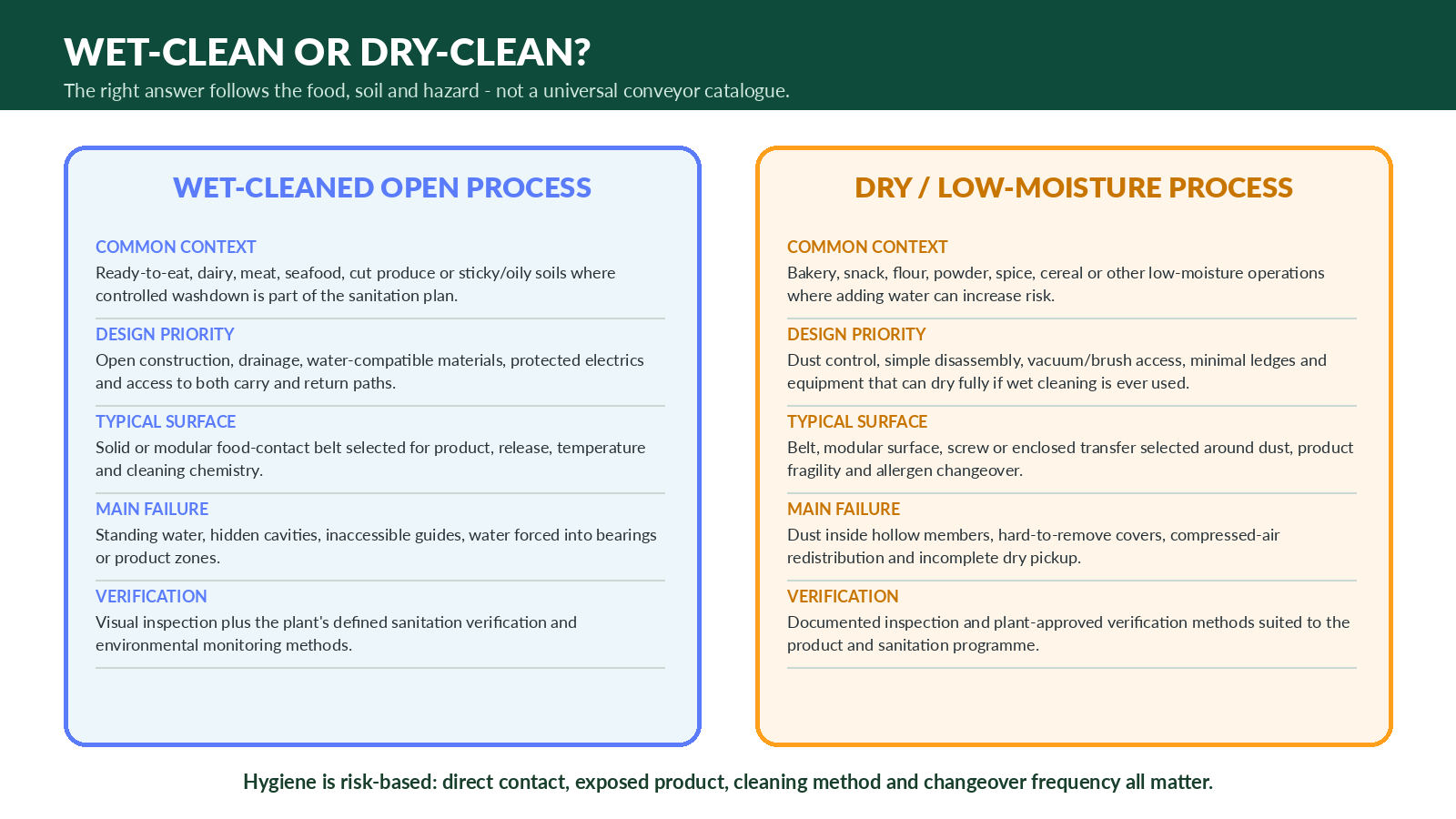
Wet or dry is a risk-based decision: match the conveyor to the food, soil and approved sanitation method.
Conveyor Types Used in Food Processing
There is no universal food conveyor. The surface and mechanism should match the product, route, process temperature, cleaning regime and level of exposure. The following comparison is a starting point, not a final specification.
| Conveyor type | Common food application | Useful strengths | Hygiene questions |
| Solid belt conveyor | Exposed or packaged products needing continuous support; small items, dough, pouches or fragile packs | Simple continuous surface; can suit incline, inspection and metering | Splice, underside, belt lift/release, tracking, scraper and pulley access |
| Modular plastic belt conveyor | Wet, chilled, packaged or exposed products where open modules and positive drive suit the process | Replaceable modules, drainage options, curves or inclines in some configurations | Hinges, rods, sprocket engagement, carryway, return path and product entrapment |
| Wire mesh or metal belt | Ovens, fryers, cooling, freezing or high-temperature processes | Temperature resistance and air/liquid flow | Wire joints, edge condition, cleaning access and product damage risk |
| Slat chain conveyor | Rigid bottles, cans, jars and containers; selected hot or oily operations | Stable container movement and process integration | Slat joints, chain return, lubrication, guides and container-breakage cleanup |
| Screw conveyor | Powders, granules and ingredients in enclosed transfer or feeding applications | Contained movement and controlled feed in suitable products | Residue retention, seals, end bearings, clean-out access and allergen changeover |
| Roller conveyor | Sealed cartons, crates, totes or secondary packaging in lower-risk areas | Simple movement, accumulation and transfer of stable flat-bottom loads | Roller gaps, bearings, damaged packs, spill cleanup and zone suitability |
Sixteen Design Decisions That Determine Cleanability
1. Define the food-contact boundary
Mark every direct and indirect contact surface, including return-side contact, transfer plates, guides, scrapers, chutes, containers and cleaning tools. A surface that never touches food during normal running may still contaminate it through splash, drips, belt return or maintenance activity.
2. Select food-contact materials for the real process
Do not specify material by colour or broad label alone. Confirm suitability for the product, temperature, contact duration, cleaning chemicals, abrasion, oils and regulatory needs. Keep material declarations and component traceability with the equipment documentation.
3. Prefer open, inspectable frame geometry
Open profiles and visible joints make it easier to see soil and confirm cleaning. Hollow members should be avoided in critical areas or hygienically sealed and protected from damage. Temporary plastic caps on open tubes are not a reliable hygiene strategy.
4. Detail welds and transitions carefully
Continuous, smooth, accessible welds are easier to clean than intermittent welds, crevices and sharp internal corners. Grinding and polishing should not create thin sections or hidden cracks. Where dissimilar components meet, avoid steps that catch product.
5. Design every surface to drain
Slope horizontal surfaces where practical, orient members so liquid runs away from food zones, and avoid upward-facing channels. Drainage should lead to a controlled destination rather than across a walkway, electrical enclosure or clean product route.
6. Choose the belt and joint around soil and release
The belt must carry the product, release it cleanly and survive cleaning. Consider solid versus modular construction, surface texture, cleats, sidewalls, sealed edges, splice type, positive drive, temperature and product marking. A highly textured belt may improve grip but increase cleaning effort.
7. Make belt release and tensioning repeatable
Sanitation access improves when the belt can be lifted or released without a long mechanical adjustment. The mechanism should return to the correct tracking and tension after cleaning. Quick release is only useful if it is safe, robust and difficult to reassemble incorrectly.
8. Expose the carryway and return path
Residue often travels to the underside. Return rollers, wear strips, support beds and sag areas need access for cleaning and inspection. If the belt rests against a solid bed, define how the contact surface will be reached and dried.
9. Simplify guides, brackets and change parts
Side guides and adjustable brackets are common residue traps. Minimise overlapping parts, exposed threads and slotted plates in product zones. Use designs that can be removed or opened without losing small components into the line.
10. Engineer transfer points, not just straight sections
The most troublesome hygiene problems often occur where one conveyor meets another machine. Small products fall through gaps, sauces drip from noses, and transfer plates hide residue. Confirm the minimum product, gap, nose radius, scrape point, belt direction and cleaning access.
11. Keep bearings, drives and lubrication under control
Where possible, place bearings and gear drives away from direct product exposure. Use appropriate seals and guards without creating sealed dirt boxes. Lubrication points should be accessible without working over open food, and any risk of incidental contact should be assessed.
12. Route cables, hoses and sensors hygienically
Loose loops, horizontal cable trays and poorly sealed entries collect water and dust. Route utilities away from product where possible, support them so surfaces remain cleanable and select enclosures and connectors for the actual cleaning environment.
13. Design guards for both safety and sanitation
Guards must control mechanical risk, but they should also be removable or openable through a safe, defined method. A fixed guard that blocks sanitation creates pressure to clean around it; an easy-open guard without interlocking or isolation can create a safety risk. Both requirements must be solved together.
14. Plan allergen and product changeovers
Identify shared belts, crevices, hollow parts, replaceable guides and rework routes that can retain allergen. Consider dedicated components, colour control, validated cleaning methods, parts storage and how the team will verify the changeover.
15. Separate raw, cooked and ready-to-eat flow
The conveyor route should not create crossovers, overhead drip paths or shared maintenance access that compromise zoning. Review floor drainage, washdown direction, personnel movement, air movement and the route used by rejected product or waste.
16. Build verification into the machine
Provide line-of-sight, inspection openings, documented strip-down points and clear reassembly checks. The plant may use visual inspection, ATP, allergen swabs, microbiological testing or other methods according to its programme. The conveyor should make the chosen verification practical and repeatable.
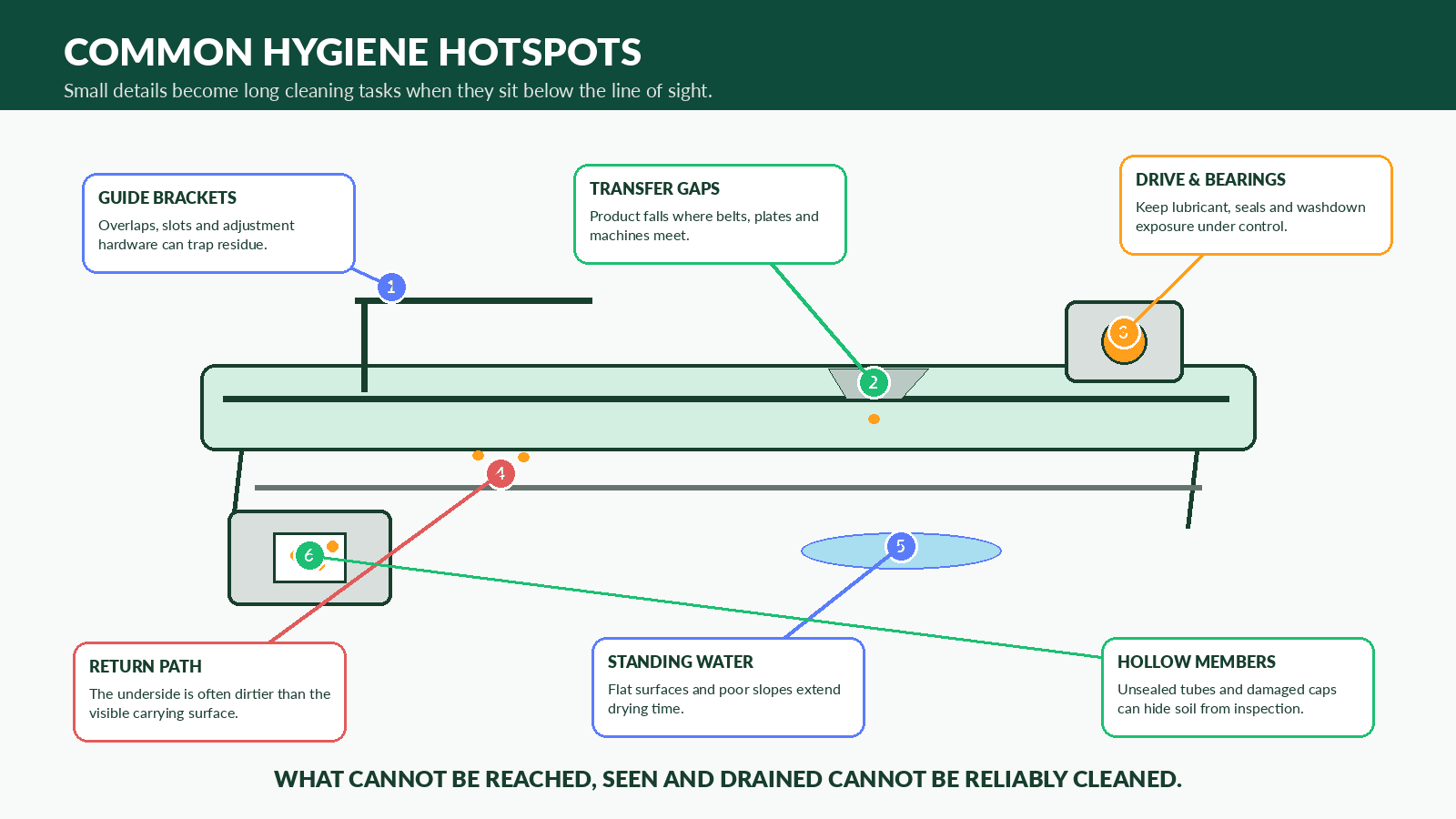
Hygiene hotspots: guide hardware, transfer gaps, return paths, drives, standing water and hollow members deserve deliberate design review.
Transfers, Guides and the Hidden Underside
A straight belt run is usually the easiest part of the conveyor to understand. The real trouble appears at the edges: where product enters, leaves, changes level, meets a guide, passes under a sensor or drops into the next machine. These interfaces deserve the same attention as the main frame.
Use the smallest and most difficult product during design trials. A narrow biscuit, sticky cube, soft pouch or broken piece may behave differently from the nominal product drawing. Watch where crumbs, oil and rinse water travel. Check the underside after the trial, not only the carrying surface. If product can reach a location during an abnormal jam, sanitation must be able to reach it too.
The return path should be treated as part of the hygienic zone whenever it can carry residue back toward product contact. Belt scrapers, drip trays and catch pans can help, but they also become equipment that must be removed, cleaned, drained and inspected. Avoid solving one contamination route by creating another hidden component.
Allergen Changeovers and Cross-Contamination Control
Allergen control is not achieved by writing a longer cleaning instruction for equipment that was never designed to change over. A conveyor shared between allergen and non-allergen products should be reviewed for retention points, removable parts, belt texture, transfer gaps, rework loops, product fall, dust movement and the storage of cleaned change parts.
Dedicated equipment or components may be the more reliable choice in high-risk situations. Where sharing is accepted, define the changeover sequence, the tools, the parts-control method, the inspection points and the verification criteria before production begins. Colour coding can support the system, but it does not replace physical segregation, cleaning validation or training.
Cross-contamination can also occur during sanitation. Water sprayed from a raw area toward a ready-to-eat line, compressed air that redistributes dust, or maintenance work above exposed equipment can defeat a well-designed belt. The complete area – including drains, walls, neighbouring machines and traffic routes – belongs in the review.
A Cleaning Sequence the Conveyor Must Support
The exact sanitation procedure belongs to the plant and product, but the conveyor should support a clear sequence. A typical risk-assessed workflow may include:
– 1. Stop production, remove product and follow the approved energy-isolation procedure.
– 2. Protect or remove sensitive components according to the cleaning plan.
– 3. Open guards, release the belt and remove approved change parts in a controlled manner.
– 4. Remove gross soil using the plant-approved dry or wet method without spreading contamination.
– 5. Apply the defined detergent or cleaning action at the correct concentration, time and temperature.
– 6. Rinse when required, then inspect all product-contact and adjacent surfaces.
– 7. Apply sanitising or disinfection steps where specified by the sanitation programme.
– 8. Drain, dry, reassemble and confirm that tools, fasteners and change parts are accounted for.
– 9. Complete pre-operational inspection and the required verification before line release.
FSSAI guidance based on Schedule 4 emphasises that food-processing equipment and the environment should be maintained in a hygienic condition, supported by documented cleaning and sanitation programmes. The specific procedure, chemicals and verification method must still be selected for the plant, food category and applicable regulatory requirements.
Two Practical Plant Scenarios
Scenario 1: Wet-cleaned ready-to-eat line
A chilled ready-to-eat product moves from portioning to inspection and primary packaging. The soil is moist and protein-rich, the belt has direct food contact, and routine wet sanitation is required. The stronger design direction is an open stainless frame with sloped members, a food-contact belt selected for the product and chemicals, controlled belt release, accessible carry and return paths, minimal overlapping guides, sealed and protected electrical components, and drainage that does not cross the clean product route. The team should trial the smallest portion, the worst spill and the full sanitation sequence before acceptance.
Scenario 2: Dry snack and seasoning line
A low-moisture snack product passes through seasoning and inspection before packaging. Fine powder settles on ledges and inside covers. Routine wet cleaning could extend drying time and introduce moisture into a dry environment. The design therefore prioritises dust containment, vacuum access, simple removable covers, minimal hollow spaces, smooth product transitions and a documented dry-clean changeover. If occasional wet cleaning is required after a major event, the equipment must be opened, washed and completely dried through a validated process before restart.
| Human detail that changes the design Ask the cleaning crew to demonstrate the worst current changeover using the existing line. Time every tool change, reach, lift and inspection step. The moments where people improvise usually identify the next conveyor design requirement. |
Throughput, Cleaning Time and Lifecycle Value
Food conveyor projects are often justified by higher output, but hygiene time is part of capacity. A line that runs five percent faster and takes forty-five extra minutes to clean every night may deliver less available production time over the week. The correct comparison includes production rate, changeover duration, sanitation labour, drying time, maintenance access, product loss, rejected start-up material and the risk of an incomplete clean.
Cleaning efficiency should not be confused with cleaning shortcuts. The goal is to remove unnecessary disassembly, hidden surfaces and repeated re-cleaning while preserving the required sanitation outcome. Open access, quick belt release and well-drained construction can reduce effort because the team can do the required work directly and verify it confidently.
Lifecycle value also includes spares and repair hygiene. A proprietary belt or seal with long lead time may extend downtime. A replacement weld or temporary patch may create a new crevice. Ask how the equipment will be maintained after three years, not only how it looks on installation day.
| Lifecycle element | What to include in the comparison |
| Capital equipment | Conveyor, frame, belt, drive, controls, guards, sensors and integration |
| Hygienic design features | Open construction, belt release, drainage, cleanable guides, protected utilities and access |
| Installation and site work | Supports, floor interfaces, drainage, utilities, line integration and commissioning |
| Sanitation operating cost | Labour, water, chemicals, tools, drying time, parts handling and verification |
| Production impact | Changeover time, planned cleaning window, start-up checks, product loss and line availability |
| Maintenance impact | Bearing and belt access, food-grade lubricants, spare parts, repair method and post-maintenance clean |
| Risk and compliance | Food-safety plan, allergen control, zoning, documentation, validation and applicable requirements |
Eight-Step Selection and Implementation Process
1. Classify the application
Define the product, exposure, contact zone, consumer risk, temperature, throughput and packaging state.
2. Observe the real soil
Run the worst product and document crumbs, fat, syrup, dust, spills, broken pieces, allergens and difficult clean-up locations.
3. Define the sanitation method
Agree whether the line is dry-cleaned, wet-cleaned or uses a controlled combination, including chemicals, pressure, temperature and drying needs.
4. Select conveyor type and materials
Choose the conveying surface, frame, seals, drives and electrical protection around the product and cleaning method.
5. Engineer hygienic access
Design drainage, belt release, guides, transfer points, return path, utilities, guarding and safe maintenance access.
6. Review across functions
Include food safety, sanitation, production, maintenance, safety and operators in the drawing and risk review.
7. Test product and cleaning
Use representative products, worst-case spills and a realistic cleaning trial. Measure strip-down, cleaning, drying, reassembly and inspection time.
8. Validate and improve
Document procedures, train teams, verify the sanitation outcome after startup and correct recurring residue or access problems.
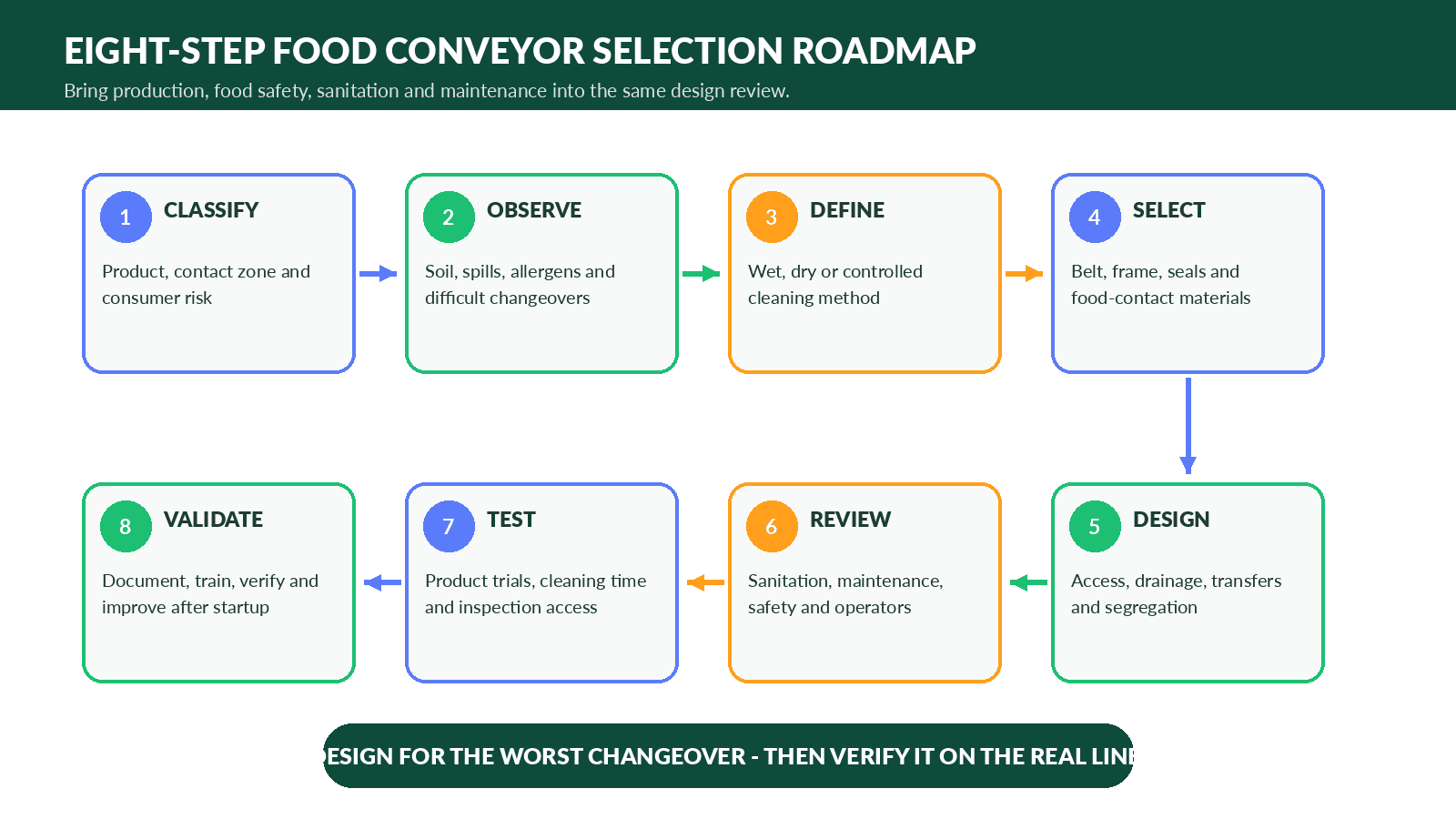
Eight-step roadmap: design, trial and verify the conveyor with the people who will run and clean it.
Information to Share for an Accurate Quotation
A useful quotation needs more than conveyor length and width. Share the information that determines product handling and hygienic design:
| Information group | Details to provide |
| Product and process | Food name, physical condition, minimum and maximum size, weight, temperature, stickiness, oil, moisture, fragility and packaging state. |
| Contact and hygiene zone | Direct contact, exposed nearby product, primary pack, secondary pack, raw, cooked, ready-to-eat and required segregation. |
| Soil and contamination | Crumbs, paste, fat, sugar, powder, allergens, broken product, chemicals and expected spill conditions. |
| Cleaning method | Dry pickup, vacuum, foam, rinse, sanitiser, water temperature, pressure limits, frequency and required drying time. |
| Materials and declarations | Required food-contact documentation, belt material preference, stainless specification, lubricant and chemical compatibility needs. |
| Performance | Normal and peak throughput, line speed, duty cycle, accumulation, product spacing and planned growth. |
| Layout | Length, width, elevation, curves, inclines, transfer heights, surrounding machines, floor drains and available access. |
| Controls | Start/stop, variable speed, sensors, inspection, rejection, machine handshakes, PLC/HMI and traceability interfaces. |
| Safety and access | Guards, isolation points, sanitation access, maintenance envelope, walkways and operator interaction. |
| Acceptance | Product trial, cleaning trial, FAT/SAT, documentation, training, spares, response time and performance criteria. |
Common Food Conveyor Design Mistakes
– Choosing a white or blue belt and assuming the entire machine is now food grade.
– Specifying stainless steel without defining grade, finish, weld quality, chemical exposure or drainage.
– Designing for the average product while ignoring crumbs, broken pieces, sticky batches and worst-case spills.
– Allowing the belt carrying surface to be cleaned while leaving the return path and support bed inaccessible.
– Using hollow frames with open ends, damaged caps or uninspectable internal spaces.
– Placing bearings, cable trays, fasteners or lubrication points directly above exposed product.
– Adding guards and covers that control safety risk but make sanitation access impractical.
– Using high-pressure cleaning where it can force water or soil into bearings, enclosures or neighbouring hygienic zones.
– Ignoring drainage and discovering after installation that rinse water crosses walkways or pools under the line.
– Planning allergen changeover only through an SOP without testing actual residue retention and cleaning access.
– Purchasing the conveyor before the sanitation method, chemicals and available cleaning window are defined.
– Accepting the line after a dry product run without a full cleaning, drying, reassembly and pre-op inspection trial.
Frequently Asked Questions
1. What is the best conveyor for food processing?
There is no single best type. The correct food processing conveyor system depends on the product, contact zone, cleaning method, temperature, route, throughput and contamination risk. Solid belts, modular belts, slat chains, wire mesh, screw conveyors and packaged-product rollers each suit different applications.
2. Does stainless steel automatically make a conveyor hygienic?
No. Stainless steel can provide useful corrosion resistance and cleanability, but hygiene also depends on surface condition, welds, geometry, drainage, accessibility, joints, fasteners, seals and the way the equipment is installed and maintained.
3. Which conveyor belt material is food grade?
Food-contact suitability is application-specific. The supplier should provide relevant material information, while the plant should confirm compatibility with the food, temperature, contact time, cleaning chemicals, mechanical load and applicable requirements.
4. Is a modular plastic belt better than a solid belt?
Not universally. Modular belts can provide positive drive, drainage and replaceable sections, but hinges and rods require cleaning attention. Solid belts provide continuous support and may reduce openings, but splices, underside access and belt release remain important. Product trials and sanitation review should decide.
5. What is a washdown conveyor?
A washdown conveyor is designed so that its materials, geometry, electrical components and access support a defined wet-cleaning process. The term should not be accepted without confirming water pressure, temperature, chemicals, drainage, ingress protection and cleaning procedure.
6. Can roller conveyors be used in food plants?
Yes, especially for sealed cartons, crates, totes or secondary packaging in suitable zones. For exposed food, roller gaps, bearings, underside access and cleaning complexity usually require closer assessment.
7. How can a conveyor reduce allergen changeover time?
Reduce retention points, provide safe access, use removable or dedicated parts where appropriate, control parts storage, select cleanable surfaces and validate the actual changeover. Faster access is useful only when the required cleaning and verification outcome is maintained.
8. Should food conveyors use wet or dry cleaning?
The product and hazard determine the method. Wet cleaning may suit many moist or ready-to-eat operations; dry cleaning may be essential for low-moisture foods where water creates risk. Some lines need a controlled combination. Follow the plant sanitation programme and risk assessment.
9. How should a food conveyor be drained?
Surfaces should be oriented so water and product leave the equipment without pooling, entering hollow sections, crossing clean zones or creating slippery areas. The final drainage path must be coordinated with floors, drains, utilities and neighbouring machines.
10. What should be tested before accepting a food conveyor?
Test representative and worst-case products, transfer performance, peak rate, cleaning access, belt release, drainage, drying, reassembly, guarding, controls, maintenance access and the agreed sanitation verification process.
11. How often should a food conveyor be cleaned?
Frequency depends on the food, process, hazard, production schedule and regulatory or customer requirements. It should be defined in the documented sanitation programme, not assumed from the equipment type.
12. What details should I send a conveyor manufacturer?
Provide product data, contact zone, soil and allergen information, cleaning method, throughput, layout, materials, controls, safety needs, utilities, acceptance tests and the available sanitation window. Photos, videos, drawings and a process flow are especially useful.
Conclusion
The right food processing conveyor system does more than move product from one operation to the next. It makes safe work easier to repeat. It gives the cleaning team access instead of obstacles, gives maintenance a controlled way to service components, gives quality a practical way to inspect and verify, and gives production a line that can return to service without avoidable delay.
The most useful design question is not, “Can this conveyor run the product?” It is, “Can the complete team run, clean, inspect, maintain, change over and restart it under real plant conditions?” When that question is answered early, hygiene becomes part of the engineering rather than a nightly struggle.
| Discuss your food conveyor requirement with Convello Share the food or package, contact zone, cleaning method, throughput, layout, transfer points, materials and automation needs. Convello can review the requirement and recommend a belt, screw, slat, roller or custom conveyor arrangement suited to the application. Final hygiene and compliance decisions should be confirmed through the plant food-safety team and applicable regulations. |