+91 99980 88430 | +91 95589 17778
 info@convello.in | sales@convello.in

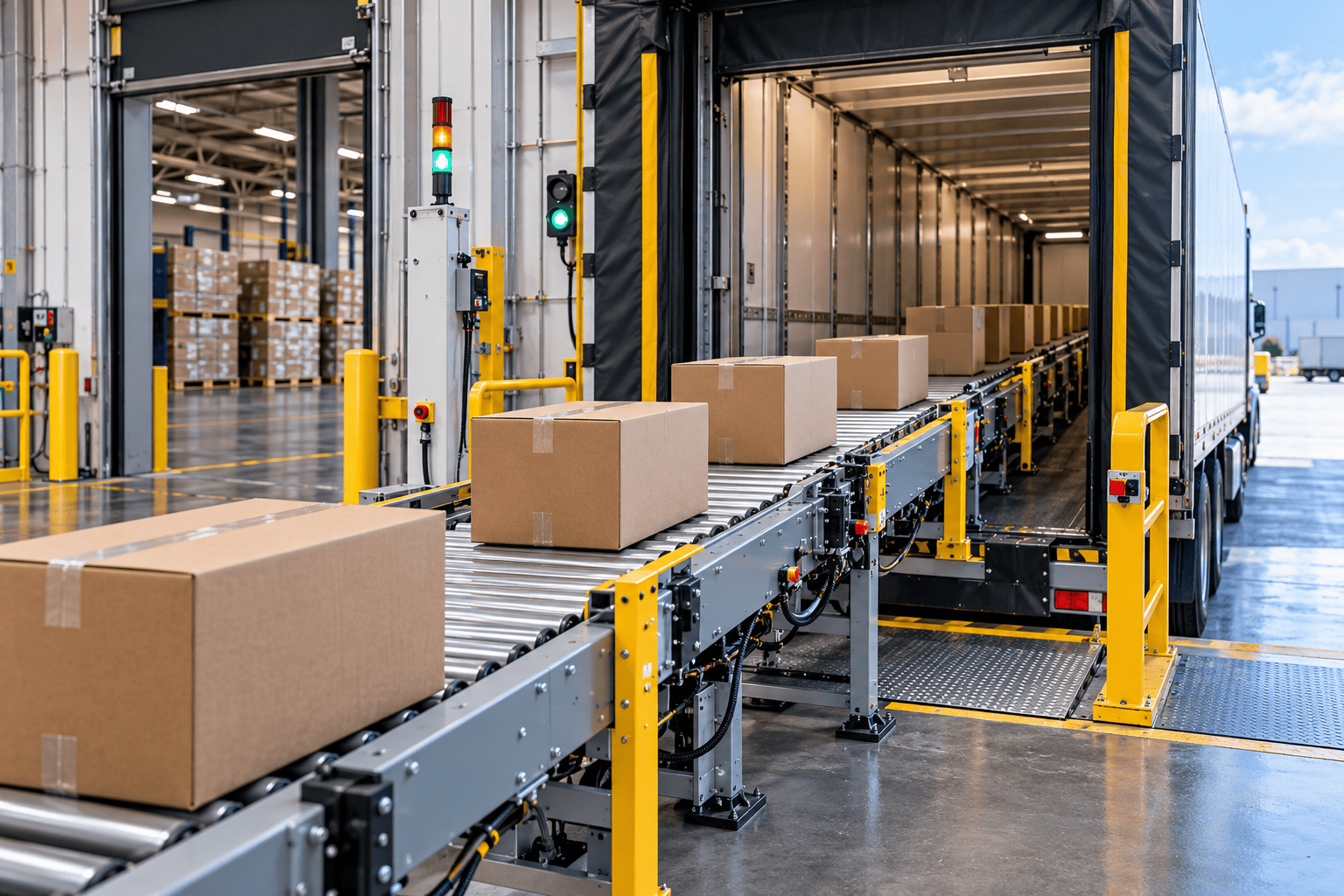
At 6:05 p.m., the final dispatch vehicle is almost ready to leave. The driver has signed one document, the warehouse team believes two cartons remain, and the telescopic conveyor is still extended into the trailer. A red dock light is visible, but nobody has formally told the driver who owns the release decision.
Then the truck moves. Not a metre. Not even half a metre. Only a few centimetres – enough for the conveyor nose to shift against the trailer floor and for every person at the bay to stop talking at the same time.
Nobody is injured. Nothing falls. The vehicle is brought back into position. Yet the near miss exposes something important: the belt was not the only machine in the job. The vehicle, dock edge, conveyor, product flow, driver, operators and traffic route were acting as one temporary system, but they were not being controlled as one system.
This is the point many truck loading conveyor safety discussions miss. A conveyor can reduce carrying, walking and repeated handling. It can bring cartons closer to the operator and support a steadier dispatch rhythm. But it cannot secure the truck, inspect a damaged trailer floor, decide who may release the vehicle or make an unsafe jam-clearing method acceptable.
| A conveyor can remove carrying. It cannot secure the truck. Safer loading starts by controlling the complete interface – vehicle, dock, conveyor, product and people – through normal operation, interruption, recovery and final handover. |
What Truck Loading Conveyor Safety Really Means
Truck loading conveyor safety is the coordinated control of the loading or unloading task, not simply the purchase of a conveyor with an emergency-stop button. The correct system depends on the vehicle, dock height, product, duty cycle, available space, worker roles, traffic pattern and the way faults are recovered.
A good loading arrangement should answer practical questions before the first carton moves: Can the vehicle move? Is the trailer floor sound? Is the bridge or dockboard secure? Can the conveyor roll, retract or tip unexpectedly? What happens when the receiving operator cannot keep up? Where does a damaged carton go? Who confirms that the vehicle may leave?
The answers should be visible in the physical design and operating method. If they exist only in a supervisor’s memory, they will become less reliable during shift change, peak dispatch, poor weather, overtime or a fault.
The Five Interfaces That Must Agree
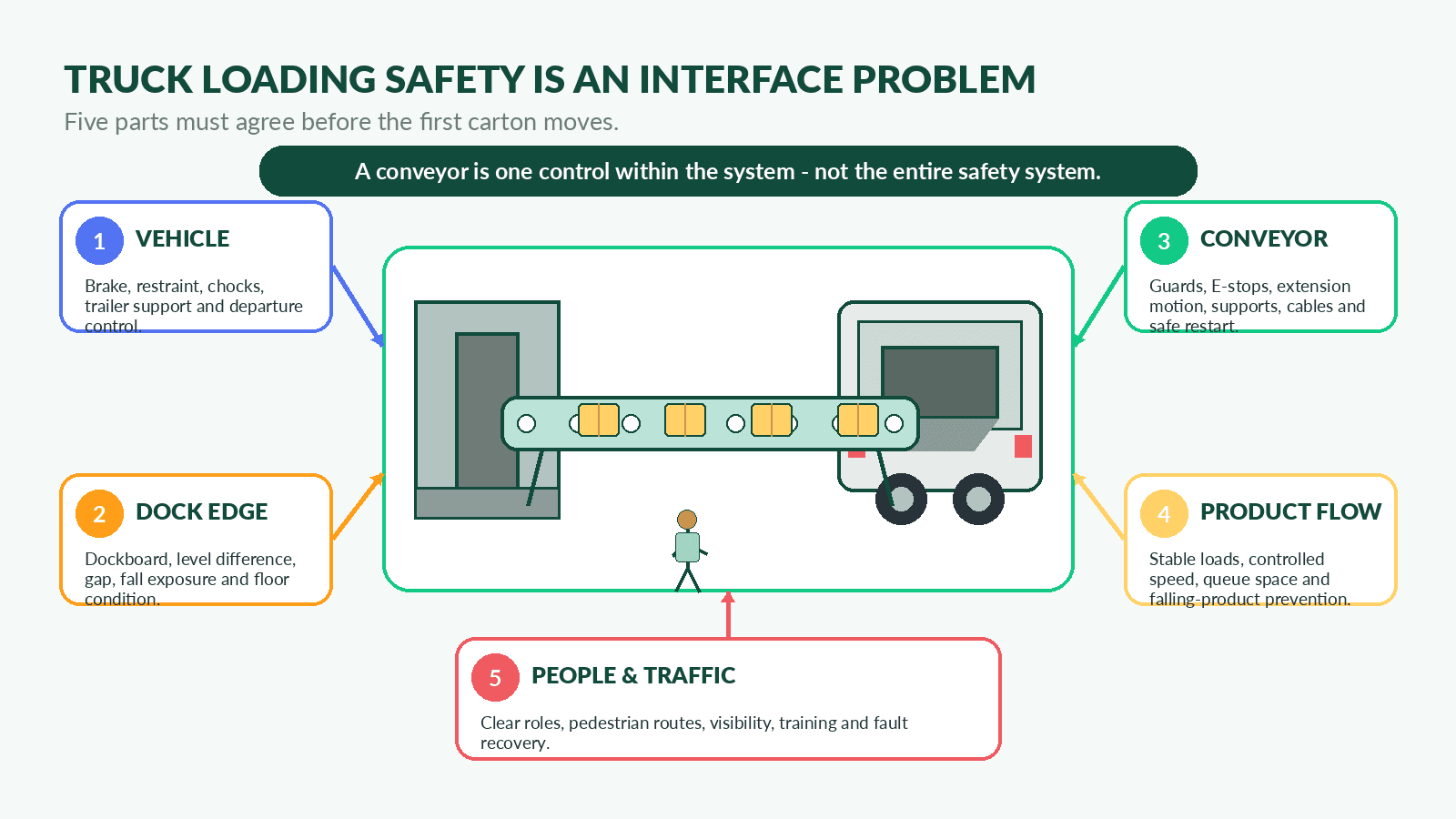
Truck loading safety is an interface problem: vehicle, dock edge, conveyor, product flow and people must be controlled together.
1. The vehicle interface
The vehicle must remain in a known, controlled state while people or equipment are exposed at the rear. Depending on the site and vehicle, the control method may include the parking brake, wheel chocks, a vehicle-restraint system, trailer support and a dock-status signal. The important point is not which device looks impressive; it is whether the control is suitable, applied correctly, checked and included in the release procedure.
2. The dock-edge interface
The gap between the building and vehicle may involve a dockboard, leveller, bridge plate, ground-level ramp or direct conveyor approach. Capacity, movement, edge protection, trailer height, floor condition and the path of wheels or conveyor supports all matter. A secure bridge does not compensate for a damaged trailer floor, and a sound trailer does not make an unsecured bridge acceptable.
3. The conveyor interface
The conveyor introduces drives, belts or rollers, nip points, extension motion, adjustable height, castors, cables, sensors and stored energy. These features must be selected, guarded and controlled around the real task. A portable conveyor that works well at one bay may become unstable when extended, turned or positioned on an uneven surface at another.
4. The product-flow interface
Cartons do not always arrive square, sealed and evenly spaced. Bags can sag. Damaged boxes can open. Labels can catch. A conveyor that feeds faster than the operator can stack creates pressure inside the trailer; a conveyor that starts unexpectedly can release several products at once. Speed, queue space, side guides, stopping logic and product suitability therefore belong in the safety conversation.
5. The people and traffic interface
Drivers, warehouse operators, forklift drivers, maintenance technicians and supervisors may all approach the same bay for different reasons. Their routes and authority should be explicit. The operator inside a trailer needs a safe way to request a stop; the driver needs an unambiguous release; maintenance needs a controlled method to isolate energy; pedestrians need a route that does not cross moving equipment or reversing traffic without protection.
Which Conveyor Is Suitable for the Loading Area?
There is no universally safest conveyor type. The safer choice is the one that fits the product, vehicle access, duty cycle, floor condition, operator task and control method. The table below is a starting point, not a substitute for engineering review.
| Conveyor option | Where it often fits | Useful contribution | Safety-critical design questions |
| Telescopic belt conveyor | Dedicated dock with frequent carton, parcel or bag loading | Extends into the vehicle and can reduce long loaded walks | Extension/retraction travel, nose position, supports, guarding, E-stops, limit controls and vehicle-release interlock |
| Portable truck-loading belt conveyor | Multiple bays, ground-level loading or changing routes | Can be moved to the active location and provide inclined transfer | Castor/brake stability, support legs, cable route, slope, product rollback, position before start and storage |
| Flexible scissor roller conveyor | Temporary carton flow, courier dispatch and variable bay positions | Compact storage and adjustable route for suitable flat-bottom products | Wheel locks, curve stability, slope, roller pitch, carton base condition and uncontrolled gravity movement |
| Fixed belt or powered roller line | High-repeatability dock or dispatch cell connected to packing/sortation | Predictable feed and easier integration with sensors and zones | Dock transition, queue logic, end-stop condition, guarding, bypass/recovery route and building traffic |
Conveyor choice should follow the complete loading task, not only the required length.
Telescopic Belt Conveyors for Dedicated High-Volume Docks
A telescopic conveyor can reach deeper into a truck or container so the working point follows the load rather than forcing people to carry every item along the full vehicle length. This can be valuable where cartons, parcels or bags move continuously through a dedicated dock.
The same extension that improves reach creates a moving interface that needs clear limits and ownership. The design should consider the nose height, operator visibility, vertical adjustment, extension and retraction speed, collision with stacked products, trailer roof and wall clearance, emergency stops, warning before motion and what happens if the vehicle position changes.
Portable Belt Conveyors for Multi-Bay or Ground-Level Work
Portable truck-loading conveyors are useful when one piece of equipment serves several doors, containers or ground-level vehicles. Their flexibility is also their design challenge. Supports, castors, brakes, cables, plugs and incline angle must be safe in every approved configuration, not only the arrangement used during commissioning.
A sensible operating method includes a marked parking position, an inspection before movement, a controlled route between bays, positive wheel or castor locking, safe cable management, confirmation of incline and discharge height, and a test run before product is introduced.
Flexible Roller Conveyors for Suitable Cartons
Expandable roller conveyors can create a temporary path where fixed steelwork would block another activity. They work best with products that have a stable, sufficiently rigid base. Soft bags, very small boxes, damaged cartons and products with protrusions need separate assessment because they may bridge gaps, skew or become unstable.
Gravity sections also need deliberate slope and end control. A line that relies on an operator’s hand to slow every carton is not controlled flow. Powered versions need the same attention to stops, start warning, zones and accessible recovery as a fixed conveyor.
Fifteen Practical Design and Control Decisions
1. Define who owns the vehicle release
The vehicle should not leave because “loading looks finished.” Define the responsible person, the confirmation method and the sequence for retracting equipment, clearing people, closing doors, removing controls and authorising departure. Drivers and warehouse teams should receive the same signal, not separate assumptions.
2. Select a suitable vehicle-control method
Parking brakes, chocks, restraint systems and trailer supports serve different conditions. The chosen method should suit the vehicles, dock geometry and exposure. Include checks for uncoupled trailers, mixed fleets, visiting drivers and situations where the loading team cannot see the cab.
3. Inspect the trailer before entry or conveyor placement
Check the floor, doors, roof clearance, water, debris, sharp edges, lighting and signs of structural damage. A conveyor may transfer product over a surface that later has to support operators, powered equipment or concentrated loads. Damaged or questionable vehicles need a defined escalation route.
4. Verify the dockboard, leveller or bridge
Confirm capacity, condition, position and protection against unintended movement. Check that wheels or conveyor supports cannot run off an unprotected edge and that the plate follows the intended vehicle movement range. Do not treat a bridge plate as a convenient place to park loose tools or damaged cartons.
5. Match the conveyor to the product
Record the smallest and largest item, base condition, weight, centre of gravity, packaging damage and any loose straps or film. Belt conveyors provide continuous support; rollers require a suitable base and adequate support points. Side guides should control products without crushing weak packaging or creating snag points.
6. Design stable support and mobility
Portable equipment needs a defined operating footprint, support arrangement and locking method. Check stability at maximum extension, incline and load. Floor joints, drain channels, dock slopes and wheel damage can change the behaviour of a mobile conveyor that appeared stable on a clean factory floor.
7. Guard the real moving hazards
Review drive components, return belts, sprockets, rollers, nip points, lift mechanisms and telescopic sections in the actual operating positions. Guarding should prevent access to hazards while still allowing inspection and maintenance through controlled methods. A cover that must be removed every shift without a safe alternative will eventually be bypassed.
8. Put stop controls where people can reach them
The operator at the dock face and the operator inside the vehicle may not share the same line of sight. Provide appropriate normal stops, emergency stops, pull cords or local controls based on the risk assessment. Clearly distinguish emergency stopping from energy isolation and require a deliberate reset after the cause has been addressed.
9. Control direction, speed and restart
Loading and unloading often use reversible conveyors. Direction should be obvious, selected deliberately and prevented from changing unexpectedly. Start warnings, permissives and restart logic should account for hidden areas inside the vehicle and for products already resting on the conveyor.
10. Size queues around the receiving task
The fastest belt does not set the safe operating rate. The person stacking inside the trailer, the destination lane, the palletising point or the downstream conveyor may be slower. Use accumulation, zoning, product-present sensors or controlled release so a temporary pause does not become a pile-up or falling-product hazard.
11. Prevent falling or uncontrolled products
Review side guides, end stops, incline grip, product spacing and the height difference at every transfer. Consider what happens when a box is open, wet, crushed or unusually light. Avoid placing people beneath elevated transfer points unless the risk has been controlled.
12. Protect cables, lighting and visibility
Portable systems often bring power and control cables across a busy area. Route and protect them against wheels, doors, sharp edges, water and trip exposure. Provide lighting inside the trailer and around the dock status, controls, product path and pedestrian route. Glare and deep shadow can hide damaged packaging or a person at the conveyor nose.
13. Separate people from forklifts and reversing traffic
A conveyor can reduce forklift entry into a trailer, but it may also create a fixed obstacle in the bay. Mark pedestrian routes, define exclusion areas, control crossing points and maintain visibility. The dock operating plan should include drivers who leave the cab, contractors and people who approach from adjacent bays.
14. Design ergonomics around the full shift
Set the working height and reach around the actual package range, trailer fill pattern and operator population. Rotating tasks, lift aids, adjustable nose height and a conveyor that follows the load can reduce avoidable travel, but repetitive lifting, twisting and high or low stacking still require assessment.
15. Design fault recovery before commissioning
Write the response to a jam, skewed carton, sensor fault, power loss, failed restraint, damaged trailer or emergency stop. Define who may intervene, what must stop, when energy isolation is required, which tools are used, how guards are replaced and how the system is checked before restart.
Ergonomics: What the Conveyor Changes – and What It Does Not
Consider an illustrative dispatch shift handling 1,200 cartons at an average 7 kg. If each carton is carried 12 metres into the vehicle, the team completes 14.4 kilometres of loaded walking while handling 8.4 tonnes of product mass. If a conveyor brings the carton to within about 2 metres of the stacking position, loaded walking falls to roughly 2.4 kilometres – around 12 kilometres avoided in that simplified example.
That is useful, but it is not an injury-reduction claim. The operator still lifts, turns and places the carton. Stack height changes during the load. Heat, trailer ventilation, floor grip, product weight variation and pace remain important. The conveyor should therefore be considered one ergonomic control within a broader work design.
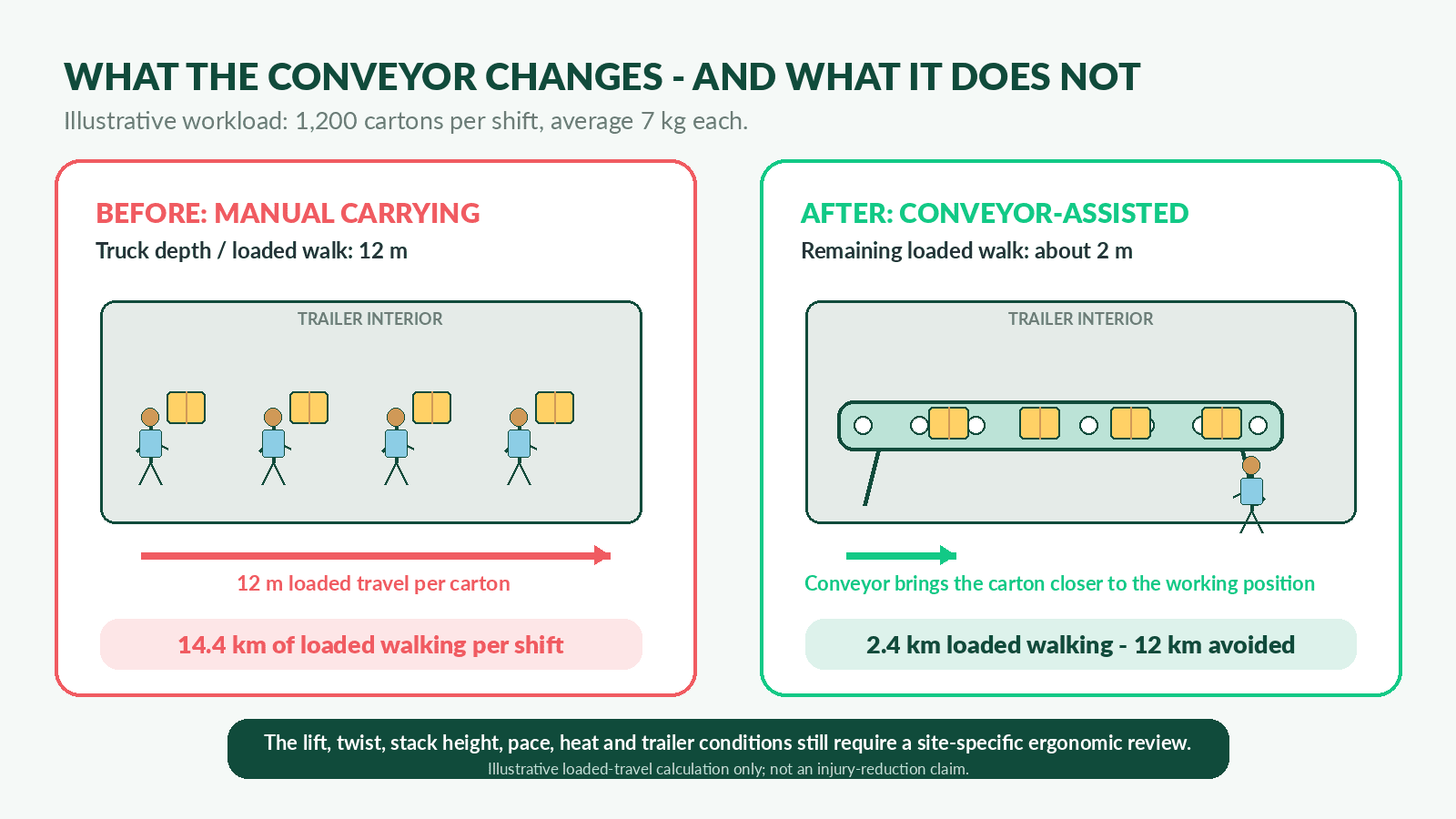
Illustrative manual and conveyor-assisted carton travel: less loaded walking does not remove the need to review lifting, twisting and stacking.
| Ask the loading team three questions Where do you wait? Where do you carry? Where do you improvise? The answers often reveal the handoff, control or recovery problem faster than a catalogue discussion about maximum belt speed. |
Throughput, Queues and Product Control Inside the Vehicle
A loading conveyor can move more product than the operator can stack safely. The system therefore needs a controlled relationship between conveyor release rate and the receiving task. This is especially important when the worker is turning, building a stable wall, changing stack pattern or moving the conveyor nose.
For a simple planning example, assume a conveyor releases 24 cartons per minute while the stacking task can sustain 20 cartons per minute for a 90-second period. The queue grows by 4 cartons per minute. Over 1.5 minutes, the theoretical queue is 6 cartons. An initial design might reserve 8 to 10 controlled positions, then validate spacing, product stability, zone logic, recovery speed and operator visibility during trials.
| Illustrative queue calculation Queue growth = (release rate – receiving rate) × interruption duration. Here: (24 – 20) cartons/min × 1.5 min = 6 cartons. Do not convert this directly into conveyor length without considering product pitch, sensors, stopping distance and the acceptable location of the queue. |
The control philosophy should also define what happens when the downstream person requests a pause, a carton falls, the destination is full or the conveyor loses product detection. A useful stop should prevent additional product from entering the problem while preserving a safe recovery route.
A Ten-Step Safe Loading and Unloading Sequence
A written sequence gives the team a shared operating picture. It should be adapted to the site, vehicle-control method and equipment, then practiced during normal work and realistic interruptions.
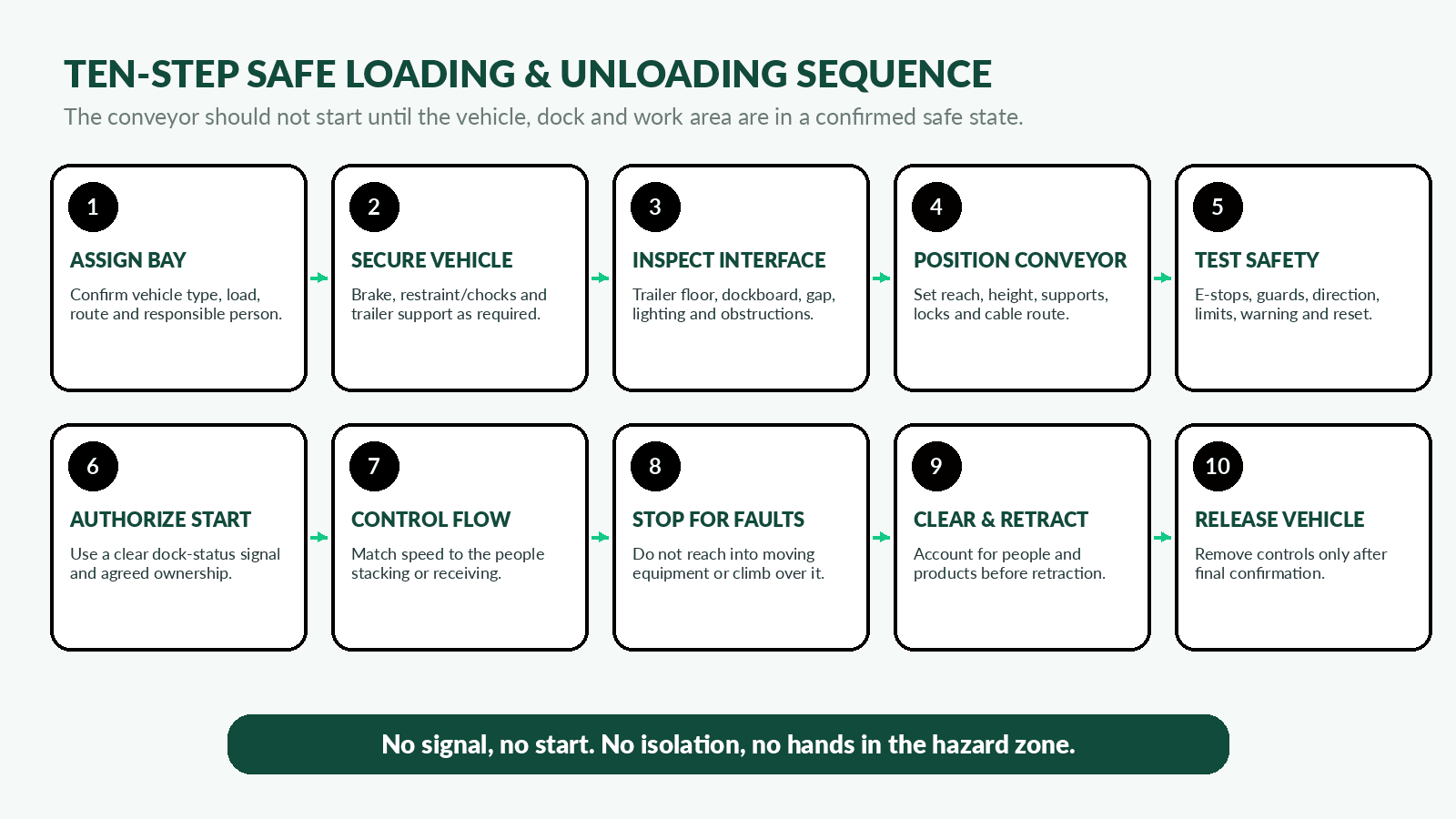
Ten-step operating sequence: assign the bay, secure the vehicle, inspect, position, test, authorise, control, recover, clear and release.
| Step | What the team confirms |
| 1. Assign the bay | Confirm the vehicle, product, loading direction, responsible person and planned equipment. |
| 2. Secure the vehicle | Apply the approved parking, restraint, chocking and trailer-support controls as required. |
| 3. Inspect the interface | Check trailer floor, doors, dockboard/leveller, gap, lighting, obstructions and weather effects. |
| 4. Position the conveyor | Set reach, height, supports, castor locks, side guides and cable route. |
| 5. Test safety functions | Check guards, stops, direction, limits, warnings, sensors and deliberate reset. |
| 6. Authorise start | Use the agreed dock-status signal and confirm that people are in their approved positions. |
| 7. Control product flow | Match release rate to stacking or receiving capacity and manage queues. |
| 8. Stop for faults | Use the appropriate stop; do not reach into moving equipment or improvise access. |
| 9. Clear and retract | Account for people and products, restore guards, clear the dock and retract/park equipment. |
| 10. Release the vehicle | Complete final confirmation before removing vehicle controls or giving a departure signal. |
Pre-Start Inspection, Jam Clearing and Controlled Restart
The difference between a normal stop, an emergency stop and energy isolation should be understood before a jam occurs. A normal stop controls routine operation. An emergency stop is a protective action for an emergency situation. Energy isolation controls hazardous energy before work that could expose a person. Pressing reset is not the same as isolating energy.
The site procedure should consider electrical, mechanical, gravitational, pneumatic and other stored energy. Telescopic sections, raised conveyors, spring-loaded tensioning, inclined products and unsupported trailer equipment can retain or create movement even after the motor has stopped.
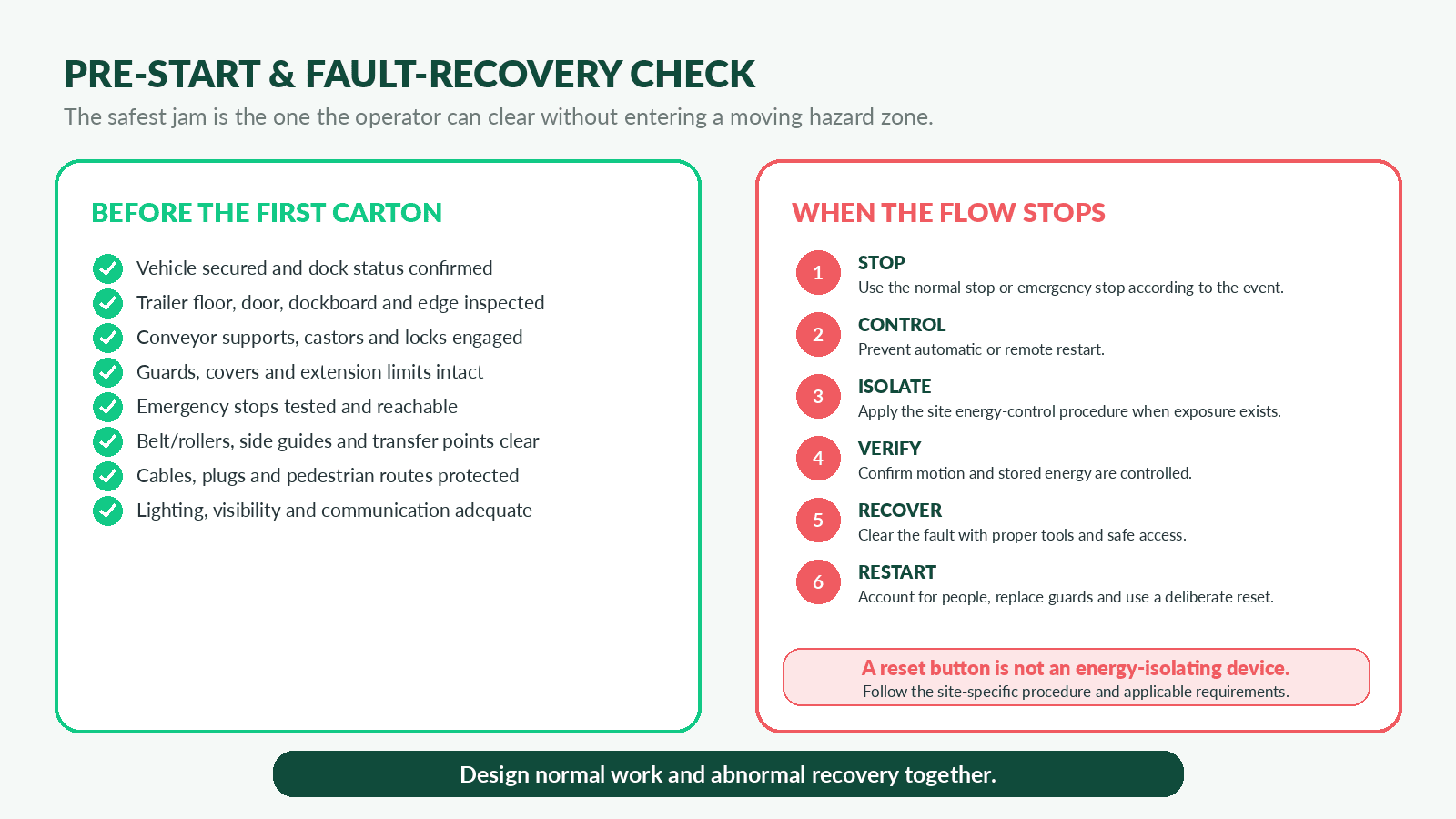
Pre-start and fault-recovery checklist: design abnormal recovery with the same care as normal loading.
A useful recovery sequence is: stop, control restart, isolate when exposure requires it, verify the controlled state, recover with the right access and tools, then account for people, restore guards and restart deliberately. The exact method must come from the site-specific risk assessment and energy-control procedure.
A Practical Dispatch-Bay Improvement Example
A mid-sized distribution centre loads mixed cartons into two vehicles during the final two hours of each shift. The old method uses a fixed gravity section ending several metres from the trailer nose. Operators carry cartons forward, empty pallets accumulate beside the bay and a forklift occasionally crosses the pedestrian route to remove overflow.
The team initially asks for a faster conveyor. Observation shows that speed is not the main loss. The real problems are changing trailer depth, inconsistent stacking pace, no controlled queue, unclear driver release and a recovery method that requires an operator to walk around the equipment whenever a carton skews.
The improvement concept uses a telescopic belt conveyor at the high-volume bay and a portable belt conveyor for the second, variable bay. The high-volume system receives a local stop inside the trailer, product-present sensing, controlled release zones, visible dock status and a defined retraction-before-release sequence. The portable system receives marked operating positions, castor locks, a protected cable route and an inspection checklist for each move.
The project also changes the work method: one person owns the dock status, destination-full is treated as a controlled stop rather than a reason to stack on the floor, damaged cartons have a defined side location, and the loading team practices a power-loss and jam-recovery drill before production handover.
This is a stronger solution than simply increasing belt speed because it addresses the moments when people used to wait, carry and improvise.
How to Measure Whether the New System Is Working
Do not judge the project only by average truck turnaround. Track a small set of leading and operating measures that reveal whether the loading interface is becoming more controlled.
| KPI area | Useful measures |
| Vehicle-control compliance | Completed pre-start and release confirmations; restraint/chock exceptions |
| Near misses | Unexpected vehicle movement, falling product, pedestrian conflict and recovery events |
| Manual handling | Loaded walking distance, product touches and high/low placement frequency |
| Product flow | Blocked minutes, queue-full stops, cartons fallen or damaged and manual bypasses |
| Fault recovery | Jam entries, time to safe state, guards removed, repeat faults and reset attempts |
| Safety-device health | E-stop, limit, interlock, sensor and warning-device test results |
| Operational performance | Sustainable cartons per hour, loading completion variance and vehicle turnaround |
| Maintainability | Inspection defects, emergency repairs, planned maintenance completion and critical-spare use |
The most useful trend is often the one that shows fewer improvised recoveries. A line that achieves a faster average by encouraging operators to bypass controls has not improved.
When a Conveyor Is Not the First Answer
A conveyor is not automatically the correct solution. If loading happens only occasionally, the product mix changes radically, vehicles cannot be positioned consistently or the facility has unresolved traffic and dock-control problems, a simpler process change may be the better first step.
Examples include changing the staging location, standardising packaging, repairing the dock, improving vehicle scheduling, separating pedestrians, adding lighting, clarifying release authority or using a suitable lift aid. A conveyor should solve a defined material-flow and handling problem; it should not be used to decorate an unstable process.
Information to Share Before Requesting a Conveyor Quote
A useful quotation needs more than length and width. Share the operating environment and failure conditions so the supplier can design the complete interface.
- Vehicle types, internal dimensions, dock height range, door geometry and how trailers are coupled or uncoupled.
- Loading and unloading directions, normal and peak cartons per hour, shift duration and seasonal peaks.
- Smallest, largest, lightest and heaviest product; base condition; packaging quality; loose film, straps or labels.
- Required conveyor reach, retracted storage space, incline/decline, available floor area and approved operating positions.
- Dockboard, leveller, ground-level ramp or bridge arrangement; trailer-floor loads and building constraints.
- Vehicle restraint, wheel-chock, dock-light or departure-control system already in use.
- Operator positions, stacking method, work height, trailer entry, ventilation and lighting conditions.
- Forklift routes, pedestrian routes, adjacent bays, reversing traffic and driver waiting area.
- Electrical supply, plug type, cable route, controls standard, PLC/HMI integration and network requirements.
- Required normal stops, emergency stops, pull cords, warnings, limit switches and safety-related functions.
- Cleaning environment, rain/dust exposure, temperature, corrosive materials and required construction finish.
- Maintenance access, isolation points, critical spares, documentation, training and acceptance-test requirements.
- Expected shutdown window, installation responsibility, site induction and commissioning constraints.
Common Truck Loading Conveyor Mistakes
| Mistake | Why it matters |
| Buying by maximum belt speed | The real constraint is often stacking, destination capacity, vehicle changeover or recovery. |
| Treating the driver and loading team as separate systems | Unclear release ownership allows different assumptions at the same bay. |
| Testing only with perfect cartons | Damaged, soft, wet or open products expose transfer and guide problems. |
| Ignoring maximum extension or incline | Portable and telescopic equipment can behave differently at the edge of its operating range. |
| Placing controls only at the fixed end | The person inside the vehicle may need a local, reachable way to stop the flow. |
| Using the E-stop as a routine operating stop | This confuses emergency action, normal stopping and safe restart. |
| Clearing jams without a recovery design | People reach, climb or bypass guards when the intended access is poor. |
| No destination-full logic | Products continue to arrive when the operator or lane cannot receive them. |
| Loose cables across the bay | Mobility is gained at the expense of trip, damage and power-loss exposure. |
| Releasing the vehicle before equipment is clear | The departure process must include conveyor retraction, people and product confirmation. |
Frequently Asked Questions
1. Does a truck loading conveyor make loading safe by itself?
No. It can reduce carrying and support controlled product flow, but vehicle control, trailer condition, dock connection, guarding, traffic separation, training and fault recovery still need to be designed.
2. Which conveyor is suitable for loading cartons into trucks?
Dedicated high-volume docks often benefit from telescopic belt conveyors. Portable belt or flexible roller conveyors may suit multi-bay or temporary operations. Product base, vehicle access, throughput and site layout determine the selection.
3. Can a telescopic conveyor be used for unloading as well as loading?
Many systems can operate in both directions when designed and controlled for that use. Direction selection, queue logic, operator positions and safe restart should be clearly defined.
4. What safety devices should a loading conveyor include?
The required devices depend on the risk assessment. Common considerations include guards, reachable stop controls, emergency stops, limit switches, start warnings, direction indication, product sensing, support locks and appropriate safety-related control functions.
5. Are wheel chocks enough to secure every truck?
Not necessarily. Vehicle type, dock arrangement, slope, trailer coupling and site rules matter. The project should use a suitable, verified vehicle-control method and a clear departure-release process.
6. How can a conveyor reduce manual handling?
It can bring the product closer to the stacking or receiving position, reduce loaded walking and remove some transfers. Lifting, turning, stack height and repetitive pace remain and should still be assessed.
7. How fast should a truck loading conveyor run?
The speed should support sustainable product flow without exceeding the ability of people or downstream equipment to receive safely. Test normal product, damaged product, peak demand, pauses and recovery.
8. How much accumulation is required?
Estimate the difference between release and receiving rates during a realistic interruption, then validate the result against product pitch, conveyor stopping behaviour, available space and acceptable queue location.
9. What is the difference between an emergency stop and isolation?
An emergency stop is a protective action for an emergency. Energy isolation controls hazardous energy before exposure during servicing or certain recovery tasks. A reset or stop button is not an isolation device.
10. Can a flexible roller conveyor handle bags and pouches?
Only after product trials and engineering review. Flexible rollers generally favour stable, flat-bottom products. Soft or small packages may sag, bridge gaps or skew, making a continuous belt more suitable.
11. What should be tested during commissioning?
Test vehicle and dock scenarios, approved conveyor positions, safety devices, controls, product range, peak flow, full destination, damaged cartons, power loss, sensor faults, jam recovery, retraction and vehicle release.
12. What information does Convello need to prepare a quotation?
Share product data, vehicle and dock dimensions, throughput, layout, operating positions, traffic routes, controls, safety requirements, environment, installation constraints and representative photos or drawings.
Conclusion: Control the Handoffs, Not Just the Belt
The safest truck loading conveyor is not simply the longest, fastest or most automated model. It is the system that fits the vehicle and product, keeps the dock interface controlled, reduces unnecessary carrying, stops product before a queue becomes a hazard, gives operators clear authority and provides a safe route through abnormal events.
Watch the work at the end of a difficult shift. Notice where people wait, carry and improvise. Those moments usually reveal the decisions the conveyor project must address.
| Planning a loading or unloading conveyor? Share the vehicle types, product range, dock arrangement, throughput, layout, operating positions and current pain points with Convello. The team can review whether a telescopic, portable, flexible, fixed or hybrid conveyor arrangement suits the application. |