+91 99980 88430 | +91 95589 17778
 info@convello.in | sales@convello.in

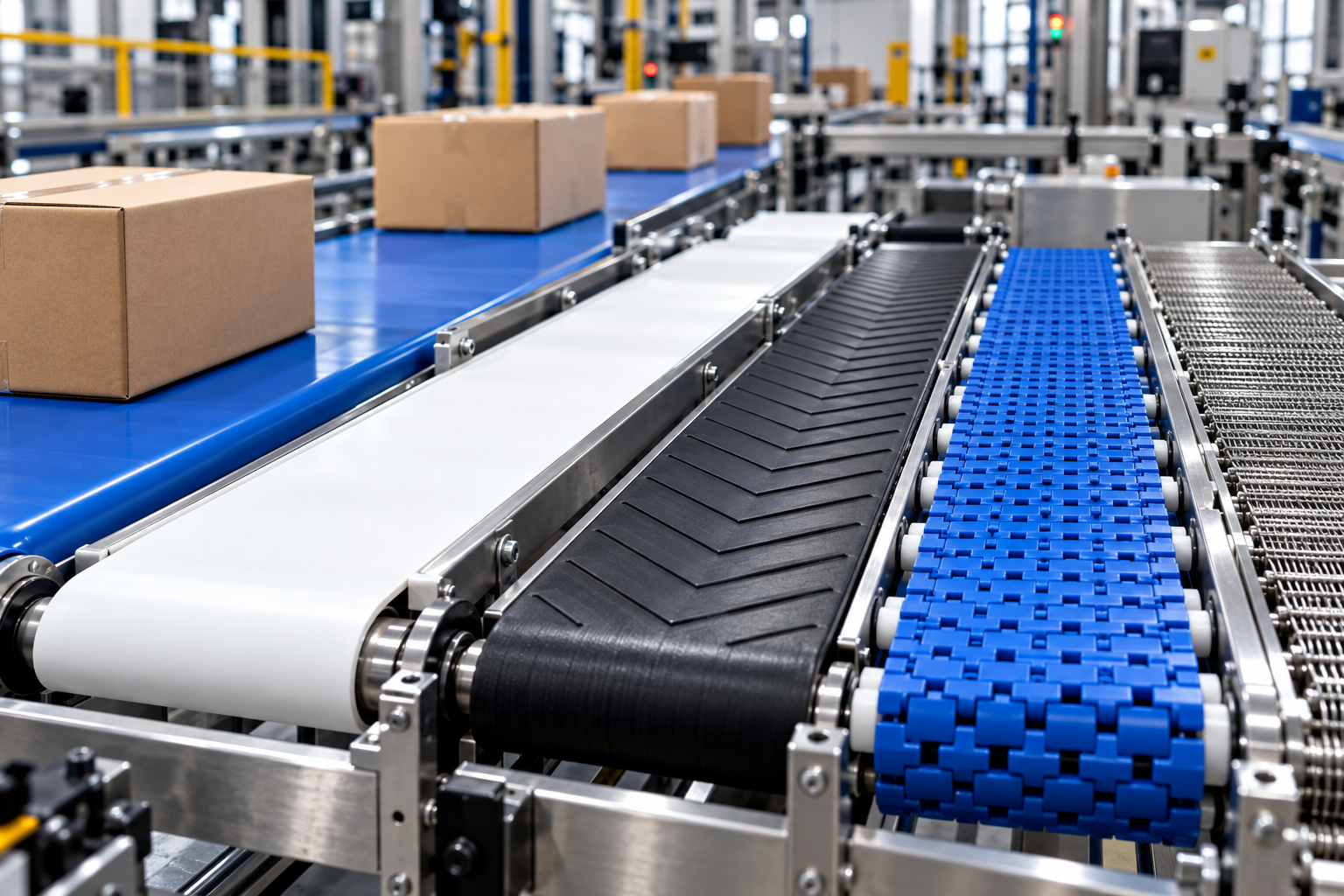
| Quick answer There is no universally best conveyor belt material. The correct selection is the belt grade and construction that supports the actual product, route, speed, environment, cleaning method and maintenance plan. Start with the product and worst normal operating condition, not with colour, price or the material currently installed. |
At 6:40 A.M., the Replacement Belt Looked Perfect
The maintenance team had finished before first shift. The replacement belt was clean, centred and properly joined. During the empty test run, it tracked well. At 6:40 a.m., the production supervisor signed the line back into service.
By 9:15, small detergent cartons were hesitating on the incline. An operator began nudging every tenth carton. At noon, labels were showing faint scuff marks. Later, the sanitation team reported that the approved cleaner left the surface tackier than expected. The motor had not failed, the splice was intact and the conveyor frame had not moved. Yet the line was already developing new workarounds around a belt that was less than one shift old.
| The human clue The belt was new. The line was already adapting around it. Operators were compensating for grip, surface behaviour and cleaning response before anyone called the issue a belt-selection problem. |
This is why conveyor belt material selection should not begin with a catalogue colour or a single line on a purchase order. A belt touches the product thousands of times. It bends around pulleys, slides over a bed, runs through dust or moisture, meets cleaners and oils, and crosses transfer points where a few millimetres can decide whether a pouch moves smoothly or folds into a jam.
A practical selection conversation starts with simple questions: What slips? What sticks? What gets hot? What gets wet? What gets trapped? What does the operator have to wipe, lift or adjust during the shift? Those answers often matter more than the generic label on the top cover.
What Conveyor Belt Material Selection Really Includes
The phrase “belt material” is useful, but incomplete. Two belts described as PVC can behave very differently because their surface profile, thickness, fabric reinforcement, underside, splice and formulation are different. The final specification normally includes several layers of decisions:
- Top cover or conveying surface – the part that touches the product.
- Carcass or reinforcement – fabric or other structure that carries tension and controls stretch.
- Running side – the underside that contacts pulleys, slider beds or rollers.
- Surface profile – smooth, matte, rough-top, diamond, crescent, fabric or another pattern.
- Overall thickness and minimum pulley diameter – important at small transfers and compact drives.
- Splice or joining method – endless joint, mechanical fastener or application-specific connection.
- Accessories – cleats, sidewalls, tracking guides, perforations, flights or sealed edges.
- Application documentation – food-contact declarations, antistatic properties, flame behaviour, chemical resistance or other project-specific evidence where required.
A good conveyor supplier therefore asks for the product, process and environment before recommending a belt. The material family is the start of the discussion, not the final answer.
Quick Comparison: Six Conveyor Belt Material Families
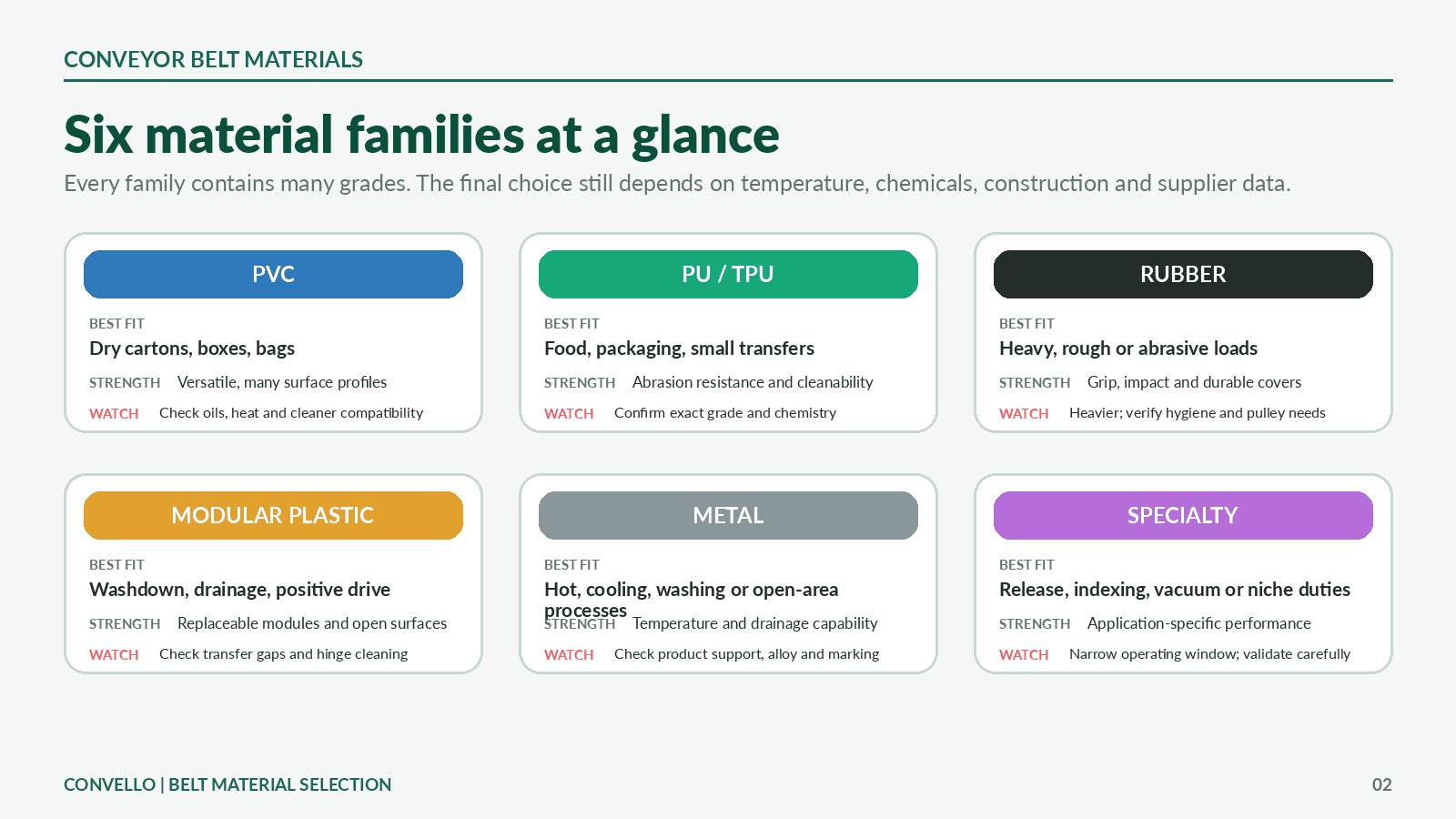
Six material families at a glance. Every family includes multiple grades and constructions.
| Material family | Common starting applications | Potential strengths | Important checks |
| PVC fabric belt | Dry cartons, boxes, bags, general packaging and unit loads | Broad range of surfaces; familiar maintenance; often economical | Confirm oils, heat, cleaning chemicals, flexing and food-contact documentation |
| PU / TPU fabric or monolithic belt | Food, packaging, small-pulley, abrasion or selected oily applications | Good surface options, cleanability and abrasion performance in suitable grades | Exact polymer grade, hydrolysis, temperature and chemical compatibility matter |
| Rubber belt | Heavy loads, rough bags, abrasive or impact-prone applications | Grip, impact absorption and durable cover options | Heavier construction, pulley size, energy, marking and hygiene must be checked |
| Modular plastic belt | Washdown, drainage, positive drive, curves and replaceable sections | Sprocket drive; modules and accessories; open-surface options | Transfer gaps, hinge cleaning, noise, impact and product support require design |
| Metal belt or wire mesh | High-temperature, cooling, washing, drying and open-area processes | Temperature capability, drainage and airflow in suitable designs | Alloy, corrosion, product marking, support, tracking and maintenance must be engineered |
| Specialty belt | Release, vacuum, indexing, antistatic or unusual temperature duties | Targeted performance for a narrow requirement | Do not generalise; validate the exact grade and operating window |
The table is a starting map, not a universal approval list. A wet, oily, hot or hygienic duty can move the same product from one belt family to another. The actual grade and conveyor design must be reviewed together.
1. PVC Conveyor Belts: The General-Purpose Starting Point
PVC fabric belts are widely used for light and medium unit handling because they are available in many thicknesses, colours and surface patterns. They can be a practical choice for cartons, boxes, bags, packaged goods, inspection lines and general manufacturing where the environment is reasonably controlled.
The real choice is often not simply “PVC or not PVC”. It is smooth versus textured, low-friction versus grip surface, one-ply versus multi-ply, and fabric underside versus coated underside. A smooth PVC belt may transfer a flat carton well on a horizontal line but struggle when dust settles on an incline. A rough-top belt may improve grip yet hold more residue and increase marking on a delicate package.
| Shop-floor question Does the problem happen only after dust builds up, after cleaning, or when the product changes? That pattern often reveals whether the surface and environment are mismatched rather than the drive being too small. |
PVC should not be treated as a single chemical-resistance or temperature rating. Oils, fats, detergents, ambient heat, product heat and the cleaning cycle can all change suitability. Use the supplier data for the exact belt grade and test with the actual product when the operating condition is important.
2. PU or TPU Belts: When Cleanability, Flexing or Abrasion Matters
PU and TPU belts are often considered where a tougher surface, smaller pulley diameter, cleanability or selected oil and fat resistance is important. They are common in food, packaging and precision product handling, but the exact formulation and construction still decide the result.
A fabric-reinforced PU belt and a monolithic positive-drive belt are not interchangeable ideas. One may offer a thin, flexible construction for small transfers; the other may remove fabric layers from the product-contact area and support a different cleaning strategy. Both can still fail if the temperature, cleaner, tension, pulley diameter or splice is outside the approved range.
The phrase “food grade” also needs discipline. Food suitability belongs to a specific belt grade, colourant, construction and supporting declaration – not to the letters PU on their own. The hygienic performance of the full conveyor also depends on frame access, edges, guides, returns, drains and the cleaning method.
3. Rubber Conveyor Belts: For Heavier, Rougher and More Abrasive Duty
Rubber belts are a familiar choice for heavier products, rough bags, impact zones and abrasive material handling. Depending on the grade and construction, they can provide strong grip, cover thickness and resistance to wear. This is valuable when sacks are dropped onto a loading section or when sharp, irregular material would quickly damage a lighter belt.
The same robust construction can create trade-offs. A thicker belt may need larger pulleys and more drive torque. The surface may mark delicate packaging. The belt may be less suitable for a hygiene-critical process unless the exact grade, construction and cleaning approach are proven. A heavy-duty answer should be chosen because the duty demands it, not because it feels safer on paper.
For an incline, do not solve every slip problem by adding tension. Grip profile, product base, dust, loading point, centre of gravity and incline angle should be reviewed first. Excess tension can create bearing load, splice stress and tracking problems without solving the underlying surface mismatch.
4. Modular Plastic Belts: Positive Drive, Drainage and Replaceable Sections
Modular plastic belts are assembled from interlocking modules and driven by sprockets. They can support positive drive, open surfaces, drainage, flights, side guards, curves and replacement of damaged sections. These features make them attractive in washdown, packaged-food, container, crate and selected production applications.
They are not automatically the cleanest or most flexible answer. Hinge areas, rods, sprockets and supports must be accessible to the cleaning method. Small products may need nose bars, transfer plates or a different belt because the pitch and transfer gap are too large. Impact can damage modules, and accumulation behaviour may differ from a low-friction fabric belt.
The useful question is not “Can a modular belt be washed?” It is “Can this specific belt and conveyor be opened, cleaned, inspected, drained and restarted within the plant’s real sanitation window?”
5. Metal and Wire-Mesh Belts: For Heat, Airflow and Open-Area Processing
Metal belts and wire-mesh constructions are used in selected heating, baking, cooling, washing, draining and drying processes because they can provide open area, airflow and temperature capability that polymer belts may not offer. The alloy, weave, edge, drive and support arrangement must match the process.
The product may see every wire intersection. Small or soft items can sag, mark or catch. Metal belts can also transfer heat into or away from the product, which may be useful or harmful. Corrosion, thermal expansion, sanitation, lubrication, tracking and maintenance access are all part of the design.
Measure the product temperature at the moment it contacts the belt. The oven setpoint, room temperature and product-core temperature are not the same thing. A ten-minute production trial can reveal more than a catalogue comparison when thermal behaviour is important.
6. Specialty Belts: Useful When the Requirement Is Specific
Specialty options can include silicone surfaces, PTFE-coated materials, timing belts, vacuum belts, perforated belts, antistatic constructions, flame-retardant grades and other application-specific products. These belts can solve a defined release, indexing, suction, electrical or temperature problem.
Their strength is focus. Their risk is over-generalisation. A belt selected for release may have different grip, wear or splice behaviour. A belt selected for antistatic performance still needs the whole conveyor grounding and maintenance approach reviewed. Treat specialty properties as part of a complete specification, not as a marketing shortcut.
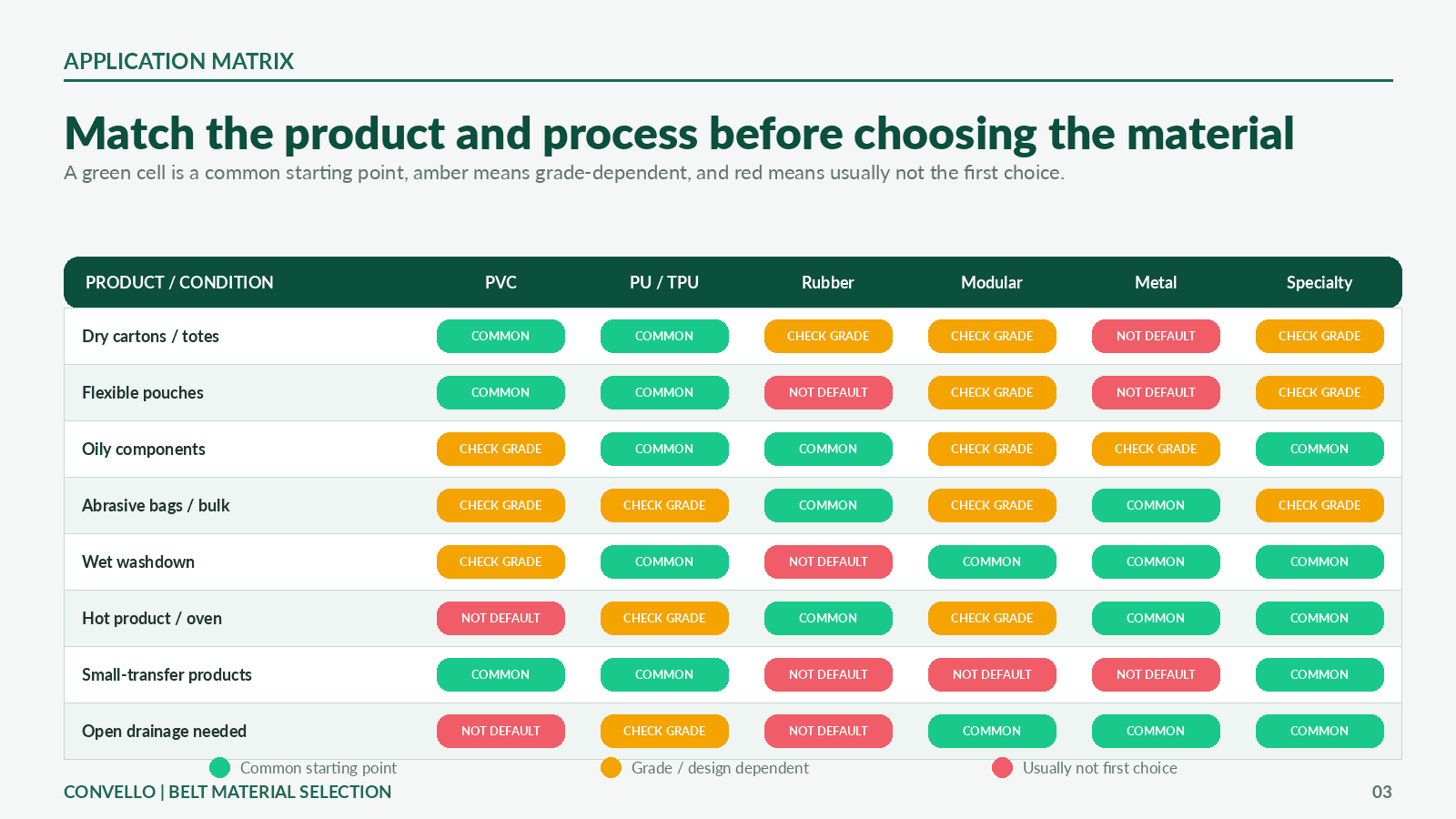
Application matrix: common starting points still require grade and design validation.
Fifteen Factors That Can Change the Correct Belt
| Selection factor | Why it matters |
| 1. Product underside | Flat, ribbed, flexible, oily, dusty, sharp, soft or unstable. The surface touching the belt often decides grip and support. |
| 2. Product dimensions and weight | Include the smallest and largest item, maximum unit weight and total load per metre. |
| 3. Orientation and centre of gravity | Tall containers and soft packs can tip or rotate even when the belt has enough capacity. |
| 4. Route and incline | Horizontal, incline, decline, curve, elevation change and reversible operation create different friction and containment needs. |
| 5. Transfer geometry | Pulley diameter, nose bar, dead plate, gap and matching line height matter for small products and delicate packaging. |
| 6. Speed and motion profile | Continuous motion, indexing, rapid starts, stops and reversing affect grip, stretch and splice stress. |
| 7. Accumulation behaviour | Some products need low-friction slip; others must remain positively located without back pressure. |
| 8. Product and ambient temperature | Record minimum, normal and maximum contact temperatures, including start-up and cleaning. |
| 9. Abrasion and impact | Dust, sharp edges, dropped loads and trapped debris can wear the cover, modules or splice. |
| 10. Oils, fats and process chemicals | Identify everything that touches the belt, including product leaks, lubricants and cleaning agents. |
| 11. Cleaning method | Dry wipe, foam, spray, hot water, steam, chemical concentration, contact time and inspection access all matter. |
| 12. Hygiene and documentation | Define direct contact, exposed product, packaged product and required declarations before selection. |
| 13. Moisture and drainage | Standing water, washdown, condensation and open-area needs may change belt construction and frame design. |
| 14. Electrical or fire-related properties | Where relevant, define antistatic, conductivity or flame behaviour with the complete conveyor and site requirements. |
| 15. Maintenance reality | Splicing skills, spare availability, change time, access and local support can decide lifecycle performance. |
| A better selection question Do not ask only, “What material is the product?” Ask, “What is the worst normal combination of product, contamination, temperature, speed and cleaning that this belt must survive every week?” |
Belt Material Is Not the Same as Belt Surface
A material family describes the chemistry and basic construction. The surface determines how that belt behaves against the product. Two belts from the same family can deliver opposite results because one is smooth and low-friction while the other is rough, tacky or profiled.
| Surface or accessory | Why it may be selected | Watch-outs |
| Smooth / matte | General horizontal conveying, inspection and transfers | Can be easier to clean, but may provide limited incline grip |
| Rough-top / grip-top | Inclines, declines and products that tend to slide | Can mark products, trap soil or increase transfer resistance |
| Low-friction | Accumulation and controlled product slip | Requires careful side-guide, stop and back-pressure design |
| Fabric or impression surface | Release, gentle handling or special product contact | Texture can affect cleanability and product marking |
| Cleated / flighted | Inclines, spacing or bulk containment | Cleat pitch, height, product damage and return clearance matter |
| Perforated / vacuum | Hold-down, suction or drainage duties | Hole pattern, cleaning and vacuum system capacity must match |
| Sidewall or edge containment | Loose products or steep routes | Flexing, cleaning, transfer and return-path access require design |
A belt material can be chemically suitable and still fail operationally because its surface friction is wrong. This is why a representative product sample is one of the most useful items to send with a quotation request.
Three Practical Application Scenarios
Scenario 1: Cartons on a Dusty Incline
A distribution line carries corrugated cartons up a modest incline. The cartons move correctly after cleaning but begin to hesitate late in the shift. The first response is to tighten the belt. That may temporarily increase traction, but it also raises bearing and splice load.
The better investigation checks carton underside, dust, incline angle, loading pattern, surface profile and required cleaning. A suitable textured PVC or PU belt may be considered, but the sample must be tested for label scuffing, transfer behaviour and residue retention. The answer is the belt and surface that keeps moving the actual carton without creating a new cleaning or maintenance problem.
Scenario 2: Seasoned Pouches After Filling
Flexible pouches leave a filler with small amounts of oil and seasoning on their surfaces. They need continuous support, short transfers and stable presentation to a checkweigher. A roller conveyor would not support them well, and a generic smooth belt may become unpredictable as oil accumulates.
A suitable PU or TPU belt may be shortlisted, but only after confirming the exact oil, cleaner, temperature, pulley diameter, transfer nose and cleaning cycle. The team should test both a clean pouch and the worst normal pouch from late in the run. The “best” material is the one that remains predictable after the process has made it dirty.
Scenario 3: Hot Machined Components
Machined components leave a process warmer than the room, occasionally carrying oil and sharp burrs. The conveyor has short accumulation periods, and the product must not be marked before inspection. A standard light belt selected from ambient temperature alone may soften, cut or transfer residue.
The team should measure contact temperature, edge condition, weight, impact and cooling time. Depending on the result, a heat-resistant rubber, metal, modular or specialty belt may be evaluated. Product support and marking are as important as maximum temperature. A technically heat-resistant belt that scratches the component is still the wrong belt.
Warning Signs That the Material May Be Mismatched
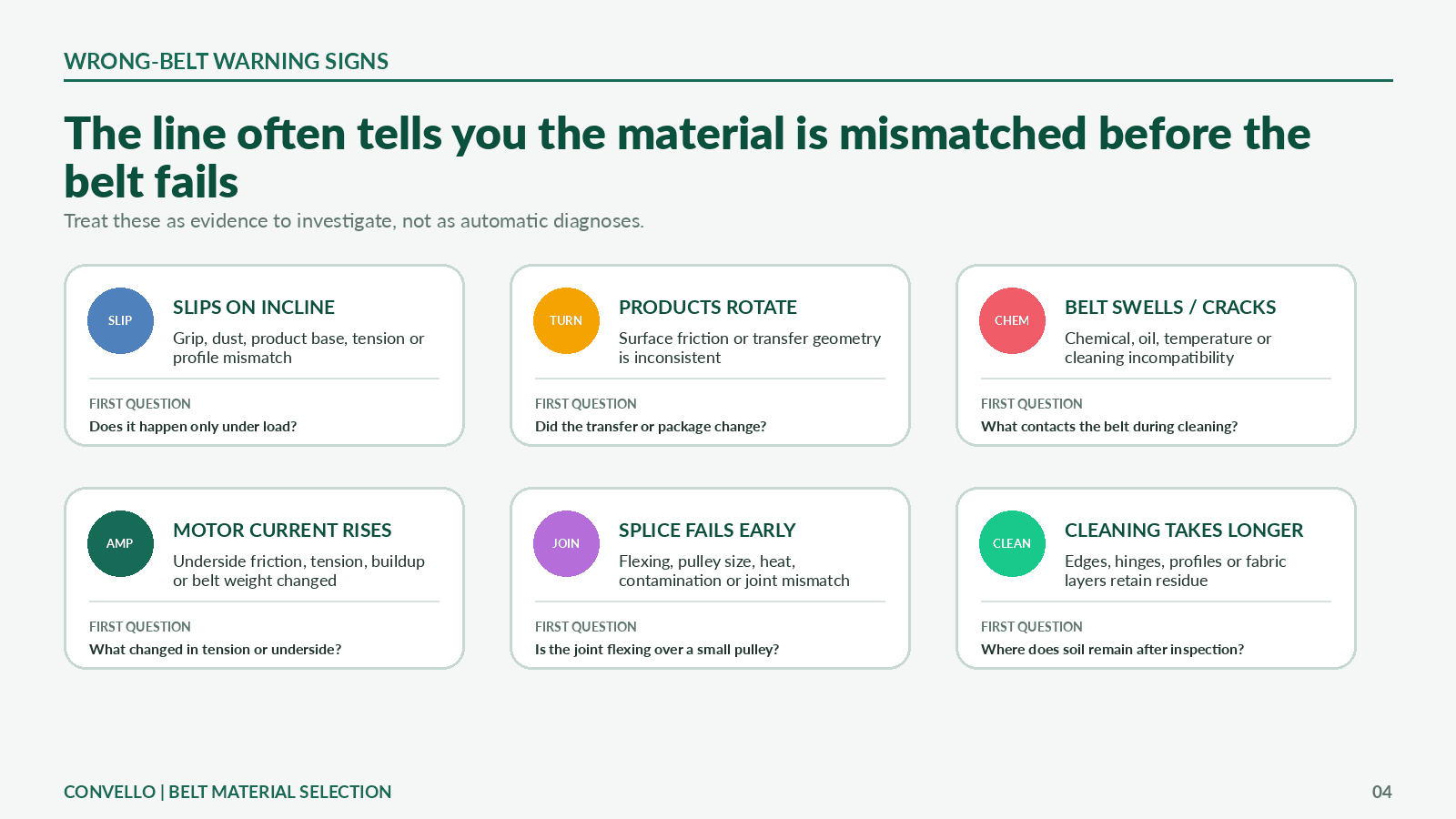
The line often shows evidence of a mismatch before the belt fails.
| Observed pattern | What to investigate |
| The line runs empty but fails under load | Surface grip, support, belt stretch, drive capacity or product interaction may be different under real load. |
| Tracking changes after cleaning | Moisture, chemical exposure, residue, tension or uneven friction may be affecting the belt. |
| Motor current is higher than before | Underside friction, excess tension, buildup, belt weight or misalignment should be checked. |
| Products rotate or arrive crooked | Surface friction, guides, transfer geometry or inconsistent package underside may be involved. |
| The belt softens, swells, cracks or becomes tacky | Oil, chemical, temperature or cleaning incompatibility may exist. |
| The splice fails repeatedly | Pulley size, flexing, contamination, heat, tension or joint selection may be wrong. |
| Cleaning takes longer than planned | Profiles, fabric layers, hinges, edges or inaccessible returns may be retaining residue. |
| Operators keep changing tension | The team may be using tension to compensate for grip, tracking, loading or transfer problems. |
These are not automatic diagnoses. They are reasons to stop guessing and collect evidence. Change one controlled variable at a time, record the result and validate the correction under representative load.
Lifecycle Cost: The Lowest Purchase Price May Not Be the Lowest Cost
Belt cost is visible on the purchase order. The cost of a poor selection is spread across production, maintenance, sanitation, product quality and operator time. A belt that costs less but needs more tension, cleaning, tracking and replacement may be the most expensive component on the line.
| Lifecycle-cost area | What to include |
| Purchase and joining | Belt, fabrication, splice, fasteners, installation and commissioning |
| Planned replacement time | Production window, access, tools, technicians and restart verification |
| Unplanned downtime | Lost production, overtime, delayed dispatch and downstream disruption |
| Cleaning and sanitation | Labour, water, chemicals, drying time and pre-start inspection |
| Energy and mechanical load | Drive current, slider-bed friction, tension and bearing load |
| Product quality | Scuffing, tipping, contamination, heat transfer, marking and rejects |
| Spares and availability | Lead time, local stock, exact specification control and emergency alternatives |
| Illustrative decision Suppose Belt A is Rs 23,000 cheaper than Belt B. If Belt A creates only three additional 35-minute production stops in a year, the apparent saving can disappear quickly once production loss, maintenance time and recovery are counted. Use your plant values; this is a method, not a market benchmark. |
How to Run a Useful Belt Sample Trial
A sample trial should reproduce the worst normal condition, not the easiest product on a clean bench. Use the smallest and largest item, the poorest packaging condition that is still accepted, the actual incline or transfer, and the same contamination and cleaning method seen in production.
- Photograph and record the product underside, weight, dimensions and condition.
- Test dry, wet, dusty or oily states that occur during a normal shift.
- Use the real incline, speed, start-stop pattern and accumulation time where possible.
- Check the smallest pulley or transfer diameter in the proposed design.
- Run enough cycles to reveal heat, tracking, stretch, residue and surface change.
- Apply the approved cleaning chemical at the real concentration, temperature and contact time.
- Inspect product marking, belt surface, splice, edges, underside and return path.
- Record the exact belt code, construction, splice and result. A colour description is not a specification.
Eight-Step Conveyor Belt Material Selection Workflow
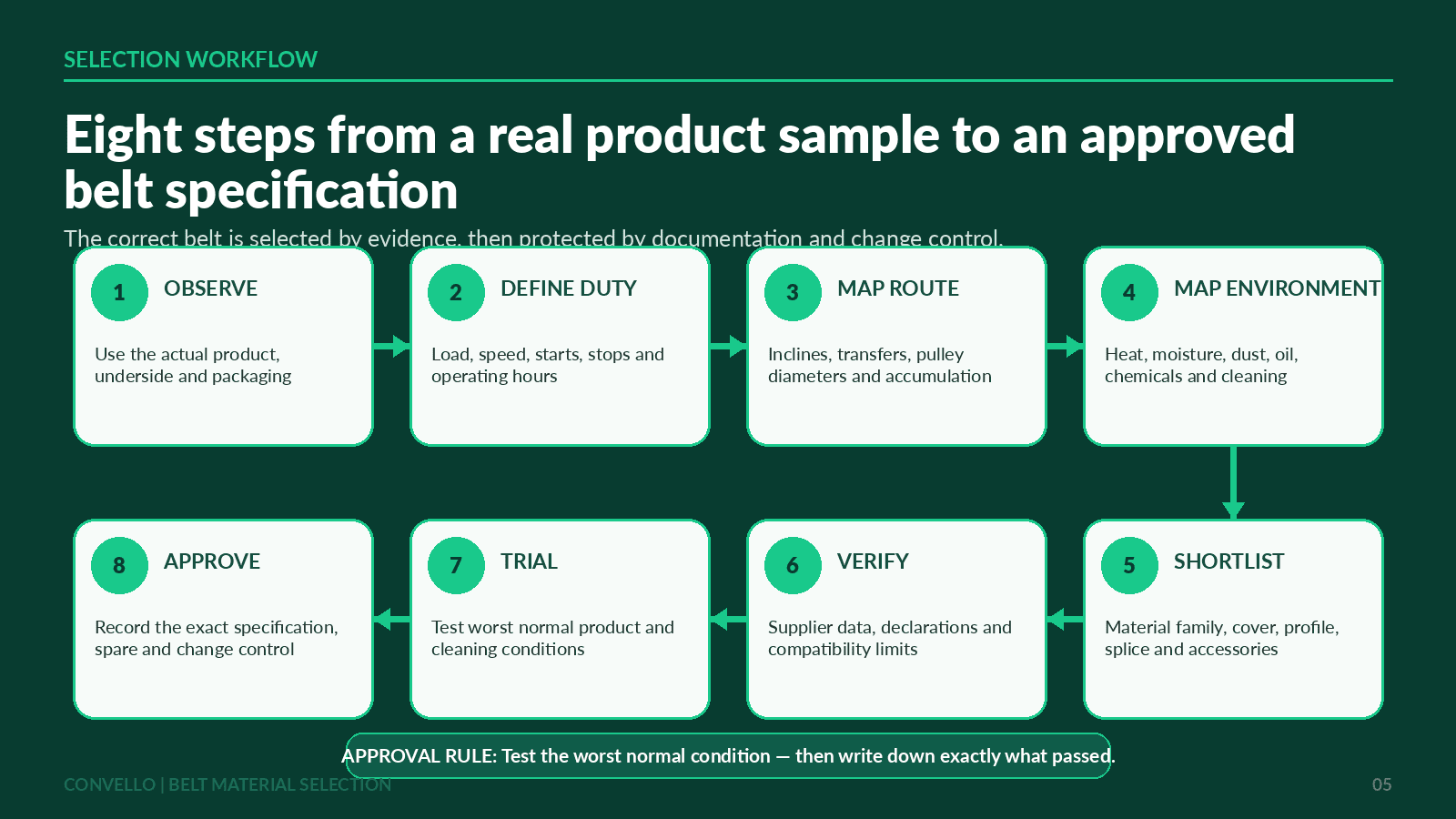
Select by evidence, then protect the result with documentation and change control.
| Step | Practical action |
| 1. Observe the actual product | Use real samples, including the underside, packaging variation, contamination and worst accepted condition. |
| 2. Define the duty | Record unit weight, load per metre, speed, throughput, starts, stops, operating hours and accumulation. |
| 3. Map the route | Include incline, decline, transfers, pulley diameters, supports, curves, reversing and available space. |
| 4. Map the environment | List temperatures, moisture, dust, oil, fats, chemicals, cleaning and outdoor exposure. |
| 5. Shortlist the complete construction | Choose the material family, top surface, reinforcement, underside, thickness, splice, cleats, guides and edges. |
| 6. Verify data and documentation | Review manufacturer limits, compatibility, food-contact evidence and project-specific requirements. |
| 7. Trial the worst normal condition | Test representative products and cleaning. Observe the line under load, not only during an empty run. |
| 8. Approve and control changes | Record the exact belt code and supplier. Define the approved spare and require review before substitution. |
Information to Share for an Accurate Belt Conveyor Quote
- Product name, photos, dimensions, weight and underside condition
- Smallest, largest and heaviest product, plus load per metre
- Required throughput, belt speed, starts, stops and operating hours
- Conveyor length, width, incline or decline and transfer heights
- Drive and tail pulley diameters, nose bars and any tight transfers
- Product and ambient temperature range at the belt contact point
- Dust, oil, fat, moisture, chemicals and cleaning method
- Hygiene zone and any required food-contact or material declarations
- Current belt code, construction and splice if an existing line is being changed
- Current problems: slipping, tracking, marking, swelling, buildup, wear or cleaning time
- Preferred surface, cleats, sidewalls, guides, sealed edges or perforations
- Available maintenance window, local splicing capability and spare-belt strategy
- Layout drawing, process video and representative product samples
A short video from the product entry, transfer, incline and discharge often explains more than a long email. Show the line during the problem, not only after it has been cleaned and reset.
Common Conveyor Belt Selection Mistakes
| Mistake | Why it causes trouble |
| Selecting by colour | Green, blue, white or black does not define chemistry, construction, food suitability or temperature range. |
| Using the current belt as the only specification | The current belt may already be the reason the line is underperforming. |
| Saying only “food grade” | Define product contact, cleaning method, declarations, hygiene zone and conveyor access. |
| Using the maximum temperature as a single number | Consider product contact temperature, duration, ambient heat, cleaning and thermal cycling. |
| Ignoring the underside | Slider-bed friction, pulley contact, tracking and drive behaviour depend on the running side. |
| Adding tension to solve every grip problem | Excess tension can create bearing, splice and tracking problems. |
| Choosing a deep profile without cleaning review | Grip can improve while sanitation time and residue retention become worse. |
| Testing only a perfect package | Use worst normal cartons, pouches, bags or components from production. |
| Ignoring the splice and pulley diameter | A suitable cover can still fail if the joint or flexing requirement is wrong. |
| Approving a generic replacement | Record the exact manufacturer code, construction and approved alternative. |
| No spare strategy | A correct but unavailable belt can still create long downtime. |
| Changing several variables at once | A controlled trial should show which change actually solved the problem. |
Frequently Asked Questions
Which conveyor belt material is best?
There is no universal best material. The correct belt is the exact grade and construction that fits the product, load, route, temperature, cleaning, chemicals, speed and maintenance plan.
What is the difference between PVC and PU conveyor belts?
PVC and PU are different polymer families, but real performance also depends on formulation, thickness, reinforcement, surface, underside and splice. PU or TPU is often considered for demanding abrasion, hygiene or small-pulley duties, while PVC is widely used for general unit handling. Confirm the exact grade.
Is a PU belt always food grade?
No. Food-contact suitability belongs to a specific belt grade and supporting declaration. The full conveyor design and cleaning method also affect hygienic performance.
When should a rubber conveyor belt be selected?
Rubber is commonly considered for heavier, rougher, impact-prone or abrasive duties where grip and durable cover thickness are important. Pulley size, product marking, hygiene and energy should still be reviewed.
What are the advantages of modular plastic belts?
They can provide positive sprocket drive, open surfaces, drainage, curves, flights and replacement of damaged modules. Transfer gaps, hinge cleaning, noise, impact and product support must be designed.
When is a metal conveyor belt suitable?
Metal or wire-mesh belts are used in selected heating, cooling, washing, drying and open-area processes. Alloy, temperature, corrosion, support, product marking and maintenance must be engineered.
How do I choose a belt for an incline?
Check product base, centre of gravity, incline angle, dust, moisture, speed, surface profile, cleats and side containment. Do not rely only on extra tension.
How do oils and cleaning chemicals affect belt choice?
Compatibility is grade-specific. Provide the exact oil, fat, chemical name, concentration, temperature, contact time and rinse method to the belt supplier.
Does belt thickness matter?
Yes. Thickness can affect minimum pulley diameter, flexing, transfer gap, tracking, splice design, energy and product support.
Should I choose a smooth or rough-top belt?
Choose according to grip, product marking, transfer and cleaning. Rough-top may improve traction but can retain residue or mark delicate packaging.
How can I reduce the risk of selecting the wrong belt?
Share real product samples and process data, shortlist complete constructions, verify supplier limits and run a representative trial under the worst normal condition.
What information does Convello need to recommend a belt conveyor?
Share the product size and weight, throughput, route, incline, speed, temperature, contamination, cleaning, transfer points, current problems and layout. Photos, video and samples improve the recommendation.
Final Takeaway
The right conveyor belt is not the belt with the most impressive material name. It is the belt that keeps the real product stable, survives the real environment, can be cleaned and maintained by the real team, and continues doing that after the first clean, the tenth changeover and the busiest shift of the month.
| Discuss your application with Convello Share your product sample, dimensions, weight, route, speed, incline, temperature, cleaning method and current problem. Convello can review the complete belt conveyor requirement – including material family, surface, structure, transfers, controls and maintenance access – before preparing a project-specific recommendation. |