+91 99980 88430 | +91 95589 17778
 info@convello.in | sales@convello.in


At 7:03 a.m., first shift is gathering around a packing line. The conveyor control panel shows no fault. The green tower light is on. Production is waiting for the usual start signal.
A closer look tells a different story. A pallet has been parked against the pull-cord route. One side guard is held by two fasteners instead of four after the previous night’s maintenance. A crushed carton is hidden below the return belt. None of these conditions looks dramatic on its own. All three are easy to excuse when the day is already behind schedule.
This is an illustrative plant-floor scene, but the behaviour is familiar. Conveyor incidents and near misses often begin with ordinary deviations: a temporary obstruction, a removed cover, an improvised tool, a full reject lane, a sensor that is repeatedly bypassed or a restart that occurs before everyone understands what changed.
A practical conveyor safety checklist exists to interrupt that drift. It turns “someone probably checked it” into a visible, repeatable decision: the line is either ready to start, or it is not.
| The practical rule A conveyor does not become safe because the start button works. It becomes ready only when the route, guarding, controls, people, product flow and recovery process have been verified for the actual operating condition. |
Quick Answer: What Should a Conveyor Safety Checklist Cover?
A complete conveyor safety checklist should cover five groups of questions: the area around the conveyor, the mechanical and guarding condition, the electrical and control condition, the way people and products will interact with the line, and the method for stopping, isolating, recovering and restarting after a fault.
That means checking more than the emergency-stop button. It means confirming that the stop can be reached, the route to it is clear, the guard it protects is in position, the operator understands when to use it, and the recovery process does not expose someone to moving, electrical, pneumatic, hydraulic, spring, gravity or stored product energy.
The checklist in this guide is a planning framework. It should be customized to the conveyor manufacturer’s manual, the machine-specific risk assessment, the product being handled, the facility layout, the applicable Indian national and state requirements, electrical rules, client standards and site operating procedures.
What a Checklist Can – and Cannot – Do
A checklist is useful because it makes routine conditions visible. It can remind a team to inspect a pull cord, verify a guard, clear a walkway, test an interlock, record a defect and assign an owner. It can also create a common language between production, maintenance, safety, engineering and contractors.
A checklist cannot replace engineering judgment. It cannot prove that a guard opening is correctly dimensioned, that an emergency-stop architecture has the required performance, that a support frame is structurally adequate or that a control circuit meets the project’s safety requirements. Those questions require competent design, risk assessment, validation and documentation.
This distinction matters because checklists sometimes become a false certificate. Every box is ticked, yet the team has learned to accept a recurring fault, a missing guard fastener or a blocked recovery route as “normal.” A useful checklist must allow a genuine “do not start” decision and make sure the decision is supported by supervisors and production planning.
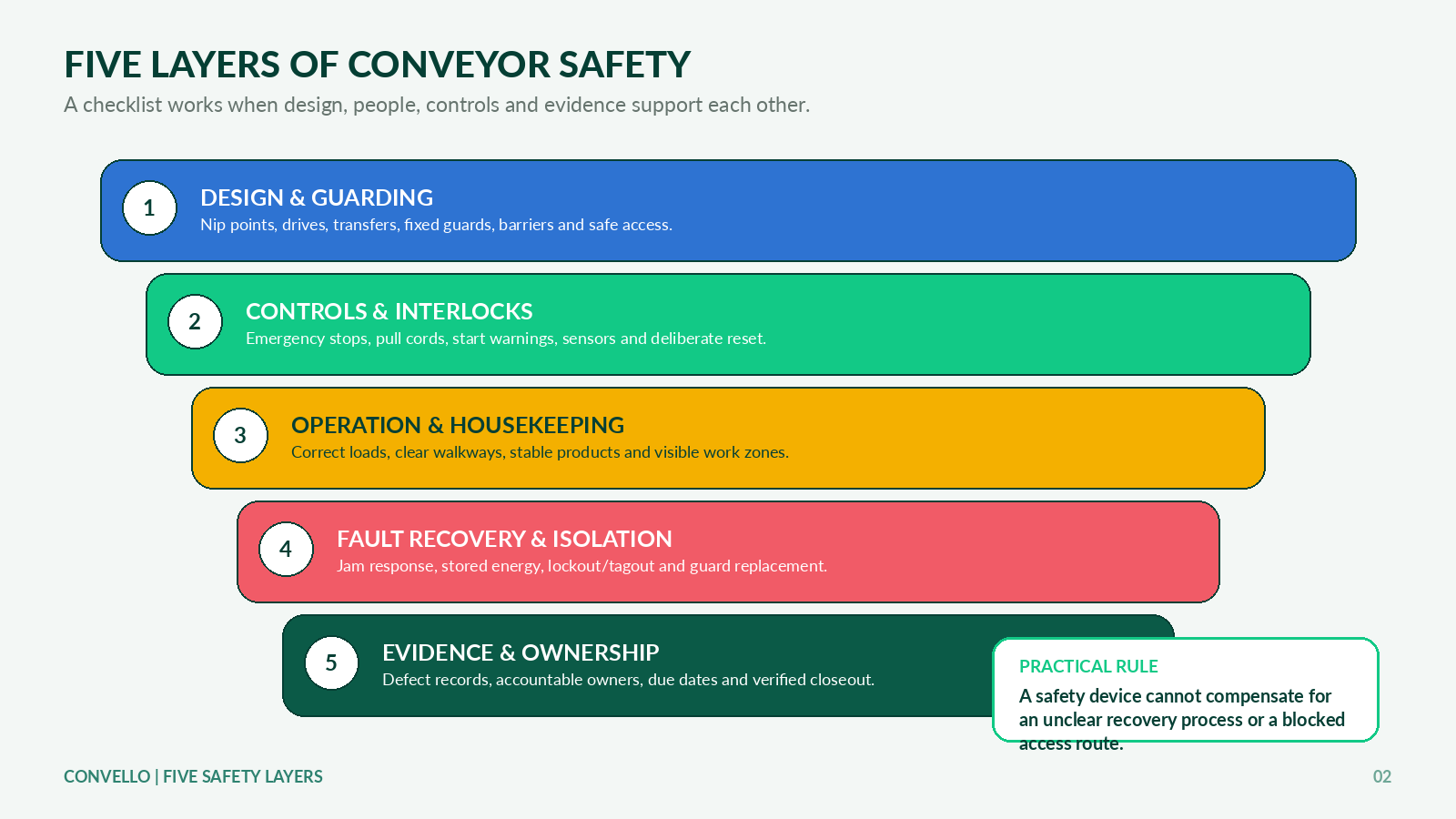
Five safety layers: a device is only one part of a working safety system.
Five Layers of Conveyor Safety
| Layer | What it should achieve |
| 1. Design and guarding | Hazards are reduced through layout, fixed and movable guards, safe distances, barriers, crossovers, product containment and maintainable access. |
| 2. Controls and interlocks | Stops, pull cords, sensors, warning devices, interlocks, reset logic and machine-to-machine handshakes support controlled operation. |
| 3. Operation and housekeeping | Loads stay within design limits; products remain stable; walkways, work zones and emergency devices remain accessible. |
| 4. Fault recovery and isolation | The team knows how to respond to jams, full lanes, fallen products and maintenance tasks, including when hazardous energy must be isolated. |
| 5. Evidence and ownership | Defects are recorded with location, severity, owner, due date, action and verified closeout instead of being passed between shifts. |
When one layer is weak, people usually compensate. They stand beside a sensor, hold a carton straight, use a stick to move a package, climb across a frame, silence an alarm or rely on memory before restarting. Those workarounds are valuable warning signs: they show where the system no longer matches the real task.
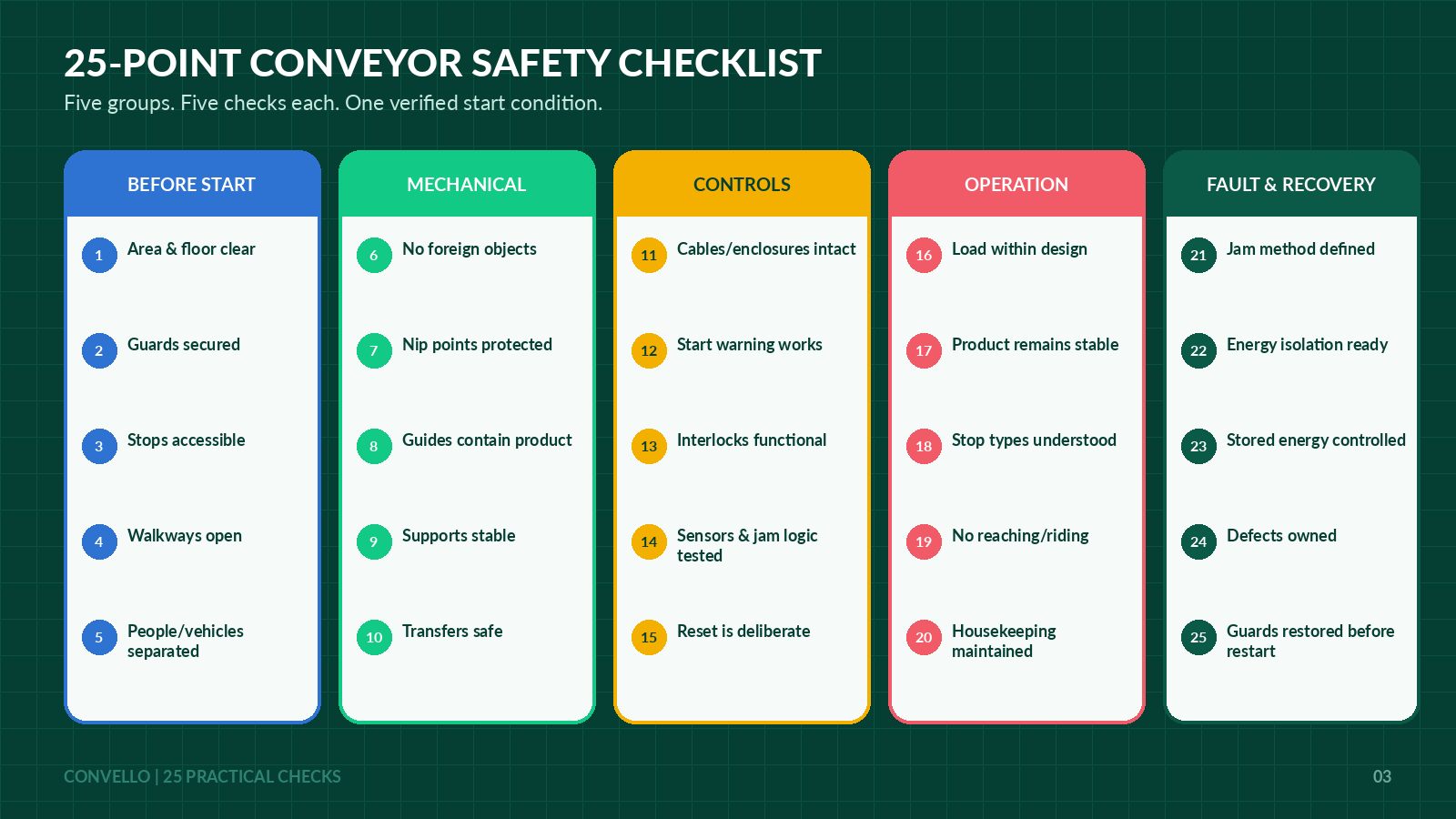
Twenty-five practical checks organised around the way the conveyor is started, used and recovered.
25 Practical Conveyor Safety Checks Before Start-Up
The checks below are deliberately written as questions a supervisor, operator or maintenance technician can verify on the floor. The exact frequency and authorised person should be defined in the site procedure. Some checks are visual; others require a controlled functional test by trained personnel.
Group 1 – Area and People Before Start
1. Is the floor, route and surrounding work area clear?
Look for spilled product, oil, loose stretch wrap, broken pallets, tools, temporary cables and packaging debris. The question is not only whether the conveyor can move; it is whether people can walk, stop, observe and leave the area safely.
2. Are all walkways, crossovers and access points usable?
A crossover that is blocked by stock or a stair landing used as storage is not available when someone needs it. Check handrails, gates, steps, head clearance and the route used for normal operation and emergency response.
3. Are emergency stops and pull cords visible, reachable and unobstructed?
A device can be technically installed and practically unavailable. Confirm that pallets, bins, mobile tables, cleaning trolleys and parked equipment do not block the approach or prevent full operation.
4. Is the start-up zone clear of people, vehicles and contractors?
Confirm the complete conveyor route, including sections hidden by machines, mezzanines, walls or racking. Drivers, cleaners, maintenance contractors and visitors may not understand the normal start warning.
5. Is responsibility for starting and releasing the line clear?
One person should know who has authority to start, who confirms the area is clear and who can stop the start if a condition is uncertain. A group standing near the panel is not the same as clear ownership.
Group 2 – Mechanical Condition and Guarding
6. Are guards, covers and barriers fitted and secured?
Check drive guards, chain and sprocket covers, pulley and return-run guards, transfer guards, side panels and barriers around lifts or cross transfers. Missing bolts, bent mesh, oversized gaps and temporary wire ties are defects, not cosmetic issues.
7. Are nip points, rotating parts and return paths protected?
Focus on locations where belts meet pulleys, rollers turn beside fixed frames, chains engage sprockets, products transfer between conveyors or a person could reach beneath a return run. Protection should match the actual approach route.
8. Is the conveyor free from foreign objects and trapped product?
Remove loose straps, labels, cartons, tools and product only through the approved safe method. A small object can become a jam, projectile, tracking problem or reason for someone to reach into the system after start.
9. Are frames, supports, anchors and mobile locks stable?
Fixed conveyors should not walk, twist or settle under load. Portable and flexible conveyors should have stable supports, sound castors and effective locks. Check telescopic or height-adjustable equipment for unintended movement.
10. Are transfer points and product-containment features intact?
Side guides, end stops, chutes, skirts and transition plates should contain the product without creating new pinch points. Look for sharp edges, loose guide brackets, excessive gaps and drop zones where products can fall toward people.
Group 3 – Electrical, Controls and Interlocks
11. Are cables, plugs, conduits and electrical enclosures intact?
Look for crushed flexible conduit, open glands, damaged plugs, exposed conductors, loose cable trays, missing enclosure fasteners and temporary extensions across walkways. Electrical repair belongs to authorised personnel.
12. Does the agreed start warning work and reach the affected area?
The warning may be audible, visual, verbal or integrated into the control system, depending on the risk assessment and site design. It should give people a meaningful opportunity to recognise that movement is about to begin.
13. Are guard interlocks and access switches functional?
A guard that opens without stopping the relevant hazardous motion, or an interlock that has been taped, tied or bypassed, requires escalation. Functional tests should follow the approved procedure and must not encourage bypassing.
14. Do sensors, jam detection and blocked-lane logic respond correctly?
Test the situations the controls are meant to manage: no product, full accumulation, no-read, misaligned product, blocked destination or failed transfer. An alarm is useful only when the required operator response is understood.
15. Does reset and restart require a deliberate, controlled action?
Restoring power, closing a guard or clearing a sensor should not create an unexpected start. Confirm the authorised reset location, line-of-sight or communication method and the sequence for returning equipment to automatic operation.
Group 4 – Product Flow and Normal Operation
16. Is the expected product within the conveyor design limits?
Confirm size, weight, underside, centre of gravity, temperature, packaging condition and orientation. A new SKU, damaged pallet or overfilled tote can change the hazard even if the conveyor itself has not changed.
17. Will the product remain stable at the planned speed and transfers?
Watch the first products after start. Skewing cartons, unstable bottles, rolling cylinders, dragging bags and pallets with broken bottom boards can create falling-product and manual-intervention risks.
18. Do operators understand normal stop, process stop and emergency stop?
An emergency stop is not a convenient pause button, and a normal stop may not make an intervention safe. Training should explain what each control does, what remains energised and what action follows.
19. Are prohibited behaviours actively controlled?
No riding, sitting, standing, stepping over, reaching through or climbing under a conveyor unless a specifically engineered access system and procedure permit the task. Watch for behaviours that have become normal because the layout is inconvenient.
20. Can housekeeping be maintained while the line is operating?
Waste bins, spill tools and cleaning access should be available without pushing people toward moving equipment. If debris repeatedly collects at one point, the design or containment may need improvement rather than more frequent sweeping.
Group 5 – Fault Recovery, Isolation and Closeout
21. Is the jam-clearing and fallen-product method defined?
The procedure should state who may respond, which stop is used, when isolation is required, which tools are permitted and where the person should stand. “Use common sense” is not a repeatable control.
22. Are hazardous-energy isolation procedures and devices available?
When servicing or maintenance exposes people to unexpected energisation or stored energy, the applicable energy-control procedure should be used by trained and authorised personnel. Confirm isolators, locks, tags and machine-specific instructions are available.
23. Have gravity, pneumatic, hydraulic, spring and stored-product energy been considered?
A stopped motor does not mean all motion is controlled. Elevated sections, tensioned belts, lifted transfers, pressurised cylinders and queued pallets can move after electrical power is removed.
24. Are defects recorded with an owner and a due date?
A useful entry identifies the conveyor, exact location, observed condition, immediate control, risk priority, accountable owner and target date. “Maintenance informed” is not a complete handover.
25. After work, are guards restored and the area formally released for restart?
The person performing the work and the person releasing production should verify tools are removed, guards and fasteners are restored, people are clear, controls are in the intended mode and the first restart is observed.
A 12-Minute Pre-Start Route: An Illustrative Example
A checklist often fails because it is treated as a clipboard task completed at the control panel. A better method follows the physical route of the conveyor and uses inspection zones. Consider an illustrative 72-metre packaging line divided into twelve zones: infeed, drive, three workstations, two transfers, accumulation, inspection, reject, discharge and return path.
| Activity | Planning assumption | Approximate time |
| Twelve zone observations | 12 x 35 seconds | 7.0 minutes |
| Five functional control checks | 5 x 35 seconds | 2.9 minutes |
| Start communication and first-product observation | Approximately 2 minutes | 2.0 minutes |
| Illustrative total | 11.9 minutes |
This is not a universal time standard. A short gravity lane may need far less time; a multi-level automated system may require a longer and more formal sequence. The point is to design a route that can realistically be completed without encouraging rushed ticks from one location.
The route should also tell the inspector where to look. “Check guards” is vague. “Inspect drive guard G-01, lower-return guard G-02 and transfer guard G-03 for position and all fasteners” is verifiable.
The Conveyor Stopped, but the Risk Had Not
A carton jams at a transfer. The operator presses stop. The belt no longer moves, so the task appears safe. But six cartons are still queued on a decline, a pneumatic lift remains raised and the belt tension stores mechanical energy. Pulling one carton may release several other movements.
This is why a conveyor safety checklist must connect fault response to hazardous-energy assessment. The correct action depends on the machine, task and exposure. A routine operational stop may be enough for observation from a safe position. Reaching into a danger zone, removing a guard, clearing trapped product near stored energy or performing maintenance may require formal isolation under the site procedure.
| Important distinction An emergency stop is an emergency function. It is not automatically an energy-isolation device, a maintenance permit or proof that stored energy has been controlled. The machine-specific procedure must define the safe state for each intervention. |
OSHA’s hazardous-energy overview uses a jammed conveyor suddenly releasing as an example of why uncontrolled energy can seriously injure workers. For Indian projects, OSHA is a useful international reference, not a substitute for current local law, the plant’s legal obligations or the original equipment manufacturer’s instructions.
When a Full Lane Creates a Human Workaround
Imagine a carrier-sortation line where one destination lane fills faster than dispatch can clear it. The conveyor logic stops releases to that lane, but no clear exception route exists. Within minutes, cartons accumulate upstream. An operator begins lifting selected cartons across a side frame to keep the main line moving.
The unsafe behaviour is visible, but the cause is systemic. The destination-full signal, accumulation capacity, recovery route, dispatch staffing and production pressure are all part of the same problem. A checklist that only says “operators must not reach over the conveyor” records the symptom. A stronger system also asks why the operator felt the workaround was necessary and what design or process change will remove the need.
This human perspective matters. Experienced workers often detect weak design earlier than dashboards do. Repeated pushing, holding, stepping, bypassing, manual carrying or alarm resetting should be treated as information for improvement – not simply as personal non-compliance.
Daily, Weekly and Planned Inspection Rhythm
Not every safety check belongs on the same frequency. Daily checks should be quick enough to complete and focused on conditions that can change between shifts. Weekly and planned checks can examine function, wear, mounting, documentation and more complex safety devices in greater depth.
| Frequency | Typical focus | Suggested ownership |
| Before each shift or start | Area clear; guards visibly in place; stops accessible; obvious damage; product and route match plan; first products observed. | Trained operator or designated start-up owner |
| Daily / shift handover | Recurring alarms, temporary controls, rejected products, housekeeping, unusual sound or movement, open defects and isolation status. | Outgoing and incoming shift representatives |
| Weekly or risk-based | Guard fasteners, cable routing, warning labels, pull-cord condition, sensor mounting, barriers, crossovers, portable conveyor locks. | Maintenance / safety / trained inspection team |
| Planned maintenance | Functional tests, interlocks, braking or backstops where fitted, electrical inspection, structural supports, drive and return guarding, safety-control validation. | Authorised competent personnel |
| After modification or incident | Formal review of the changed product, layout, control logic, access, guarding, recovery method, training and documentation. | Engineering, safety, production and maintenance |
The schedule should be risk-based and equipment-specific. A heavily used telescopic conveyor at a loading dock, a pallet conveyor beside forklifts and a small enclosed screw conveyor do not share the same exposure or inspection method.
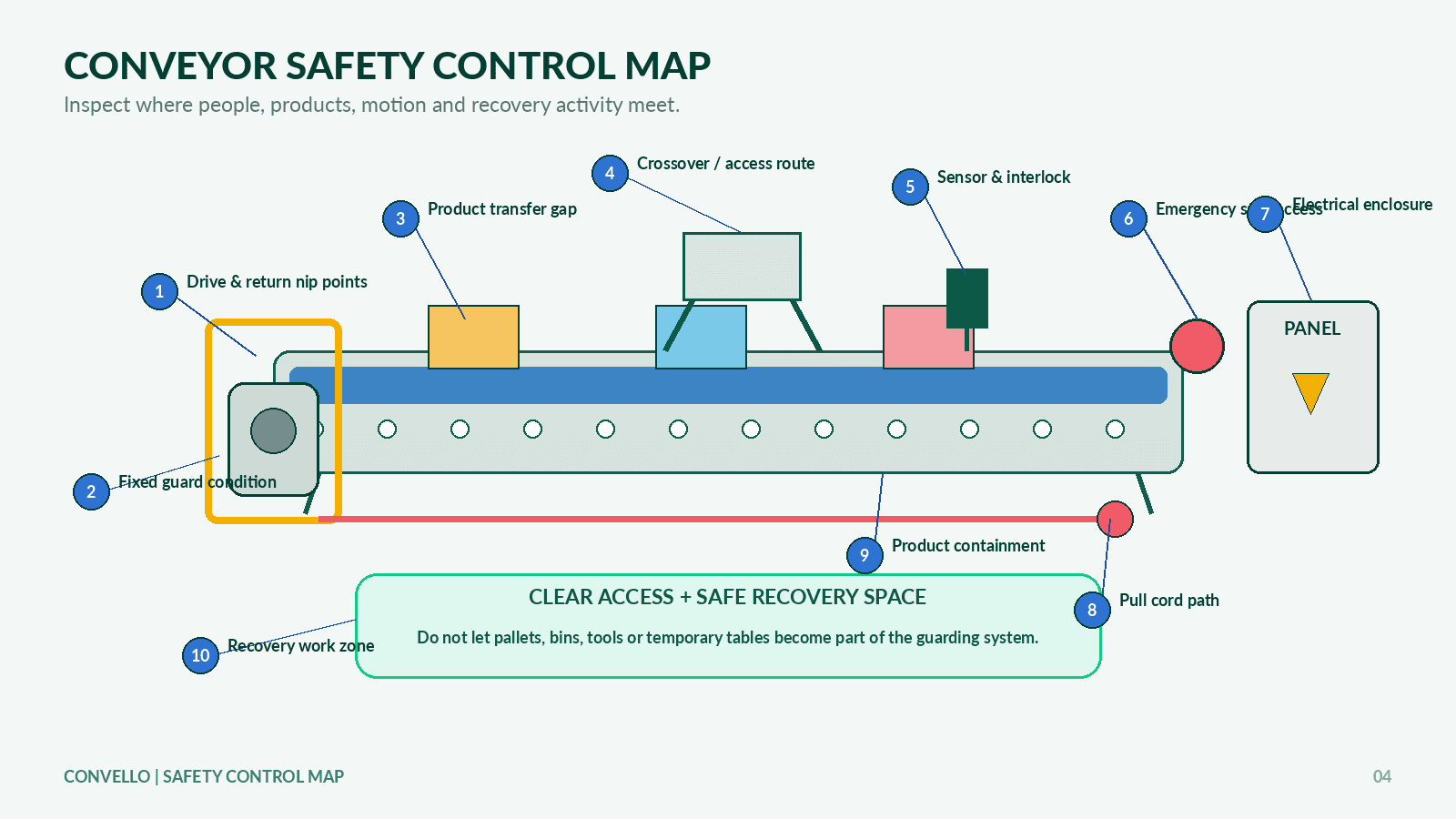
Safety control map: inspect where people, products, motion and recovery activity meet.
What to Do When the Checklist Finds a Defect
The checklist needs a response rule. Otherwise, the team discovers a defect and then negotiates whether production can continue. A simple defect workflow can use four questions:
- What exactly was observed, and where?
- Could the condition expose a person to hazardous motion, energy, falling product, electrical contact or loss of safe access?
- What immediate control is required: stop, isolate, barricade, reduce operation, remove the affected zone from service or monitor under an approved temporary control?
- Who owns the permanent action, when is it due and who verifies the closeout?
Temporary controls should be documented, authorised, time-limited and compatible with the risk assessment. A handwritten “do not use” note, a person standing beside the fault or a promise to repair it after the shift should not become an indefinite substitute for a safe design.
Safe Start and Restart After a Fault or Maintenance Task
Restart is one of the most overlooked parts of conveyor safety. The fault may have been removed, but people may still be inside the guarded area, a tool may remain on the frame, an isolator may still be locked, a sensor may be misaligned or the control mode may have changed from manual to automatic.
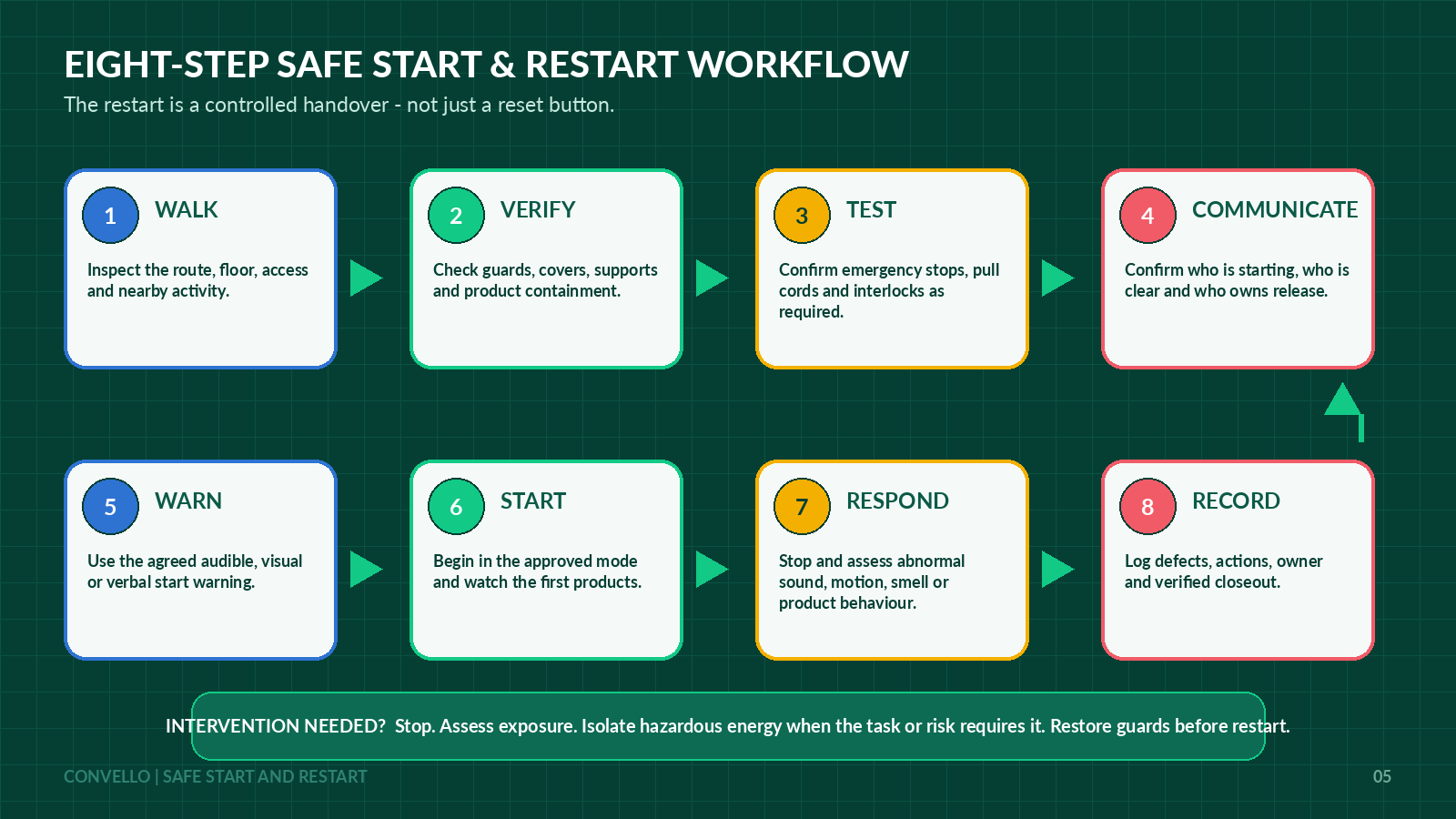
A restart is a controlled handover, not merely a reset button.
The eight-step workflow shown above is intentionally simple. The site procedure may require additional sign-off, permit release, group lockout removal, communications with upstream and downstream equipment, test mode, reduced speed or a staged start. The essential principle is that the reason for the stop has been understood, the safe condition has been restored and the restart is deliberate and observed.
Safety Features to Discuss During a New Conveyor or Retrofit Project
Safety is easier and more reliable when it is engineered into the layout instead of added after installation. During a new conveyor or retrofit enquiry, discuss the complete operating and recovery task – not only the product and throughput.
| RFQ topic | Information to share or agree |
| People and access | Operator positions, pedestrian routes, forklift traffic, cleaning access, maintenance access, crossovers, platforms and emergency escape routes. |
| Product and process | Size, weight, stability, underside, temperature, packaging quality, reject and rework routes, accumulation and falling-product risk. |
| Guards and barriers | Drive and return guards, transfer guards, side barriers, perimeter fencing, gates, elevated conveyor barriers and removable-guard requirements. |
| Controls | Start warnings, emergency stops, pull cords, local stops, guard interlocks, speed or motion monitoring, blocked-lane logic and restart philosophy. |
| Energy sources | Electrical, pneumatic, hydraulic, gravitational, spring, thermal and stored product energy; isolation points and verification method. |
| Fault recovery | Expected jams, full lanes, no-read products, fallen products, access tools, safe positions, manual mode and authorised recovery roles. |
| Documentation and training | Risk assessment, control description, drawings, operating manual, inspection schedule, spare parts, training and handover records. |
Convello’s current belt-conveyor information lists options such as emergency pull cords, guards, belt-misalignment sensors, zero-speed monitoring, covers, side guides, interlocks and safe access for cleaning or maintenance. The final combination should be selected through project-specific engineering and risk assessment rather than treated as a universal package.
Common Mistakes That Make Conveyor Safety Checklists Ineffective
| Mistake | Why it matters |
| The checklist is completed from the control panel | The inspector never walks the route, so blocked pull cords, removed lower guards and hidden product are missed. |
| Every item is a yes/no question | There is no space to record location, measurement, photo, temporary control or responsible person. |
| The form has no “do not start” authority | Production pressure turns defects into comments instead of actions. |
| Emergency stops are tested without a controlled method | Testing becomes inconsistent, surprises downstream equipment or encourages unsafe access. |
| The same checklist is used for every conveyor | A pallet line, telescopic conveyor, screw conveyor and food conveyor have different hazards and recovery tasks. |
| Temporary fixes have no expiry date | A bypass, missing fastener or barricade remains for weeks because everyone assumes someone else owns it. |
| The checklist ignores abnormal operation | Normal running looks safe, but jam clearing, cleaning, changeover and maintenance create the highest exposure. |
| Operators are blamed for workarounds without redesign | The behaviour returns because the full lane, poor access, unstable product or unreliable sensor still exists. |
| Defects are closed when work is assigned | Closeout should verify that the action was completed and the intended safe condition was restored. |
| The document is treated as proof of legal compliance | A checklist supports a safety system; it does not replace current law, standards, competent assessment or validation. |
Frequently Asked Questions
How often should a conveyor safety checklist be completed?
Complete a pre-start check at the frequency defined by the site risk assessment and procedure, commonly before a shift or restart. Add deeper weekly, planned-maintenance and post-modification inspections for items that cannot be adequately verified during routine operation.
Who should complete the checklist?
The person must be trained, familiar with the conveyor and authorised by the site. Ownership may be shared: operators inspect operating condition, maintenance examines mechanical and electrical condition, and engineering or safety validates changes and higher-level controls.
Is pressing the emergency stop enough before clearing a jam?
Not necessarily. An emergency stop stops motion through the designed emergency function, but it is not automatically an energy-isolation method. The safe response depends on the task, exposure, stored energy and machine-specific procedure.
Can an emergency stop be used as a normal production stop?
Emergency stops are intended for emergency situations and should not be used as a substitute for normal stopping, safeguarding or energy isolation. The conveyor should have appropriate normal stop and process-control functions.
Should pull cords and emergency stops be tested every day?
The functional-test frequency should follow the manufacturer instructions, risk assessment, site standard and control-system design. Visual accessibility checks may be more frequent than full functional tests. Testing must be controlled and coordinated with connected equipment.
What should happen if a guard is missing?
The affected conveyor or zone should not be operated if the missing guard exposes a hazard. Follow the site defect and isolation process, restore the correct guard and fasteners, and verify the condition before restart.
Can a tool be used to clear product without lockout?
A tool does not automatically make the task safe and cannot substitute for required guarding. The approved procedure must define whether the intervention can be done from a safe position under an operational stop or requires hazardous-energy isolation.
How should temporary conveyors be inspected?
Check stability, castor locks, cable routing, extension limits, safe height, route changes, emergency-device access and interaction with forklifts and pedestrians every time the equipment is moved or reconfigured.
Does a safety checklist replace a conveyor risk assessment?
No. The risk assessment identifies hazards, evaluates risk and determines risk reduction throughout the machine life cycle. The checklist verifies selected conditions and controls during use.
What records should be retained?
Keep the checklist result, date, conveyor ID, inspector, defect description, immediate control, responsible owner, due date, repair details and closeout verification according to the site document-retention system.
How can an older conveyor be made safer?
Begin with a machine-specific risk assessment and operating observation. Common retrofit topics include guards, barriers, crossovers, emergency stops, pull cords, interlocks, warning devices, containment, safer access, isolation points and control-logic improvements.
What information should be shared with a conveyor manufacturer?
Share the layout, product, speed, throughput, operating modes, operator positions, traffic routes, cleaning and maintenance tasks, expected jams, energy sources, existing controls, site standards and required documentation.