+91 99980 88430 | +91 95589 17778
 info@convello.in | sales@convello.in

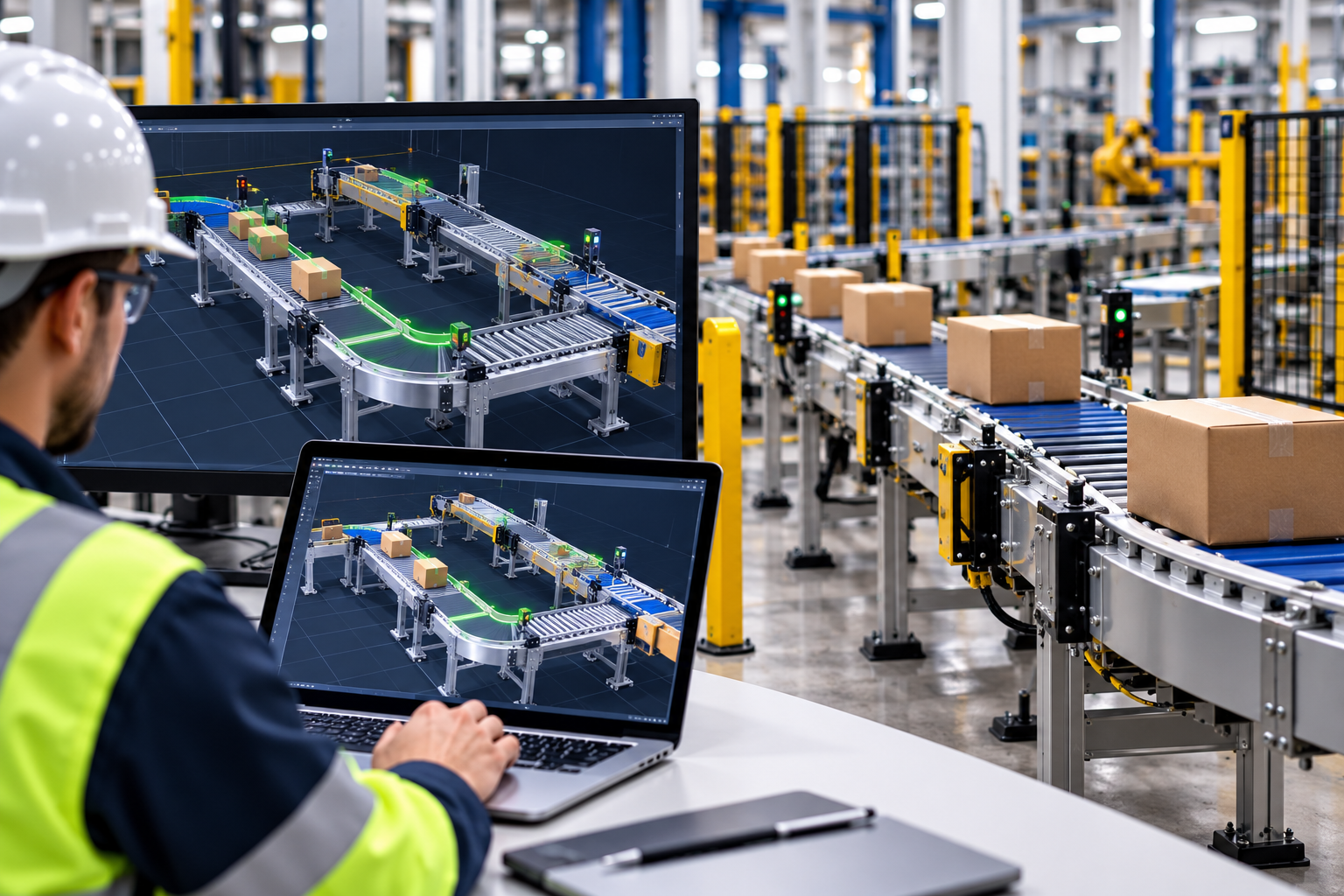
At 6:18 p.m. on Friday, the last guard is fitted to a new conveyor line. The electrical panels are powered, the sensors show healthy signals and the project team plans to begin acceptance testing on Monday morning.
The first carton reaches a merge and stops. The HMI reports “Zone 23 timeout.” The controls engineer sees a sequence problem. The mechanical team suspects the sensor bracket. Operations sees a missed production window. Within minutes, ten people are standing around one carton.
The conveyor was complete. The first full-system test had only just begun.
This opening is an illustrative commissioning composite, not a claimed Convello customer incident. It reflects a common project reality: mechanical design, control logic, product behaviour and human recovery are often tested together for the first time only after installation.
| Virtual commissioning moves part of that learning earlier. The team tests a dynamic conveyor model with real or emulated control logic before the physical line becomes the only place where mistakes can be discovered. |
What Is a Conveyor Digital Twin?
A conveyor digital twin is a virtual representation of a real or proposed material-handling system. Depending on the project, it can include conveyor geometry, elevations, product dimensions, speeds, friction assumptions, accumulation zones, sensors, drives, transfer mechanisms, PLC tags, HMI states and higher-level routing commands.
The term is often used too broadly, so the distinction matters:
| Term | Practical meaning |
| 3D model | Shows size, position, access and spatial relationships. It may look realistic but does not necessarily behave. |
| Material-flow simulation | Models rates, queues, routes and bottlenecks, often faster than real time. Control logic may be simplified. |
| Control-system emulation | Connects real or emulated PLC/HMI/WCS logic to a virtual plant so the code receives device feedback and controls virtual equipment. |
| Virtual commissioning | Uses the dynamic model to test mechanical, electrical and logical behaviour before or alongside physical commissioning. |
| Operational digital twin | Continues after startup and is synchronized with selected real data for monitoring, prediction, training or change evaluation. |
A useful model does not need to reproduce every bolt. It needs enough fidelity to answer the decisions that matter: Will the smallest carton transfer? Will one merge starve the other? What happens when a destination becomes full? Can the line restart without releasing several zones at once?
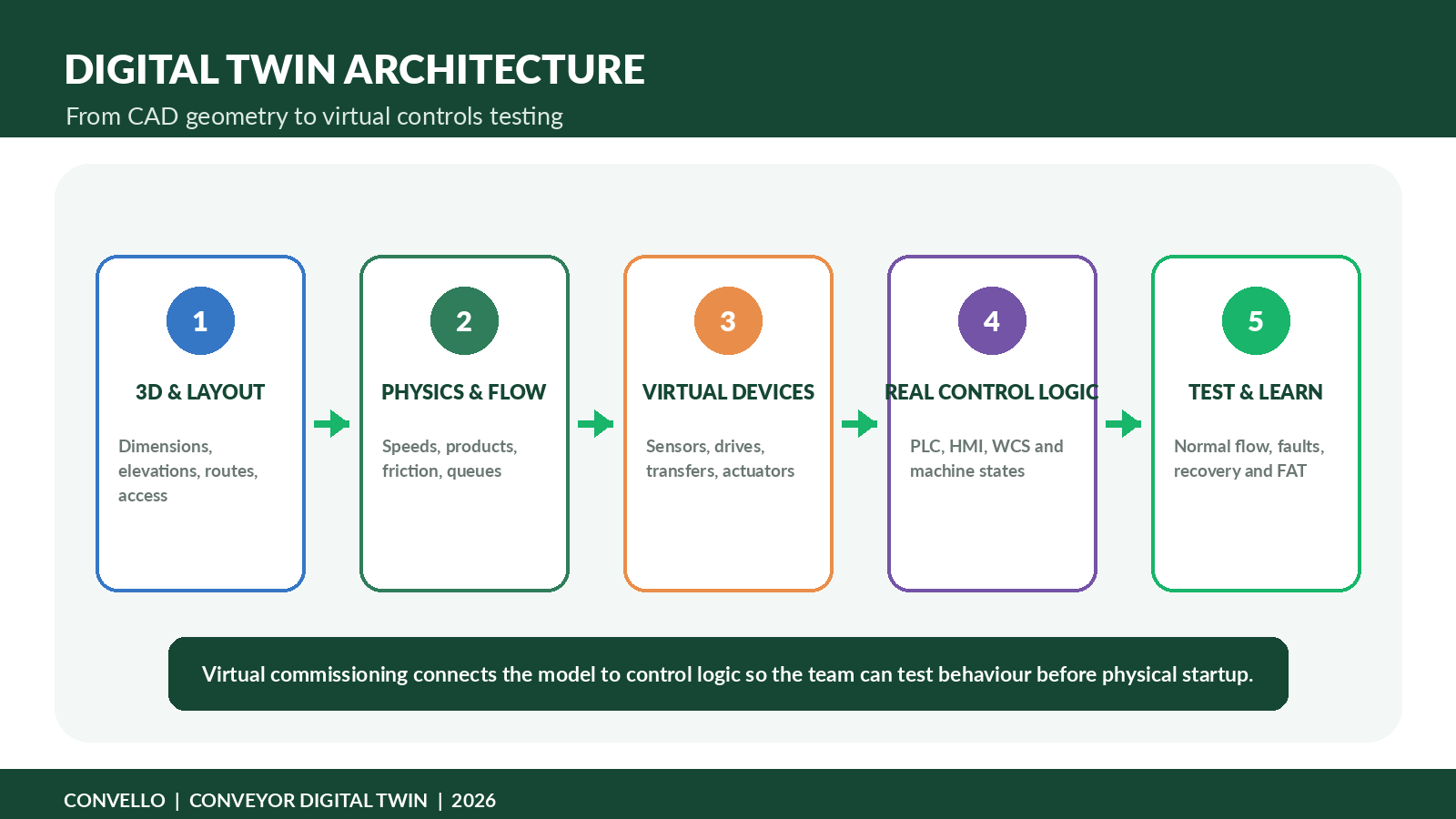
Figure 1. Virtual commissioning connects geometry, product physics, virtual devices and real control logic inside one test environment.
Why Conveyor Problems Become Expensive During Site Commissioning
On site, every test competes with installation crews, production deadlines, restricted access, incomplete upstream or downstream equipment and the pressure to start. A controls change may require a mechanical adjustment. A sensor move may require a bracket, cable and drawing revision. A failed sequence may leave products trapped in an unsafe or inaccessible position.
Virtual commissioning cannot remove every field problem, but it can move many logic, sequencing and flow questions into a safer environment where the team can pause, repeat and deliberately create failures.
What Should Be Tested Before the Conveyor Reaches Site?
- The smallest, largest, lightest, heaviest and least stable accepted products.
- Transfer gaps, height differences, speed changes and direction changes.
- Merge priorities, fairness rules and starvation of lower-priority lines.
- Accumulation capacity, destination-full logic and upstream throttling.
- Sensor positions, detection windows, debounce, timeout and no-read behaviour.
- Machine handshakes for ready, running, blocked, starved, faulted and inhibited states.
- Communication loss between PLC, WCS, WMS, scanners and third-party machines.
- Emergency-stop, controlled-stop, power-return and staged-restart behaviour.
- Wrong recipe, wrong destination and product-identity disagreement.
- Jam, partial transfer, actuator timeout and sensor disagreement.
- Manual and maintenance modes, including what remains interlocked.
- Sustained peak throughput, temporary bursts, queue growth and downstream recovery.
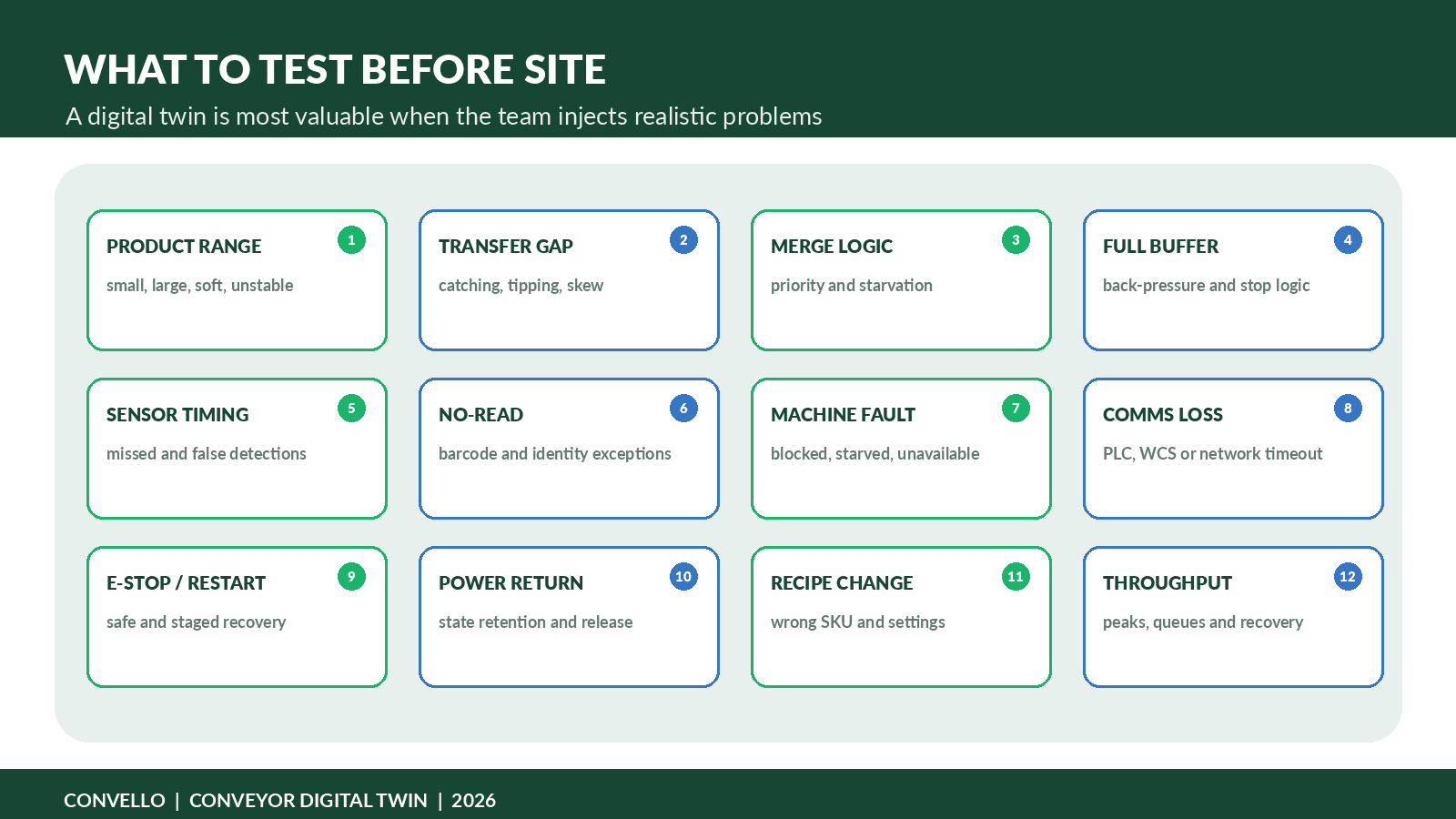
Figure 2. The model becomes useful when the team tests realistic variations and failures, not only the ideal automatic cycle.
The team should write these scenarios before the model is built. Otherwise, it is easy to create an impressive animation that demonstrates the happy path without proving the operating system.
Illustrative Indian Project: A 72-Metre Carton Conveyor Line
Consider a concept-stage FMCG project connecting two packaging lines to inspection, labelling, sortation and three dispatch destinations. The proposed system contains 72 metres of belt and roller conveyor, 34 controlled zones, three merges, four transfer modules, two barcode readers and interfaces with two packaging machines and a dispatch-control system.
The target sustained rate is 1,800 cartons per hour. During design review, the team builds a dynamic model and connects the proposed PLC sequence and HMI logic.
A simple concept-stage calculation gives the starting conditions:
| Planning check | Calculation | Illustrative result |
| Required release interval | 3,600 seconds / 1,800 cartons | 2.0 seconds per carton |
| Illustrative product pitch | Carton length + controlled gap | 0.70 metres |
| Initial conveyor speed | 0.70 m / 2.0 s | 0.35 m/s or 21 m/min |
| Backlog during 45-second stop | 30 cartons/min × 0.75 min | 22.5 cartons |
| Initial buffer with 25% allowance | 22.5 × 1.25 | 28.1, rounded to 30 positions |
| Recovery after restart | 36 cpm downstream – 30 cpm upstream | 6 cartons/min net recovery |
| Time to clear 23-carton backlog | 23 / 6 | Approximately 3.8 minutes |
The digital model does not prove that 30 positions are correct. It makes the assumptions visible so the team can test product length, zone size, recovery speed, repeated interruptions and available floor space.
During virtual testing, the team finds five issues before site installation:
- The smallest carton passes below the original photo-eye beam at one transfer.
- A fixed merge-priority rule allows Line A to starve Line B during sustained peak demand.
- The “destination full” message arrives after a carton has already committed to the divert.
- The HMI reports a generic transfer timeout without identifying the first failed condition.
- After simulated power return, several occupied zones attempt to release together.
The project team moves the sensor, changes merge logic to a controlled fairness rule, adds a pre-divert destination reservation, creates first-out alarm messages and introduces a staged restart. None of those changes requires a mechanic to wait beside a powered conveyor while software is rewritten.
| Illustrative project only: the layout, rates, calculations and findings above are planning examples. They are not a Convello customer result or a guaranteed performance level. |
Public Project Case Study: Bastian Solutions Warehouse Automation
Rockwell Automation’s published case study describes Bastian Solutions using emulation for an automated conveyor and pick-module project serving a global fashion brand. The solution combined conveyors, PLCs, I/O, sensors, variable-frequency drives, Emulate3D and controller emulation.
The virtual environment allowed mechanical and control-system issues to be troubleshot before installation. Rockwell reports that Bastian reduced total project time by 18% and reduced on-site commissioning by about five weeks. The time saved also reduced the client’s installation burden and time to market.
Rockwell Automation – Emulation Technology Speeds Up Warehouse Automation – External public case study; not a Convello installation.
Public Project Case Study: Ferrero High-Bay Warehouse
Siemens’ published Ferrero case study describes a comprehensive digital twin for a high-bay warehouse using Tecnomatix Plant Simulation with SIMATIC automation, PLC and SCADA programming. The project aimed to reduce the risk and duration of the “hot phase,” when the physical warehouse and controls must operate together.
Siemens reports a 30% reduction in commissioning time, an 88% reduction in the time needed to achieve target availability and detection of about 95% of errors before the hot phase. The result is valuable because a high-bay warehouse combines storage equipment, conveyors, routing, sequencing and software across a system that is difficult to test safely through trial and error.
Siemens – Ferrero Digital Twin Case Study – External public case study; not a Convello installation.
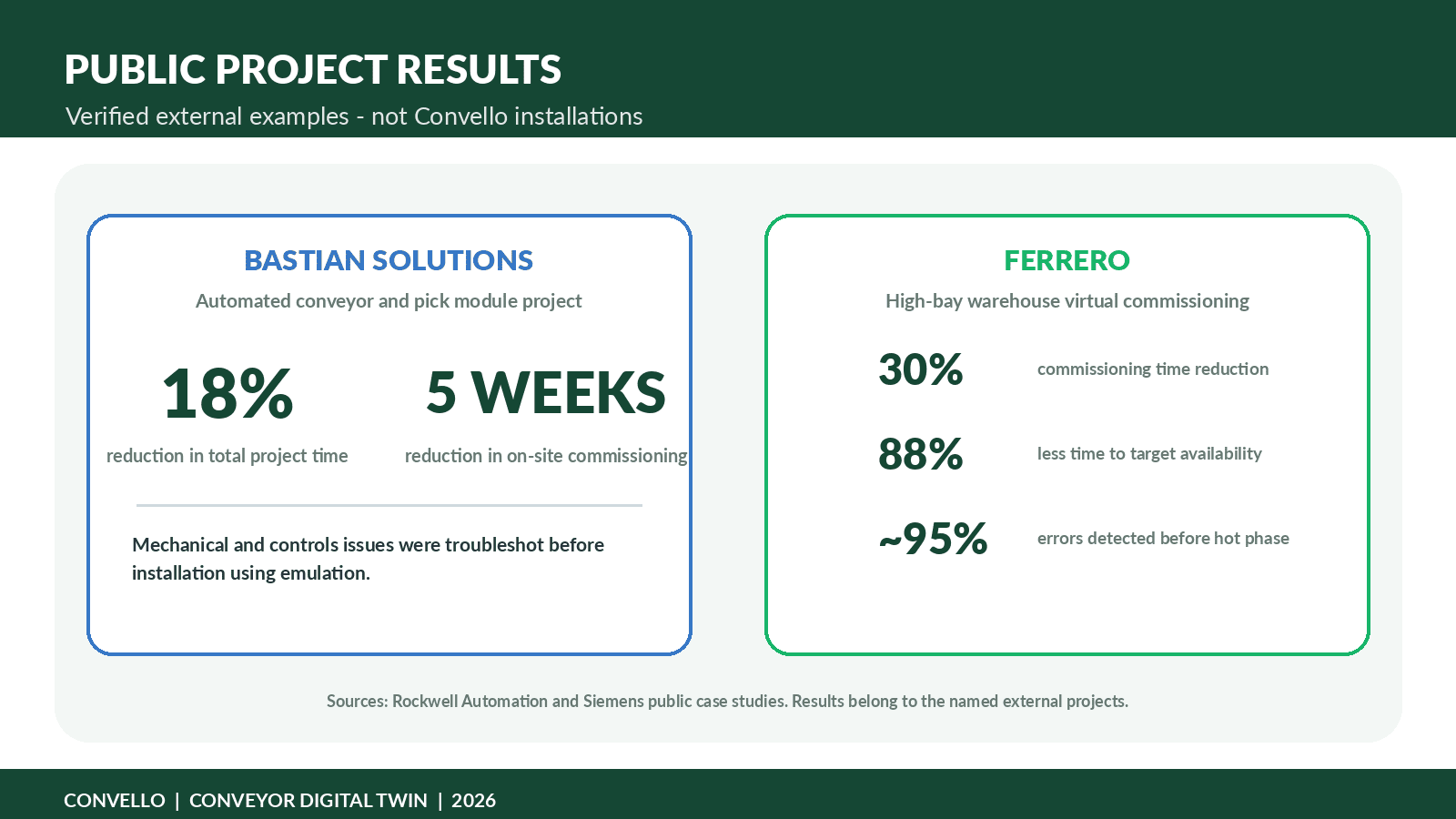
Figure 3. Published results from two external projects show how virtual commissioning can move debugging earlier in the project lifecycle.
A Third Use: Showing How an Accumulation System Behaves
Digital twins are also useful before a purchase decision is final. Rockwell’s Garvey case study describes how a conveyor and accumulation specialist used Emulate3D to reproduce beverage-line conditions and demonstrate the throughput and efficiency value of accumulation systems. For buyers, this turns a discussion about “more buffer” into a visible test of how the line behaves when a filler, labeller or packer stops.
Rockwell Automation – Emulate3D Brings Garvey Bottling Improvements to Life – External public case study; not a Convello installation.
What Virtual Commissioning Can Catch – and What It Cannot
| Category | Practical boundary |
| Often testable virtually | PLC sequence errors, missing interlocks, sensor timing, merge deadlocks, destination-full logic, alarm quality, restart order, buffer capacity and routing exceptions. |
| Testable when the model is detailed enough | Transfer behaviour, product stability, acceleration, cycle time, actuator motion and representative friction or gravity effects. |
| Still requires physical verification | Actual packaging variation, installation tolerance, field wiring, network quality, product contamination, wear, sound, vibration, access, final safety validation and operator behaviour. |
| Must never be assumed from animation alone | Compliance, safe stopping distance, guarding adequacy, final throughput guarantee and acceptance of every product condition. |
A model is an engineering tool, not a substitute for site commissioning. The strongest projects use virtual and physical testing as connected stages. Findings from the model become test cases for FAT and SAT. Field results are then used to correct the model where assumptions were wrong.
Fifteen Decisions That Determine Model Value
- Define the business question before choosing software or model detail.
- Freeze the accepted product range, including damaged-but-acceptable packaging.
- Use verified dimensions, elevations, speeds and component data.
- Model transfers and merges with more care than long straight sections.
- Represent sensor fields and delays rather than only drawing sensor icons.
- Use the actual or production-intent PLC tags and state model.
- Assign clear ownership for PLC, HMI, WCS, WMS and third-party commands.
- Represent accumulation by real zone length and product pitch.
- Include machine ready, blocked, starved, faulted and inhibited states.
- Model manual and maintenance modes, not only automatic operation.
- Write test cases with expected results and pass/fail criteria.
- Use realistic timing distributions rather than one perfect cycle time.
- Record model assumptions and uncertainty so animation is not mistaken for proof.
- Invite operators and maintenance staff to the virtual review.
- Update the model when mechanical or controls changes are approved.
Virtual FAT: A Practical Test Matrix
| Test family | Scenario | Expected result |
| Normal production | All accepted products, sustained rate, route priorities and changeovers | Stable flow with no unexplained manual intervention |
| Blocked destination | Lane or downstream machine becomes unavailable | Upstream holds safely; no misroute or uncontrolled pressure |
| Sensor fault | Stuck on, stuck off, intermittent or delayed signal | Useful alarm, controlled stop and defined recovery |
| Communication loss | PLC-WCS, scanner, machine or remote I/O timeout | System enters agreed safe/controlled state with clear ownership |
| Power return | Power restored with products occupying zones | State reconciliation and staged restart prevent uncontrolled release |
| Emergency stop | Stop occurs at different positions and loads | Energy stops as designed; restart requires deliberate validation |
| Wrong product / recipe | Dimensions or identity do not match active setup | Reject, hold or guided changeover without silent misrouting |
| Jam / partial transfer | Product stops between sections or actuator times out | No automatic repeated forcing; safe recovery is visible and documented |
| Peak and burst flow | Short burst exceeds average rate | Queues remain inside planned buffers and recover before next event |
| Operator recovery | Authorized manual action after fault | HMI guidance, interlocks and sequence support the real task |
A virtual FAT should not be a screen recording prepared by the integrator alone. Operations, maintenance, safety, IT/OT and production representatives should be allowed to ask “what happens if…?” and see the system respond.
Ten-Step Conveyor Virtual Commissioning Roadmap
- Define the business question – Decide whether the priority is throughput, commissioning risk, controls testing, operator training, expansion planning or all of these.
- Freeze the product envelope – Collect dimensions, weights, underside condition, stability, orientation, barcode location and accepted packaging variation.
- Collect the physical design – Use current CAD, elevations, transfer details, component data, access constraints and installed interfaces.
- Choose appropriate fidelity – Model only the physics and detail needed to answer the test cases; do not confuse visual polish with engineering accuracy.
- Map I/O and ownership – Define every sensor, actuator, control tag, timeout, command source and responsibility boundary.
- Connect controls – Link the model to PLC, HMI, robot, WCS, WMS or emulated equivalents as required.
- Prove normal flow – Run representative products, rates, routes and changeovers before injecting failures.
- Inject faults and recovery – Test blocked lanes, sensor faults, comms loss, power return, jams, wrong recipes and safe restart.
- Run virtual FAT – Review pass/fail results with operators, maintenance, controls, mechanical and customer stakeholders.
- Validate and update on site – Use FAT findings during physical SAT, then correct the model with measured field behaviour for future changes or training.
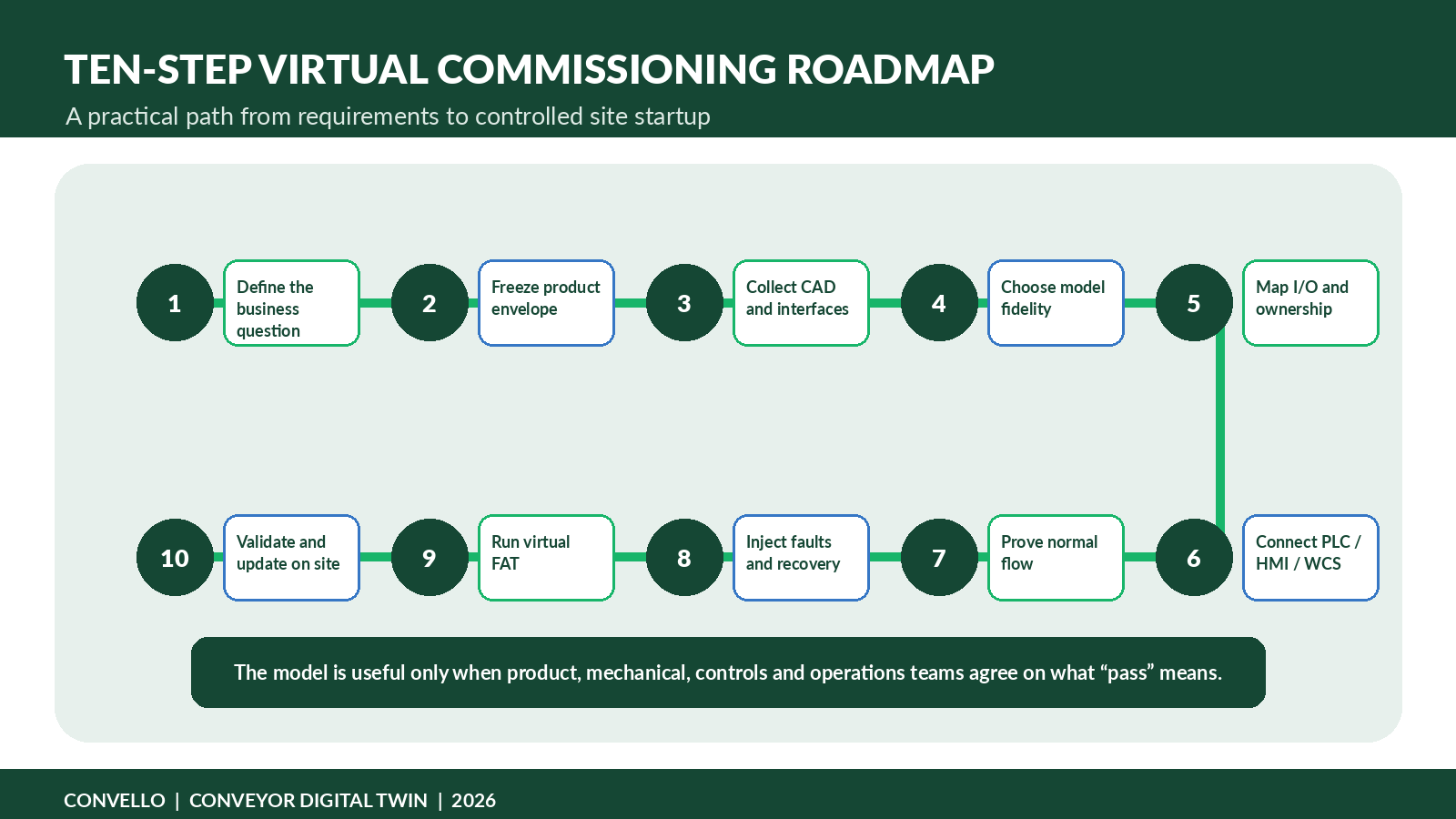
Figure 4. A structured virtual commissioning workflow starts with the business question and ends with field validation, not with an attractive animation.
Information to Share for a Conveyor Digital Twin or Simulation Project
- Current process map, business objective and known bottlenecks.
- Product dimensions, weight, underside, stability, orientation and packaging variation.
- CAD layout, elevations, transfer details, access zones and building constraints.
- Conveyor types, speeds, zone lengths, drives, sensors and actuators.
- Target average, sustained peak and short-burst rates.
- Accumulation strategy, destination capacities and downstream recovery rates.
- PLC platform, I/O list, tag structure, state model and HMI requirements.
- WMS, WCS, MES, scanner, robot and machine-interface descriptions.
- Normal, blocked, starved, faulted, manual and maintenance behaviours.
- Failure scenarios, recovery method and expected pass/fail result.
- Required outputs: layout validation, throughput study, virtual FAT, training model or lifecycle twin.
- File ownership, model update responsibility, cybersecurity and source-code expectations.
- Physical FAT/SAT plan and how virtual test results will transfer to site acceptance.
Common Mistakes
- Building a beautiful 3D model without a written test plan.
- Using only the average carton and ignoring the least stable accepted product.
- Simplifying sensors into instant perfect signals.
- Testing only normal automatic flow.
- Leaving WCS/WMS and third-party interface ownership unclear.
- Using nominal cycle times without variation, waiting or recovery.
- Treating the model result as a throughput guarantee.
- Ignoring manual, maintenance and degraded operating modes.
- Inviting operators only after the logic is frozen.
- Failing to update the model after mechanical or controls changes.
- Measuring virtual commissioning by number of animations rather than issues found and closed.
- Replacing physical risk assessment or site validation with simulation screenshots.
When Is a Conveyor Digital Twin Worth the Effort?
The strongest business case usually appears when the project combines several of the following: complex merges or sortation, many control zones, expensive shutdown time, difficult site access, high product variation, third-party machine interfaces, WCS/WMS integration, limited commissioning windows, phased installation, future expansion or repeated deployment across multiple sites.
For a short standalone gravity conveyor, a detailed dynamic twin may add little value. A simple layout review, manual calculation and physical trial may be more appropriate. The model should match the project risk, not the current technology trend.
Frequently Asked Questions
What is a conveyor digital twin?
It is a dynamic virtual model of a conveyor system that can represent geometry, product flow, devices and control states. Depending on the use case, it may connect to actual PLC, HMI or warehouse-control logic.
How is virtual commissioning different from normal simulation?
Simulation often evaluates flow and capacity using simplified rules. Virtual commissioning connects the virtual plant to production-intent control logic so sequences, interlocks, alarms and recovery can be tested.
Do we need the final physical PLC?
Not always. Some projects use a controller emulator or software PLC. The important requirement is that the tested logic, tags and timing remain representative of the system that will be deployed.
Can a digital twin test sensors?
It can test sensor location, detection windows, state changes, timeouts and logic responses when the virtual device behaviour is modelled correctly. Final field alignment and real packaging variation still require physical verification.
Can it predict conveyor throughput?
It can estimate throughput and queues when rates, product pitch, control logic, machine behaviour and downtime assumptions are credible. Results should be treated as model-based evidence, not a universal guarantee.
Can it include WMS or WCS integration?
Yes. Projects can connect or emulate routing, destination availability, identity and exception messages. Interface ownership and timeout behaviour should be defined before testing.
How accurate must the model be?
Accurate enough for the decision. Transfer behaviour needs more physical detail than a straight transport zone. A throughput study may need probability distributions that a basic PLC test does not.
Can operators use the model for training?
Yes. Operators can practise alarms, blocked lanes, recovery and changeovers before the live line is available, provided the HMI and procedures are sufficiently representative.
Does virtual commissioning replace FAT and SAT?
No. It strengthens FAT and SAT by finding issues earlier and creating reusable test cases. Physical tests remain necessary for installation, wiring, safety, product behaviour and acceptance.
Is it useful for small conveyor projects?
Sometimes, especially when the control interface or shutdown risk is high. For a simple standalone conveyor, lower-cost calculation and trial methods may be more sensible.
What files are normally required?
Common inputs include CAD, product data, conveyor speeds, zone definitions, sensor and actuator lists, PLC tags, state diagrams, interface specifications and test scenarios.
Who should attend a virtual commissioning review?
Mechanical and controls engineers, operations, maintenance, safety, IT/OT, production and relevant equipment suppliers. The people who will recover the real line should see how the virtual line fails.
Final Takeaway: Test the System, Not Only the Conveyor
A conveyor project is more than steel, rollers and motors. It is a network of products, transfers, sensors, machine states, software messages, people and recovery decisions. Physical commissioning becomes difficult when those elements meet for the first time under deadline pressure.
A well-scoped conveyor digital twin helps the team meet earlier. It makes assumptions visible, allows faults to be repeated safely and turns commissioning knowledge into written test cases. It does not remove the need for field engineering. It gives field engineering a better starting point.